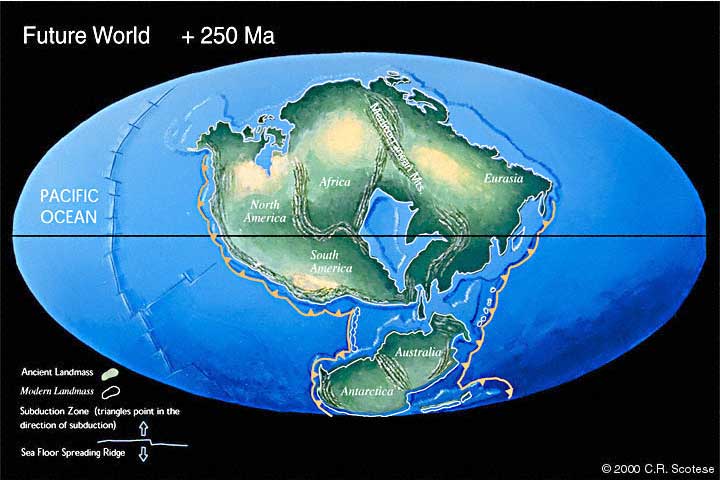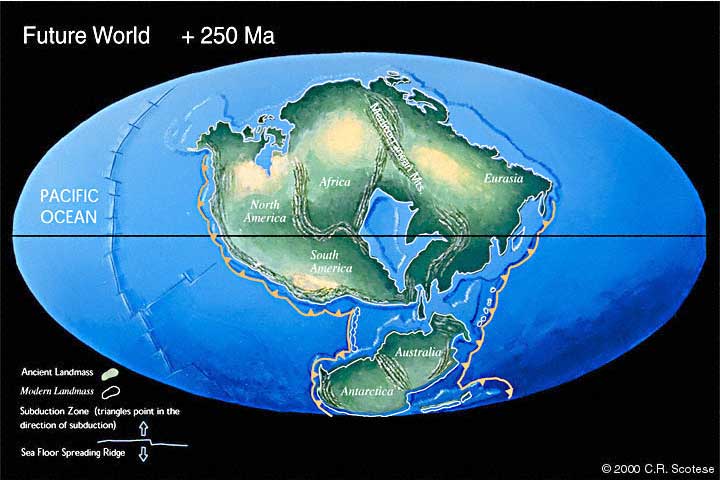
Is this what will become of the Earth's surface? The surface of the Earth is broken up into several large plates that are slowly shifting. About 250 million years ago, the plates on which the present-day continents rest were positioned quite differently, so that all the landmasses were clustered together in one supercontinent now dubbed Pangea. About 250 million years from now, the plates are again projected to reposition themselves so that a single landmass dominates. The above simulation from the PALEAOMAP Project shows this giant landmass: Pangea Ultima. At that time, the Atlantic Ocean will be just a distant memory, and whatever beings inhabit Earth will be able to walk from North America to Africa.
¿Será este el aspecto que tendrá la superficie terrestre en el futuro? La superficie de la Tierra está dividida en varias placas tectónicas grandes que se desplazan lentamente. Hace aproximadamente 250 millones de años, las placas sobre las que descansan los continentes actuales se encontraban en posiciones muy distintas, de modo que todas las masas continentales estaban agrupadas en un único supercontinente que hoy conocemos como Pangea. Dentro de aproximadamente 250 millones de años, se proyecta que las placas vuelvan a reposicionarse hasta que una sola masa terrestre predomine. La simulación anterior, elaborada por el PALEOMAP Project, muestra esta gigantesca masa continental: Pangea Última. En ese momento, el océano Atlántico será tan solo un lejano recuerdo, y los seres que habiten la Tierra podrán caminar desde América del Norte hasta África.