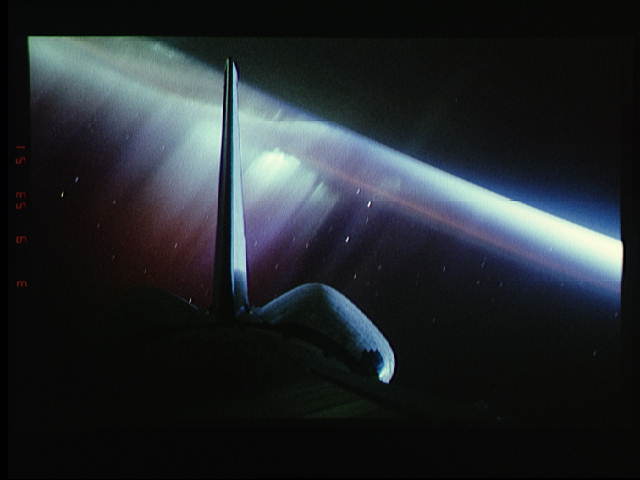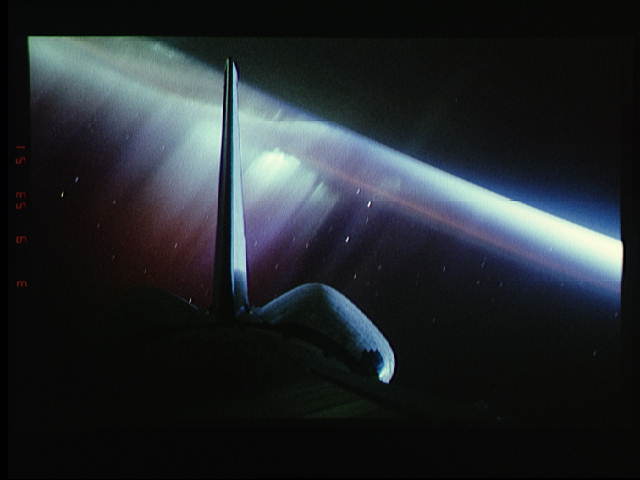
Sailing upside down, 115 nautical miles above Earth, the crew of the Space Shuttle Endeavour made this spectacular time exposure of the southern aurora (aurora australis) in October of 1994. Aurora, also known as the northern and southern lights, appear as luminous bands or streamers of light which can extend to altitudes of 200 miles. They are typically visible from the Earth's surface at high latitudes and are triggered by high energy particles from the Sun. The delicate colors are caused by energetic electrons colliding with oxygen and nitrogen molecules in the upper atmosphere. In this picture, the rear structure of the shuttle Endeavour is in the foreground with the vertical tail fin pointed toward Earth. Star trails are the short streaks above Earth's horizon.
Navegando al revés, a 115 millas náuticas sobre la Tierra, la tripulación del transbordador espacial Endeavour capturó esta espectacular exposición de larga duración de la aurora austral (aurora australis) en octubre de 1994. Las auroras, también conocidas como luces boreales y australes, aparecen como bandas luminosas o corrientes de luz que pueden extenderse hasta altitudes de 200 millas. Son típicamente visibles desde la superficie terrestre en latitudes altas y se desencadenan por partículas de alta energía provenientes del Sol. Los delicados colores son causados por electrones energéticos que colisionan con moléculas de oxígeno y nitrógeno en la atmósfera superior. En esta imagen, la estructura posterior del transbordador espacial Endeavour está en primer plano con el estabilizador vertical apuntando hacia la Tierra. Los rastros de estrellas son los trazos cortos por encima del horizonte terrestre.