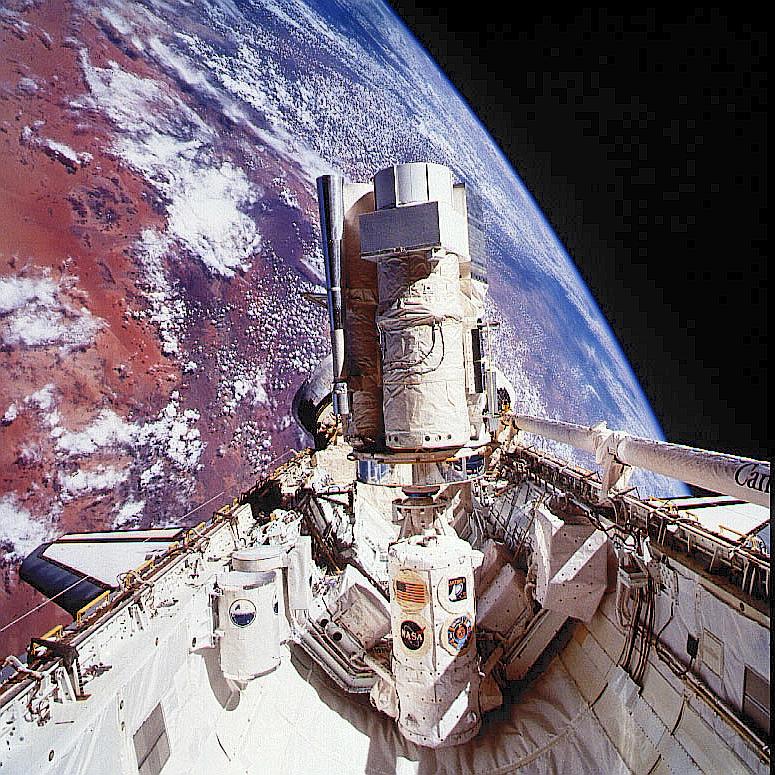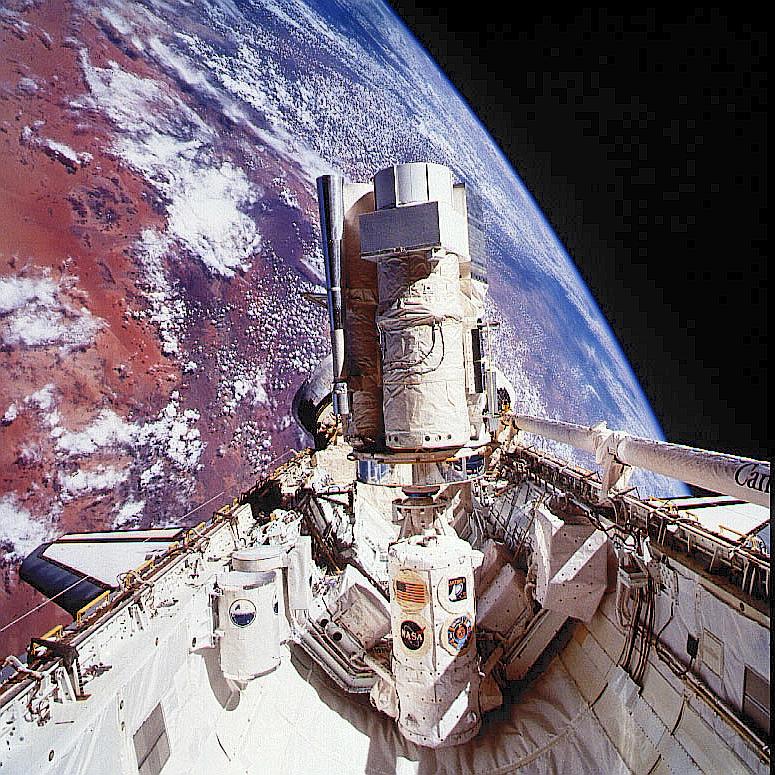
Six years ago, a cluster of three ultraviolet telescopes flew into orbit on the Astro-2 mission aboard the space shuttle Endeavour. Seen here perched in Endeavour's payload bay about 350 kilometers above the Australian desert are the Hopkins Ultraviolet Telescope (HUT), the Ultraviolet Imaging Telescope (UIT), and the Wisconsin Ultraviolet Photo-Polarimeter Experiment (WUPPE). HUT is in front of the other instruments with a silver, conical-shaped star tracker at the left of the telescope cluster. The ultraviolet region of the electromagnetic spectrum lies at wavelengths shorter than blue light and can not be seen by human eyes. Almost all ultraviolet light from the cosmos is impossible to detect at the Earth's surface because it is absorbed by atmospheric ozone. But cruising high above the clouds and protective atmosphere, these instruments could explore the universe at wavelengths beyond the blue.
Hace seis años, un conjunto de tres telescopios ultravioleta entró en órbita en la misión Astro-2 a bordo del transbordador espacial Endeavour. Vistos aquí, montados en la bodega de carga de Endeavour a unos 350 kilómetros sobre el desierto australiano, se encuentran el Telescopio Ultravioleta de Hopkins (HUT), el Telescopio de Imágenes Ultravioleta (UIT) y el Experimento Fotopolarímetro Ultravioleta de Wisconsin (WUPPE). El HUT se encuentra delante de los otros instrumentos, con un rastreador de estrellas de forma cónica y color plateado a la izquierda del conjunto de telescopios. La región ultravioleta del espectro electromagnético se encuentra en longitudes de onda más cortas que la luz azul y no puede ser percibida por los ojos humanos. Casi toda la luz ultravioleta del cosmos es imposible de detectar en la superficie terrestre porque es absorbida por el ozono atmosférico. Pero al navegar a gran altura sobre las nubes y la atmósfera protectora, estos instrumentos podían explorar el universo en longitudes de onda más allá del azul.