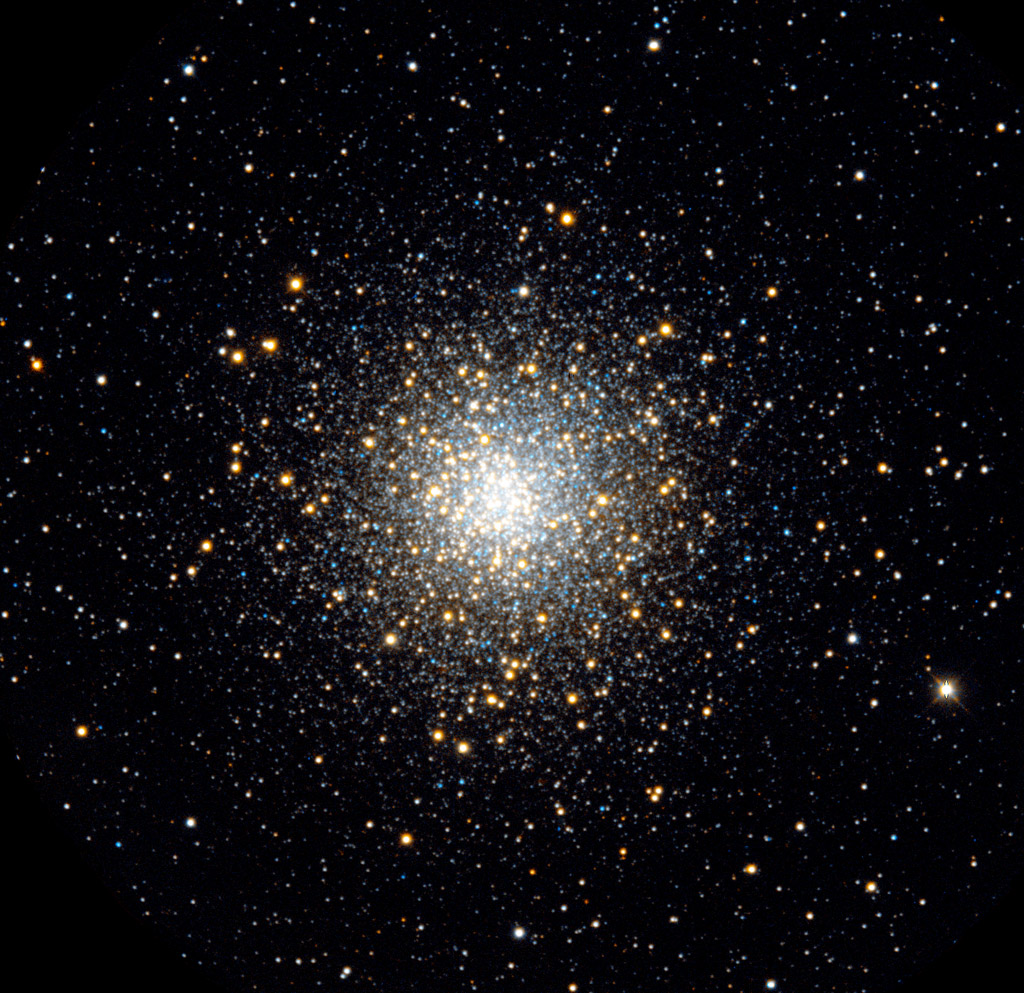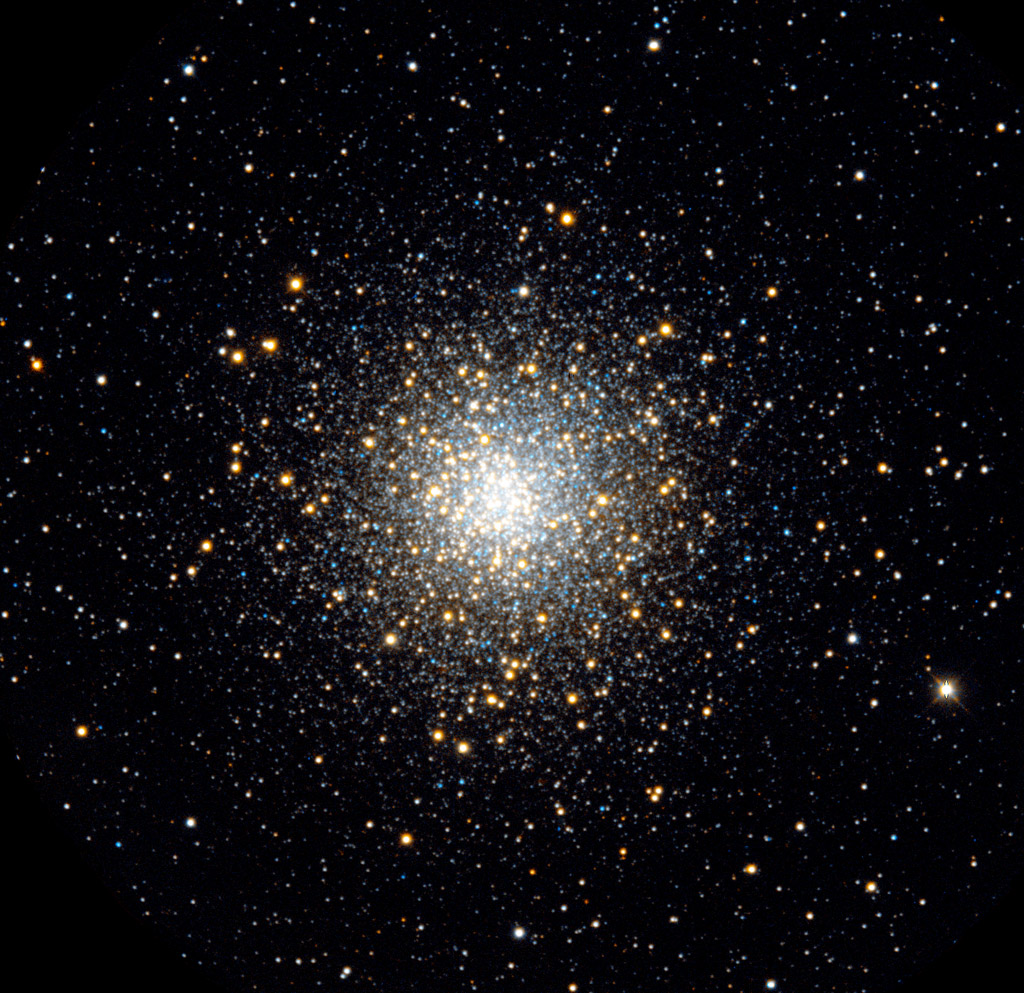
Stars like the Sun use hydrogen for fuel, "burning" hydrogen into helium at their cores through nuclear fusion. But what happens when that hydrogen runs out? For a while, hydrogen burns in a shell surrounding the stellar core and the star expands to become a red giant. The bright reddish-orange stars in this beautiful two-color composite picture of the old globular star cluster M10 are examples of this phase of stellar evolution. Yet the bright blue stars apparent in M10 have evolved beyond the simple, hydrogen shell burning stage. These stars have become "horizontal branch" giants with core temperatures hot enough to burn helium into carbon. In this image, only the barely visible, faint, gray-looking stars are likely to still be burning hydrogen at their cores.
Estrellas como el Sol usan hidrógeno como combustible, "quemando" hidrógeno para formar helio en sus núcleos mediante fusión nuclear. Pero, ¿qué ocurre cuando se agota ese hidrógeno? Durante un tiempo, el hidrógeno se quema en una capa que rodea el núcleo estelar y la estrella se expande para convertirse en una gigante roja. Las brillantes estrellas de color rojizo-anaranjado en esta hermosa imagen en dos colores del antiguo cúmulo globular de estrellas M10 son ejemplos de esta fase de la evolución estelar. Sin embargo, las brillantes estrellas azules visibles en M10 han evolucionado más allá de la etapa simple de la quema de capa de hidrógeno. Estas estrellas se han convertido en gigantes de la "rama horizontal", con temperaturas en sus núcleos lo suficientemente altas como para quemar helio y formar carbono. En esta imagen, solo las estrellas apenas visibles, tenues y de aspecto grisáceo, podrían aún estar quemando hidrógeno en sus núcleos.