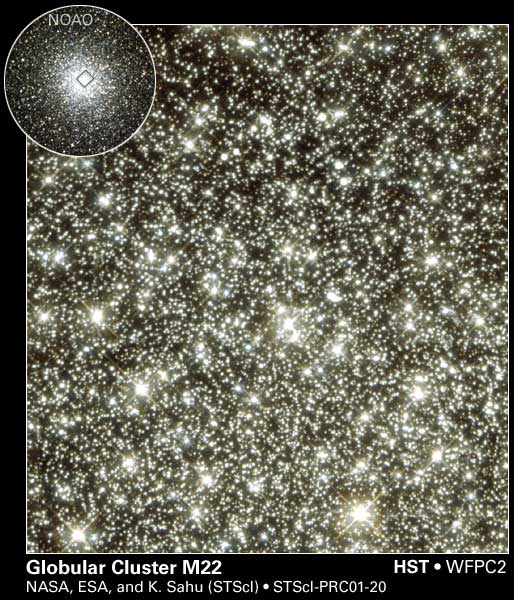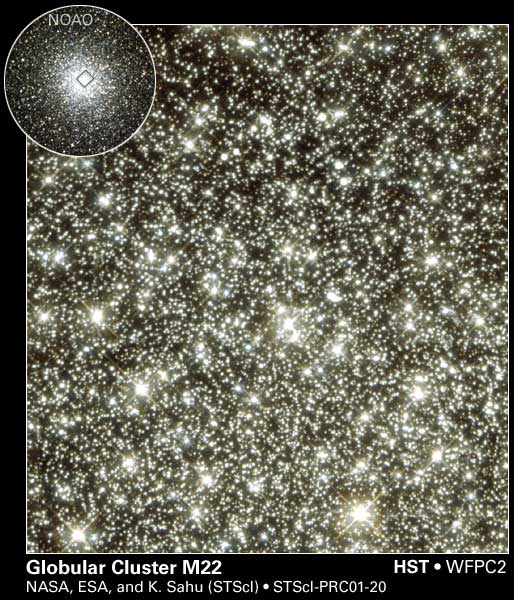
What is causing the unusual flashes behind globular cluster M22? This teeming ball of stars is the brightest globular cluster visible from Earth's northern hemisphere. M22, shown in full in the inset, spans about 50 light-years and lies 8,500 light-years away toward the constellation of Sagittarius. M22's center was recently imaged repeatedly by the high resolution Hubble Space Telescope. Behind M22 are many more stars near the center of our Galaxy. Unexpectedly, several stars near the Galactic center -- well behind M22 -- appeared to nearly double in brightness and return to normal within 20 hours. One hypothesis posed to explain these quick brightness changes is the gravitational lens effect of large planets roaming freely in the cluster. One problem with this is that no such planetary population was previously known! Future observations are planned to better understand these mysterious flashes.
¿Qué está causando los destellos inusuales detrás del cúmulo globular M22? Esta bola abarrotada de estrellas es el cúmulo globular más brillante visible desde el hemisferio norte de la Tierra. M22, mostrado en su totalidad en el recuadro, abarca aproximadamente 50 años luz y se encuentra a 8500 años luz de distancia hacia la constelación de Sagitario. El centro de M22 fue recientemente fotografiado repetidamente por el telescopio espacial Hubble de alta resolución. Detrás de M22 hay muchas más estrellas cerca del centro de nuestra Galaxia. Inesperadamente, varias estrellas cerca del centro galáctico —bien detrás de M22— parecieron casi duplicar su brillo y regresar a la normalidad dentro de 20 horas. Una hipótesis propuesta para explicar estos cambios rápidos de brillo es el efecto de lente gravitacional de grandes planetas que se mueven libremente en el cúmulo. Un problema con esto es que ¡no se conocía previamente tal población planetaria! Se planean observaciones futuras para comprender mejor estos destellos misteriosos.