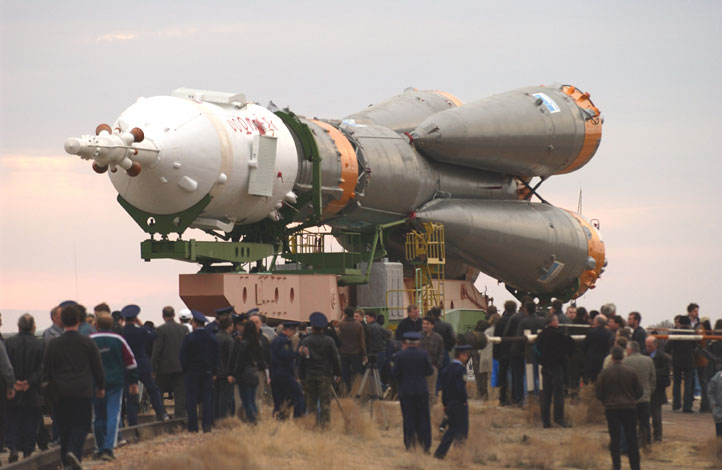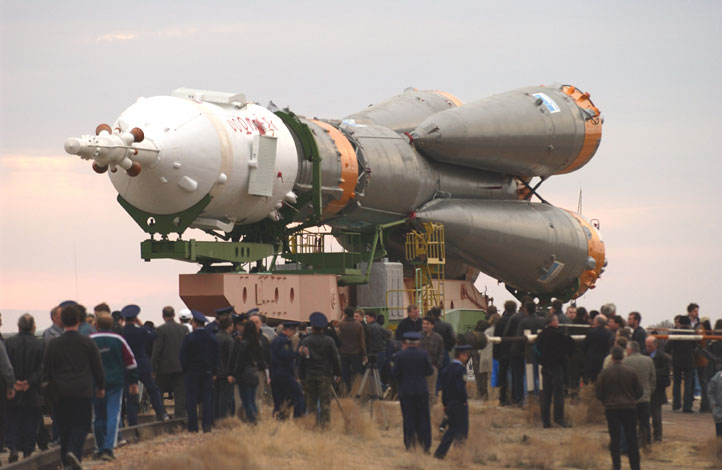
It takes a big rocket to go into space. Last weekend, this huge Russian rocket was launched toward Earth-orbiting International Space Station (ISS), carrying two astronauts who will make up the new Expedition 7 crew. Seen here during rollout at the Baikonur Cosmodrome, the rocket's white top is actually a Soyuz TMA-2, the most recent version of the longest serving type of human spacecraft. The base is a Russian R7 rocket, originally developed as a prototype Intercontinental Ballistic Missile in 1957. The rocket spans the width of a football field and has a fueled mass of about half a million kilograms. Russian rockets like this will be primary transportation system to the ISS while NASA studies the underlying reasons behind the recent tragic break-up of the Space Shuttle Columbia.
Se necesita un cohete muy potente para viajar al espacio. El fin de semana pasado, este enorme cohete ruso fue lanzado hacia la Estación Espacial Internacional (EEI) que orbita la Tierra, llevando a dos astronautas que conformarán la nueva tripulación de la Expedición 7. Visto aquí durante su traslado en el Cosmódromo de Baikonur, la parte blanca superior del cohete es en realidad un Soyuz TMA-2, la versión más reciente del tipo de nave tripulada con mayor tiempo de servicio. La base es un cohete ruso R7, originalmente desarrollado como prototipo de misil balístico intercontinental en 1957. El cohete tiene la envergadura de un campo de fútbol americano y una masa con combustible de aproximadamente medio millón de kilogramos. Los cohetes rusos como este serán el sistema de transporte principal hacia la EEI mientras la NASA estudia las causas subyacentes del reciente y trágico desintegración del transbordador espacial Columbia.