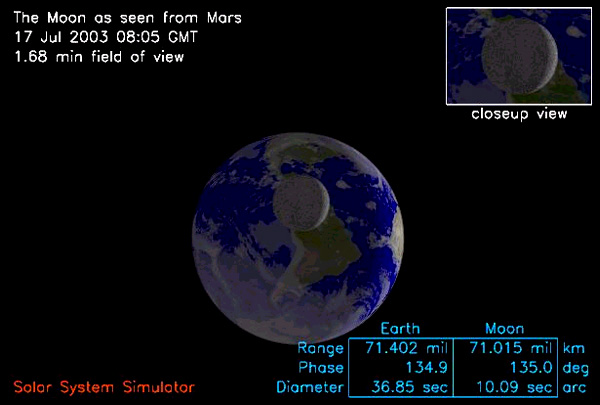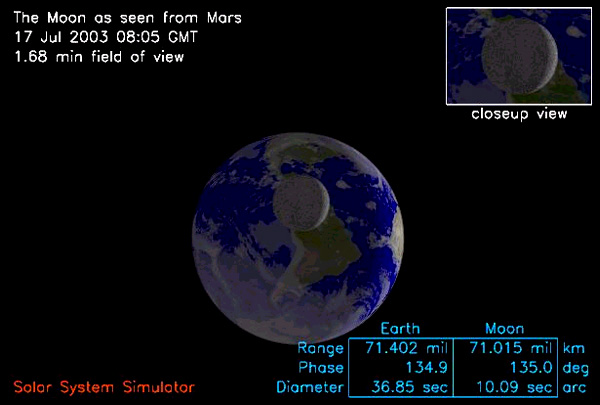
When earthdweller Patrick Vantuyne wondered what his home planet's single large moon would look like if viewed from Mars on July 17, he availed himself of the JPL Solar System Simulator. Of course, when viewed from Earth on that date (tomorrow), the gibbous Moon will pass tantalizingly close to Mars for observers in North, Central, and South America and will actually pass in front of (occult) the Red Planet for some locations, including much of Florida. Vantuyne's efforts were rewarded with this remarkable simulated view of the crescent Moon against the background of a darkened Earth. From the martian vantage point, the lunar orb is seen just below the tip of the Florida peninsula at 8:05 GMT. Observers on planet Earth who want to watch the corresponding Moon/Mars show in tomorrow's predawn sky should note the viewing times for selected cities.
Cuando el habitante terrestre Patrick Vantuyne se preguntó qué aspecto tendría la única luna grande de su planeta natal si se observara desde Marte el 17 de julio, recurrió al Simulador del Sistema Solar del JPL. Por supuesto, cuando se observa desde la Tierra en esa fecha (mañana), la Luna gibosa pasará tentadoramente cerca de Marte para los observadores en América del Norte, Central y del Sur, y en realidad pasará frente a (ocultará) el Planeta Rojo para algunas ubicaciones, incluida gran parte de Florida. Los esfuerzos de Vantuyne fueron recompensados con esta notable vista simulada de la Luna creciente contra el fondo de una Tierra oscurecida. Desde el punto de vista marciano, el orbe lunar se ve justo debajo de la punta de la península de Florida a las 8:05 GMT. Los observadores del planeta Tierra que deseen ver el correspondiente espectáculo Luna/Marte en el cielo previa al amanecer de mañana deben tener en cuenta los tiempos de observación para ciudades seleccionadas.