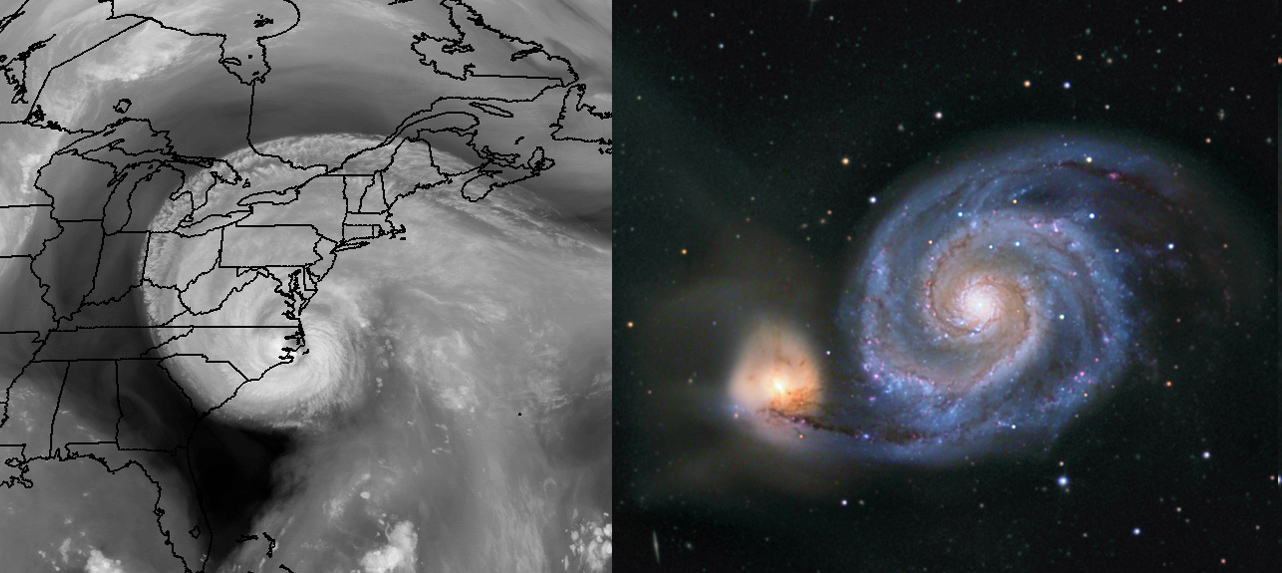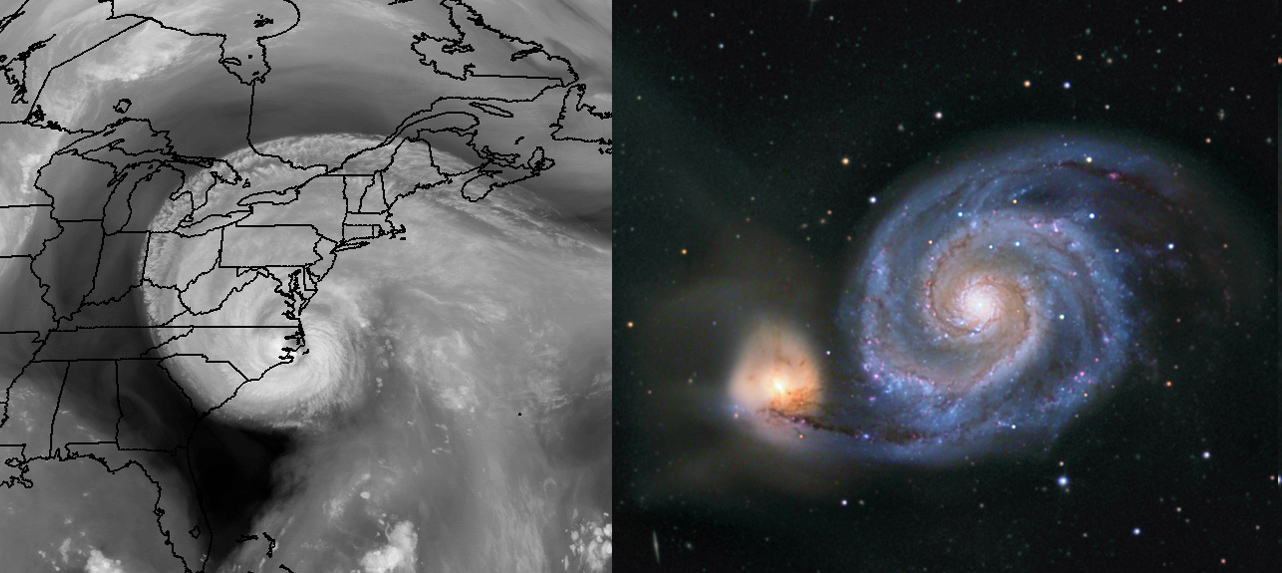
Uncomfortably close hurricane Isabel (left) and 30 million light-year distant galaxy M51 actually don't have much in common. For starters, Isabel was hundreds of miles across, while M51 (the Whirlpool Galaxy) spans about 50,000 light-years making them vastly dissimilar in scale, not to mention the extremely different physical interactions which control their formation and evolution. But they do look amazingly alike, both exhibiting the shape of a simple and beautiful mathematical curve known as a logarithmic spiral, a spiral whose separation grows in a geometric way with increasing distance from the center. Also known as the equiangular spiral, growth spiral, and Bernoulli's spiral or spira mirabilis, this curve's rich properties have fascinated mathematicians since its discovery by 17th century philosopher Descartes. Intriguingly, this abstract shape is much more abundant in nature than suggested by the striking visual comparison above. Logarithmic spirals also describe, for example, the arrangement of sunflower seeds, the shapes of nautilus shells, and ... cauliflower.
El incómodamente cercano huracán Isabel (a la izquierda) y la galaxia M51, distante 30 millones de años luz, en realidad no tienen mucho en común. Para empezar, Isabel tenía cientos de millas de ancho, mientras que M51 (la Galaxia del Torbellino) abarca aproximadamente 50.000 años luz, lo que los hace vastamente diferentes en escala, sin mencionar las interacciones físicas extremadamente diferentes que controlan su formación y evolución. Sin embargo, se parecen sorprendentemente, exhibiendo ambos la forma de una curva matemática simple y hermosa conocida como espiral logarítmica, una espiral cuya separación crece de manera geométrica con la distancia creciente desde el centro. También conocida como espiral equiangular, espiral de crecimiento, espiral de Bernoulli o spira mirabilis, las ricas propiedades de esta curva han fascinado a los matemáticos desde su descubrimiento por el filósofo del siglo XVII Descartes. Intriguingly, this abstract shape is much more abundant in nature than suggested by the striking visual comparison above. Las espirales logarítmicas también describen, por ejemplo, la disposición de las semillas de girasol, las formas de las conchas de náutilo, y... coliflor.