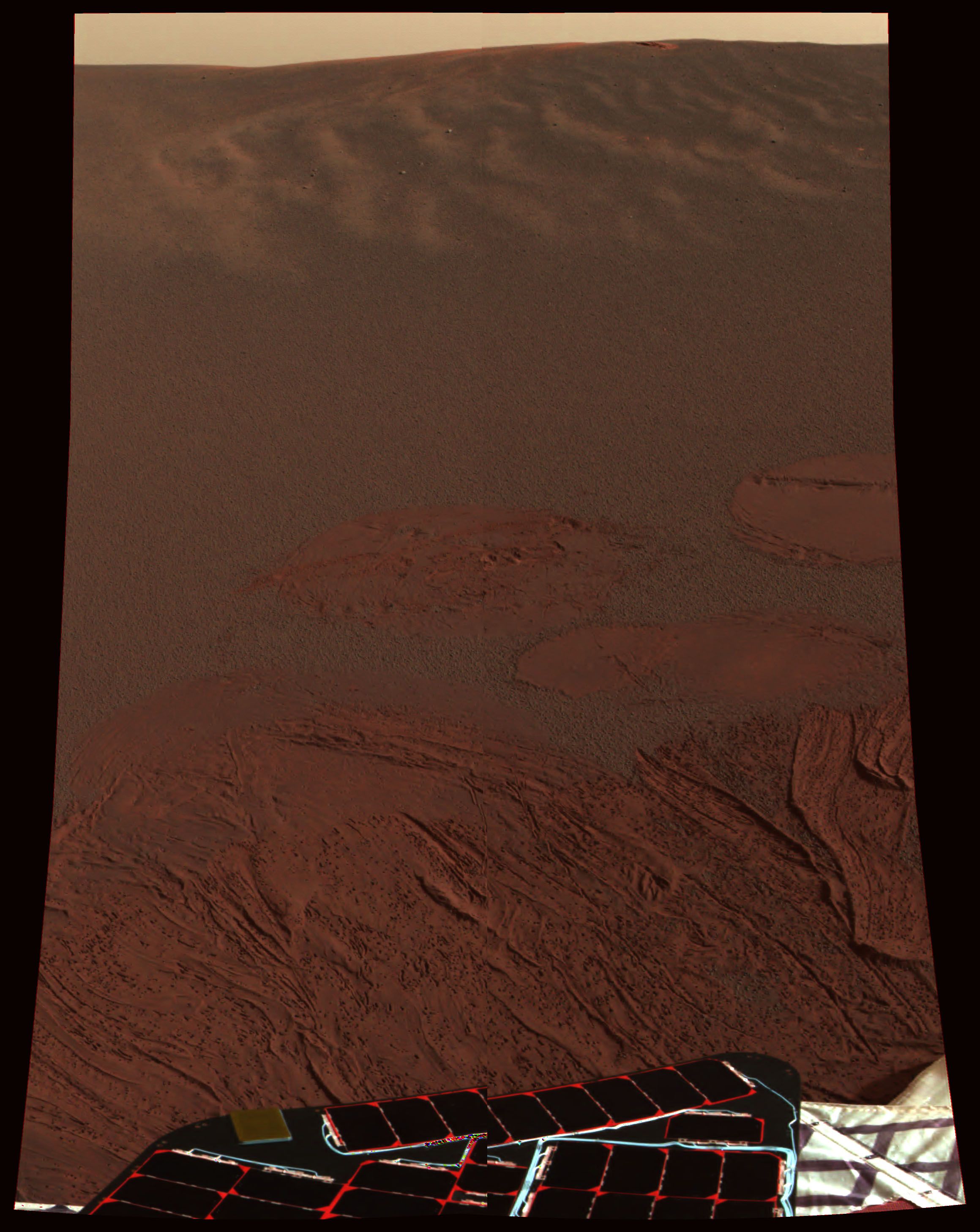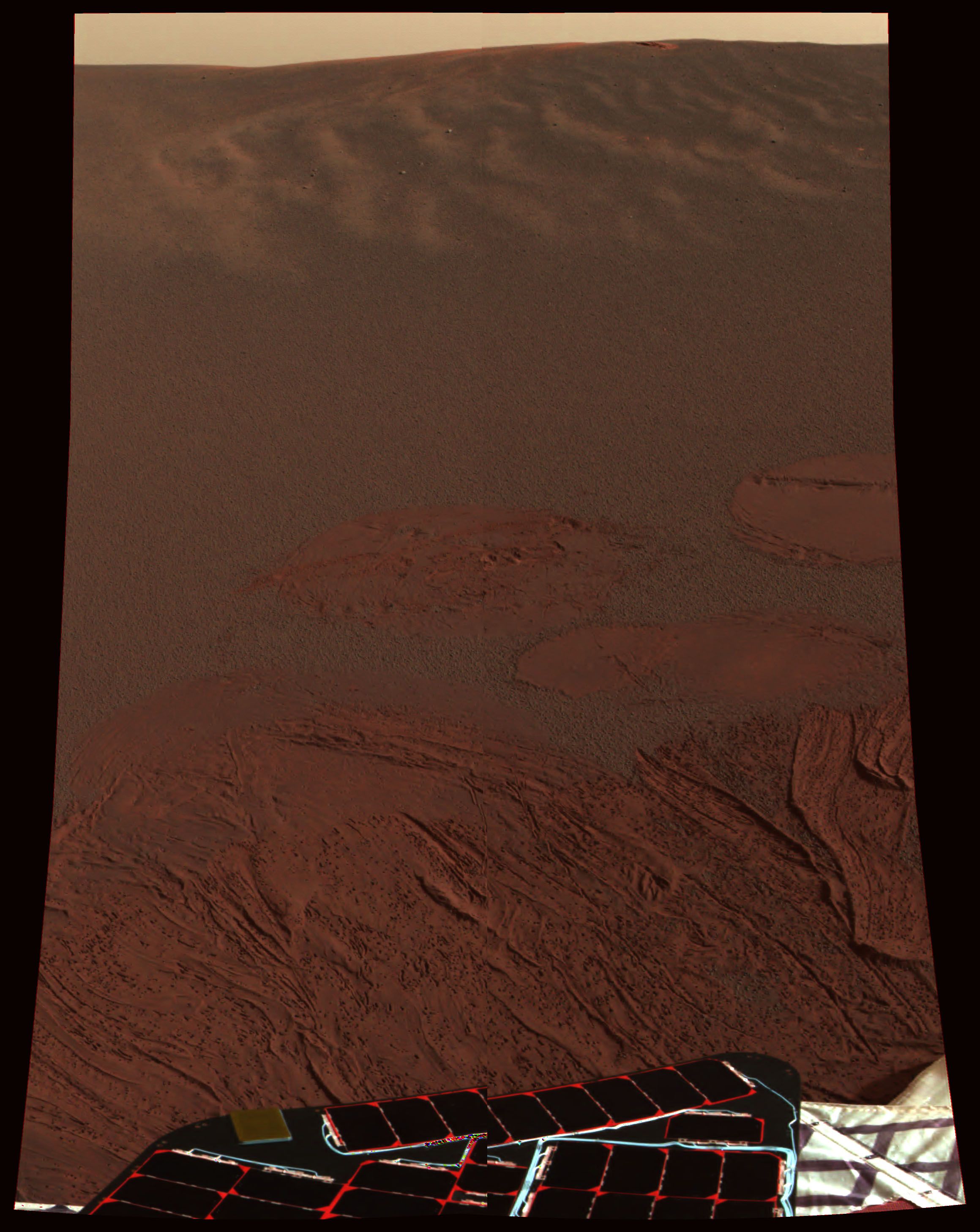
After an interplanetary journey of nearly 300 million miles, Opportunity bounced down on the martian surface at about 9:05 pm PST Saturday, its final plunge cushioned by airbags. Now the second NASA rover on Mars, Opportunity's landing site at Meridiani Planum is on the opposite side of the red planet from its twin rover Spirit. Described as unlike any ever seen on Mars, the dark, undulating terrain at Meridiani Planum (aka Terra Meridiani) is pictured above in the first stunning color view from Opportunity. This area is thought to be rich in gray hematite, an iron-bearing mineral which can form in watery environments. Part of the rover's deck is in the foreground while circular impressions and drag marks made by the airbags are visible just beyond it.
Después de un viaje interplanetario de casi 300 millones de millas, Opportunity descendió rebotando en la superficie marciana alrededor de las 9:05 pm PST del sábado, con su caída final amortiguada por bolsas de aire. Ahora el segundo rover de la NASA en Marte, el sitio de aterrizaje de Opportunity en Meridiani Planum se encuentra en el lado opuesto del planeta rojo respecto a su rover gemelo Spirit. Descrito como un terreno nunca antes visto en Marte, el terreno oscuro y ondulante de Meridiani Planum (también conocido como Terra Meridiani) se muestra en la imagen anterior en la primera impresionante vista en color de Opportunity. Se cree que esta área es rica en hematita gris, un mineral que contiene hierro y que puede formarse en ambientes acuosos. Parte de la plataforma del rover se ve en primer plano, mientras que las impresiones circulares y las marcas de arrastre dejadas por las bolsas de aire son visibles justo más allá.