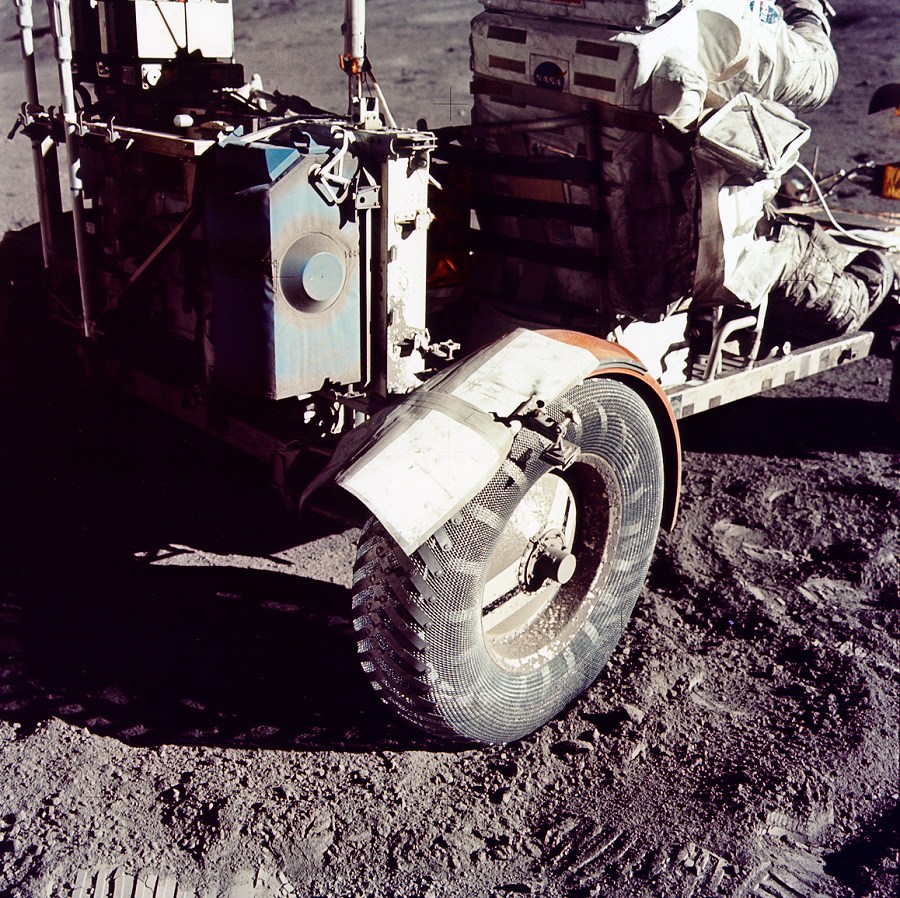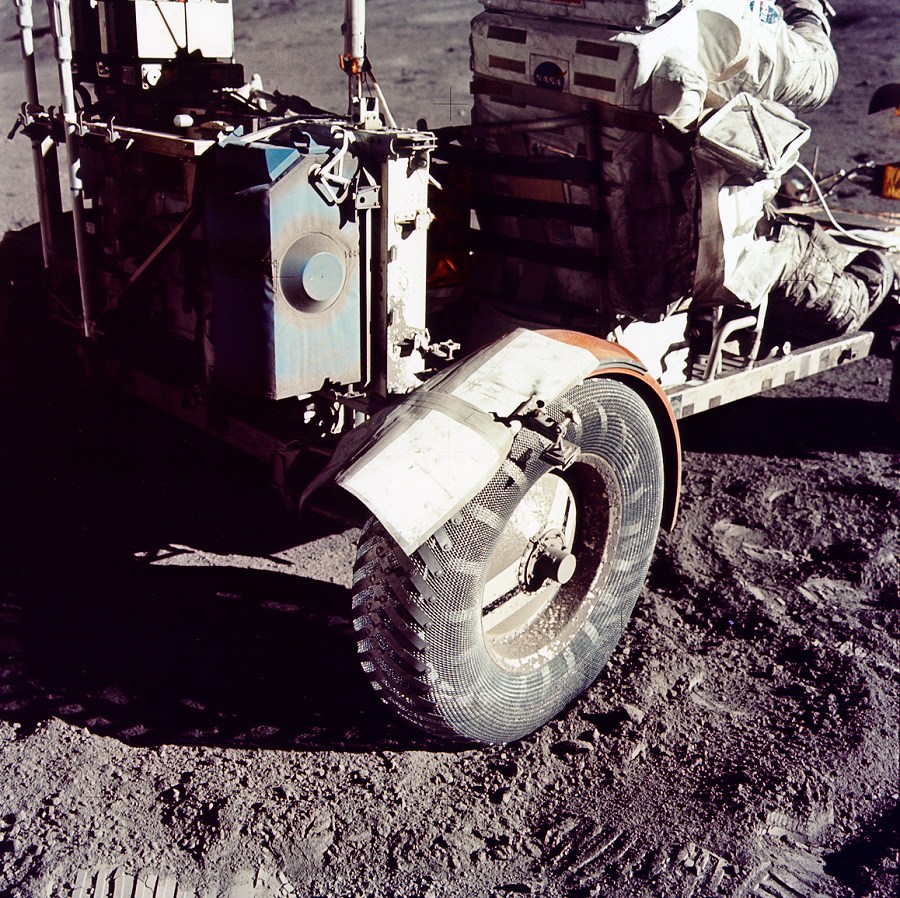
Why is the Moon dusty? On Earth, rocks are weathered by wind and water, creating soil and sand. On the Moon, the long history of micrometeorite bombardment has blasted away at the rocky surface creating a layer of powdery lunar soil or regolith. This lunar regolith could be a scientific and industrial bonanza. But for the Apollo astronauts and their equipment, the pervasive, fine, gritty dust was definitely a problem. On the lunar surface in December 1972, Apollo 17 astronauts Harrison Schmitt and Eugene Cernan needed to repair one of their lunar rover's fenders in an effort to keep the "rooster tails" of dust away from themselves and their gear. This picture reveals the wheel and fender of their dust covered rover along with the ingenious application of spare maps, clamps, and a grey strip of "duct tape".
¿Por qué es polvoriento la Luna? En la Tierra, las rocas se erosionan por la acción del viento y el agua, creando suelo y arena. En la Luna, el largo historial de bombardeo de micrometeoritos ha erosionado la superficie rocosa creando una capa de polvo lunar fino o regolito. Este regolito lunar podría ser una bonanza científica e industrial. Pero para los astronautas del Apolo y su equipo, el polvo fino y omnipresente era definitivamente un problema. En la superficie lunar en diciembre de 1972, los astronautas del Apolo 17 Harrison Schmitt y Eugene Cernan necesitaban reparar el guardabarros de uno de sus vehículos exploradores lunares en un esfuerzo por mantener las "colas de gallo" de polvo alejadas de sí mismos y de su equipo. Esta fotografía revela la rueda y el guardabarros de su vehículo cubierto de polvo junto con la aplicación ingeniosa de mapas de repuesto, abrazaderas y una tira gris de "cinta adhesiva".