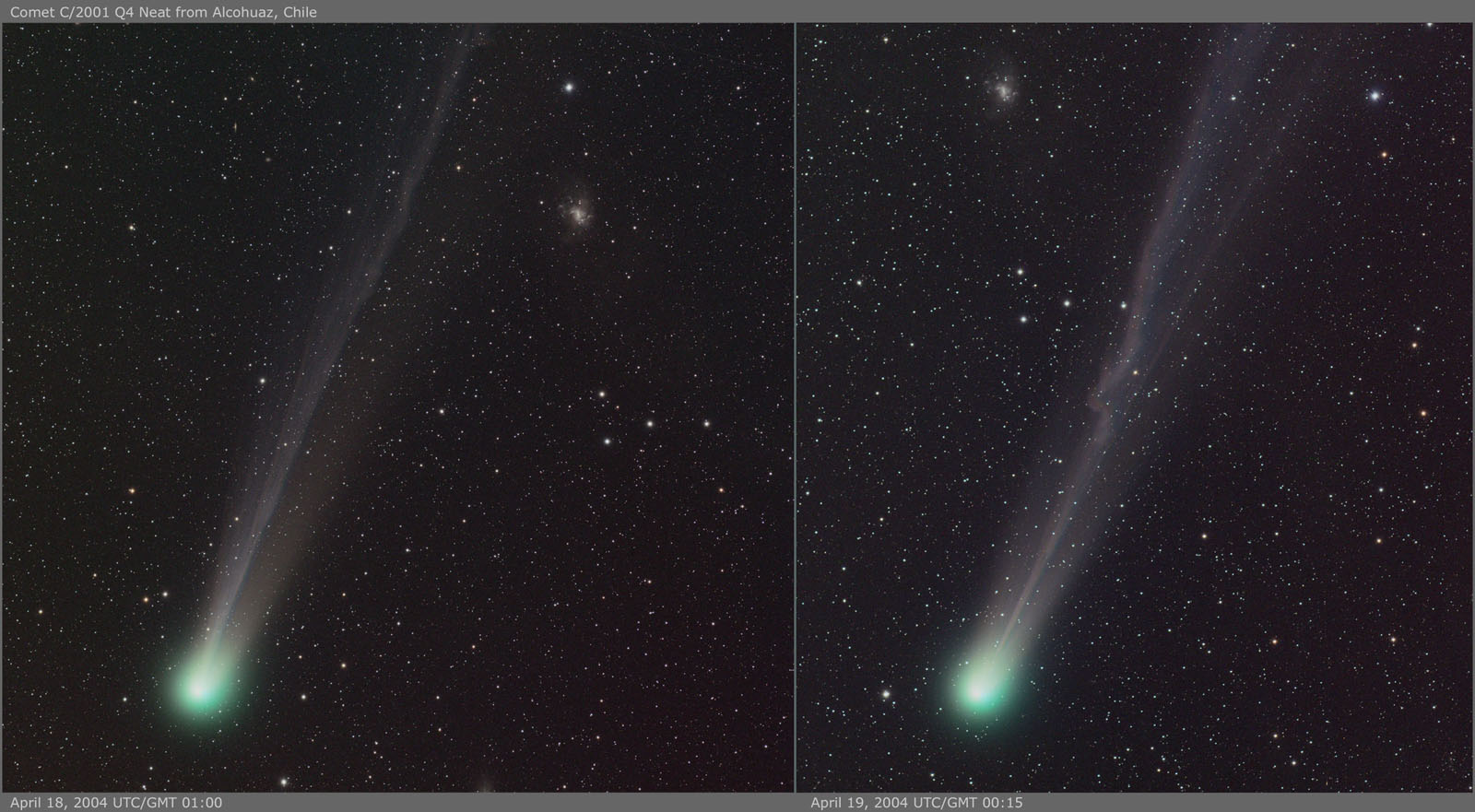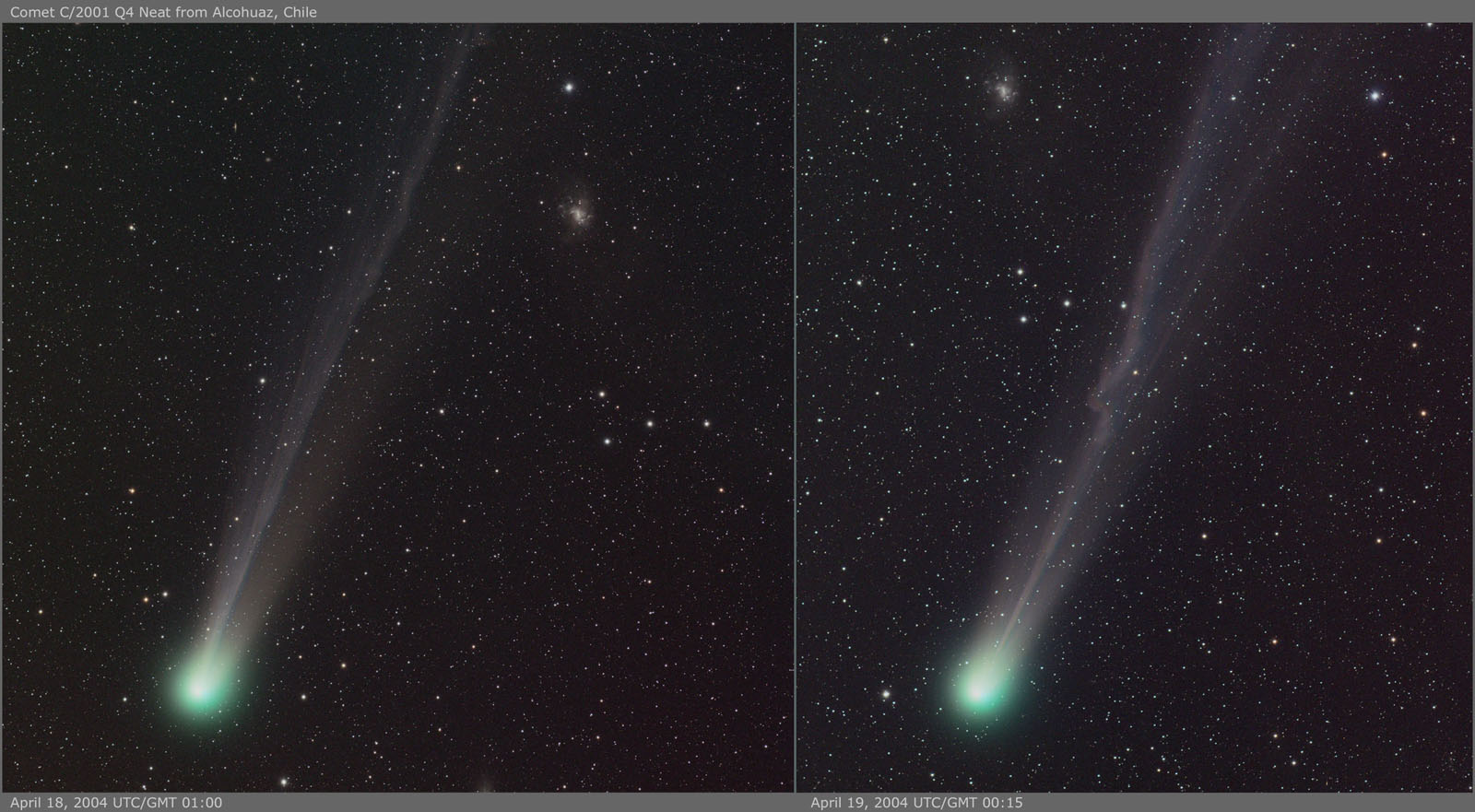
Inbound from the distant solar system, comet C/2001 Q4 will soon pass just inside planet Earth's orbit and should be one of two bright, naked-eye comets visible in southern skies in May. First picked up nearly three years ago by the Near Earth Asteroid Tracking (NEAT) project Q4 appears in both of these stunning telescopic views recorded only a few days ago, on April 18th (left) and 19th, from a site near Alcohuaz, Chile. Remarkable changes in the structure of the long, graceful tail can be seen by comparing the two photos, including the dramatic kink seen near the tail's midpoint on April 19th. The apparent motion of the comet sweeping across the sky is evident when you compare the position of the tail relative to background galaxy NGC 1313, visible as a smudge near the top of each image. Q4's closest approach to the Sun will be on May 15th while its closest encounter with planet Earth will be on May 7th (see animation by L. Koehn).
Procedente de las regiones lejanas del sistema solar, el cometa C/2001 Q4 pronto pasará justo dentro de la órbita del planeta Tierra y debería ser uno de los dos cometas brillantes visibles a simple vista en los cielos del hemisferio sur en mayo. Detectado hace casi tres años por el proyecto Near Earth Asteroid Tracking (NEAT), el cometa Q4 aparece en ambas de estas impresionantes imágenes telescópicas obtenidas hace solo unos días, el 18 y 19 de abril, desde un sitio cerca de Alcohuaz, Chile. Se pueden observar cambios notables en la estructura de la larga y elegante cola comparando las dos fotografías, incluyendo el dramático ángulo que se ve cerca del punto medio de la cola el 19 de abril. El movimiento aparente del cometa barriendo el cielo es evidente cuando se compara la posición de la cola con respecto a la galaxia de fondo NGC 1313, visible como una mancha cerca de la parte superior de cada imagen. El acercamiento más cercano del cometa Q4 al Sol ocurrirá el 15 de mayo, mientras que su encuentro más cercano con el planeta Tierra será el 7 de mayo.