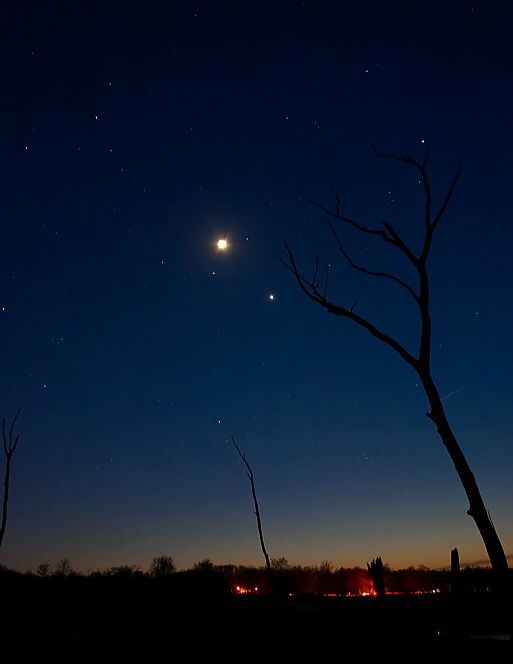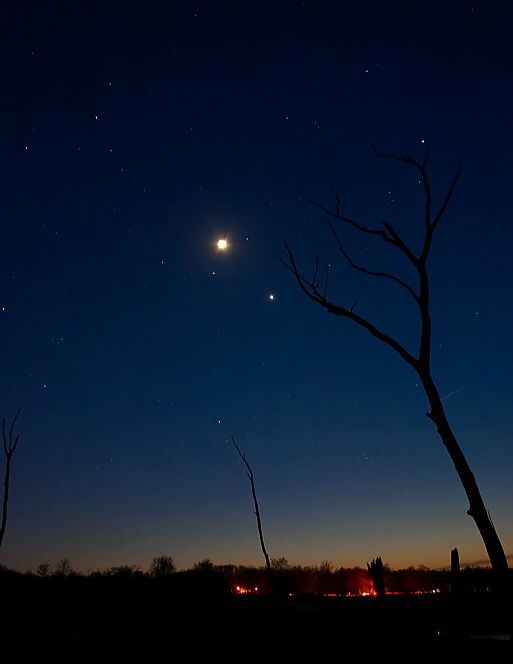
On April 23rd, the Moon along with planets Saturn, Mars, and Venus (and planet Earth of course ...) were all visible in the west at twilight, captured here from a site near Saylorvillle Lake north of Des Moines, Iowa, USA. Putting your cursor over the image will label our fellow solar system wanderers and also reveal the approximate trajectory of the ecliptic plane - defined by Earth's orbit around the Sun - angling above the western horizon. After sunset tonight, the western sky will present a similar arrangement of planets, although the Moon will have moved east out of the picture, passing bright Jupiter along the ecliptic and heading for May 4th's total lunar eclipse. May could also be a good month for comets.
El 23 de abril, la Luna junto con los planetas Saturno, Marte y Venus (y el planeta Tierra, por supuesto...) eran todos visibles en el oeste al crepúsculo, capturados aquí desde un sitio cerca del lago Saylorville, al norte de Des Moines, Iowa, EE.UU. Al pasar el cursor sobre la imagen se etiquetarán nuestros compañeros errantes del sistema solar y también se revelará la trayectoria aproximada del plano de la eclíptica —definido por la órbita de la Tierra alrededor del Sol— inclinándose sobre el horizonte occidental. Después de la puesta de sol esta noche, el cielo occidental presentará una disposición similar de planetas, aunque la Luna se habrá movido hacia el este fuera de la imagen, pasando por el brillante Júpiter a lo largo de la eclíptica y dirigiéndose hacia el eclipse lunar total del 4 de mayo. Mayo también podría ser un buen mes para los cometas.