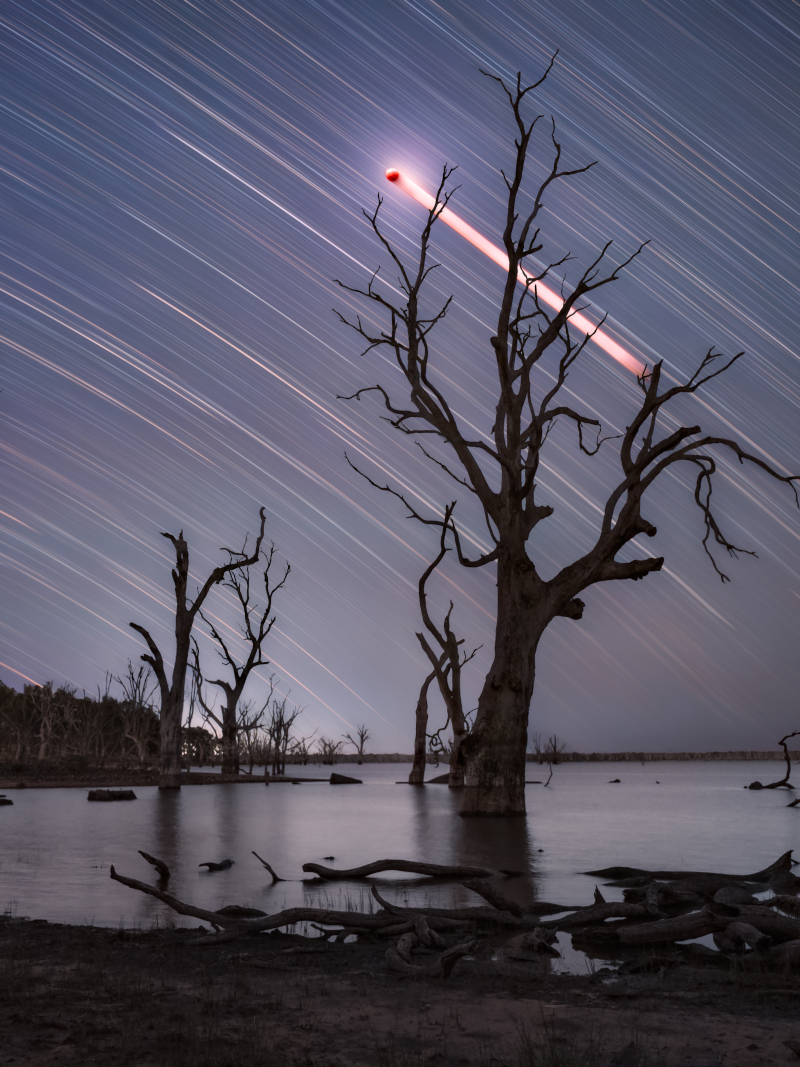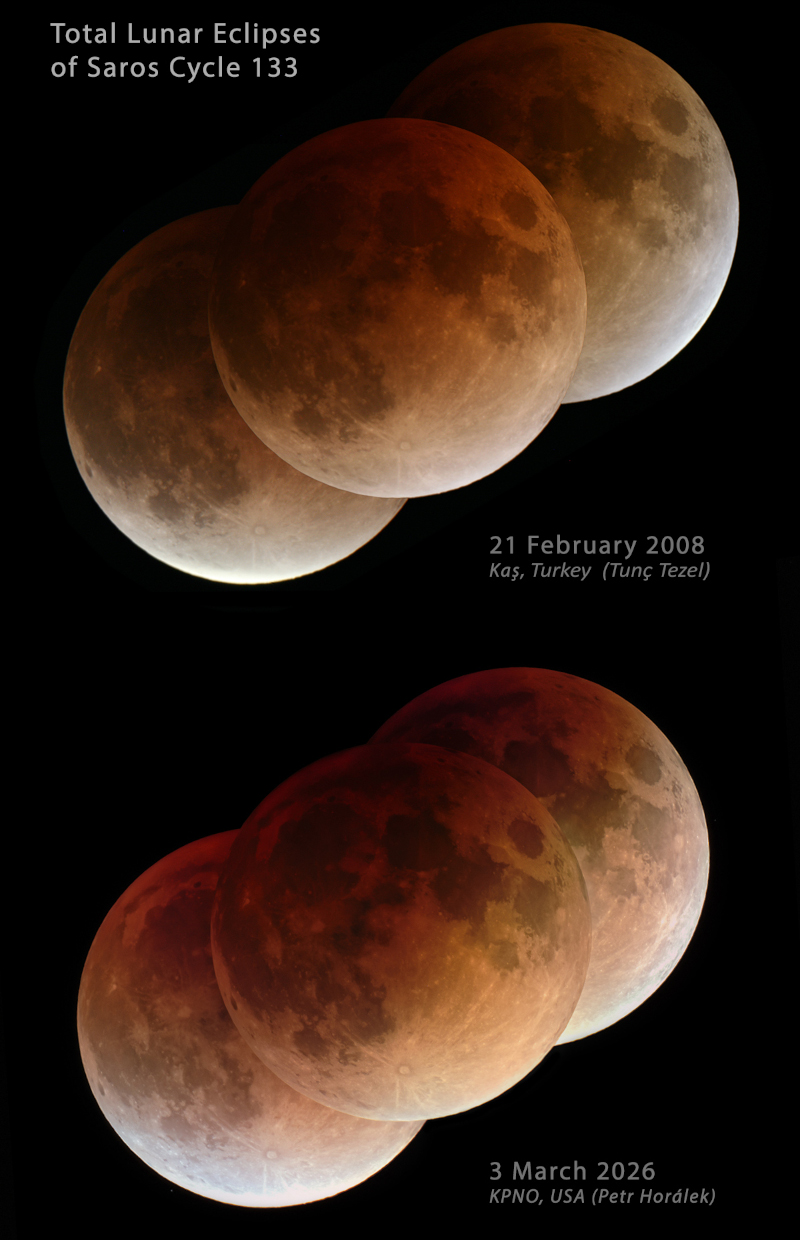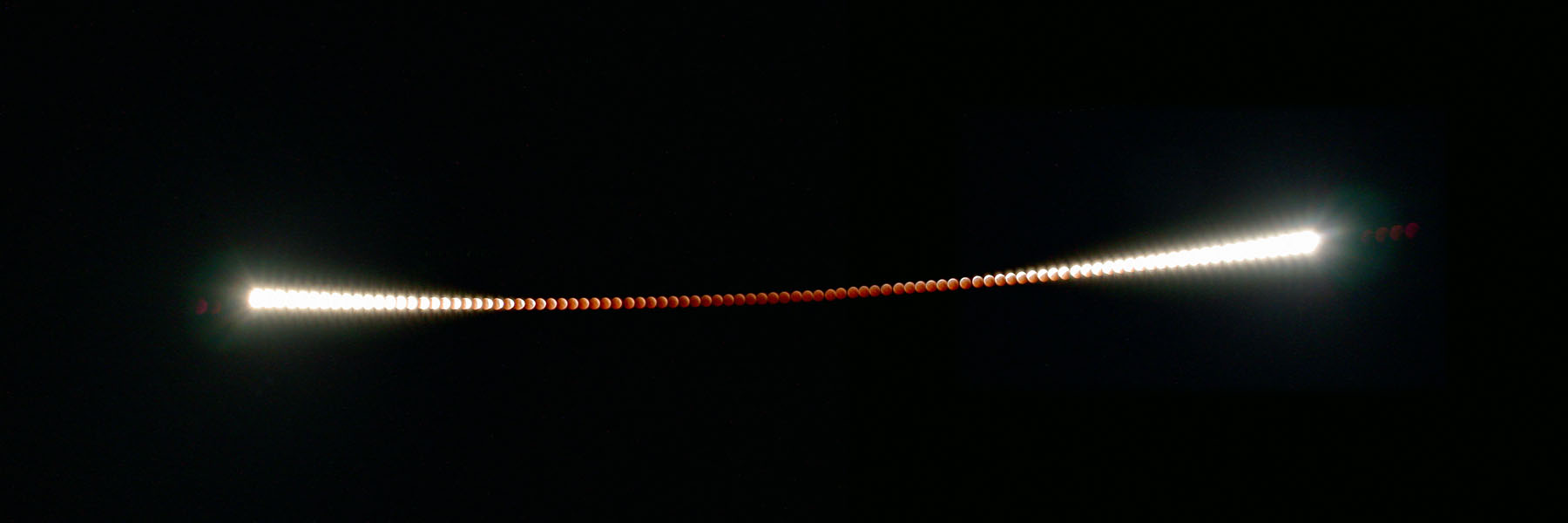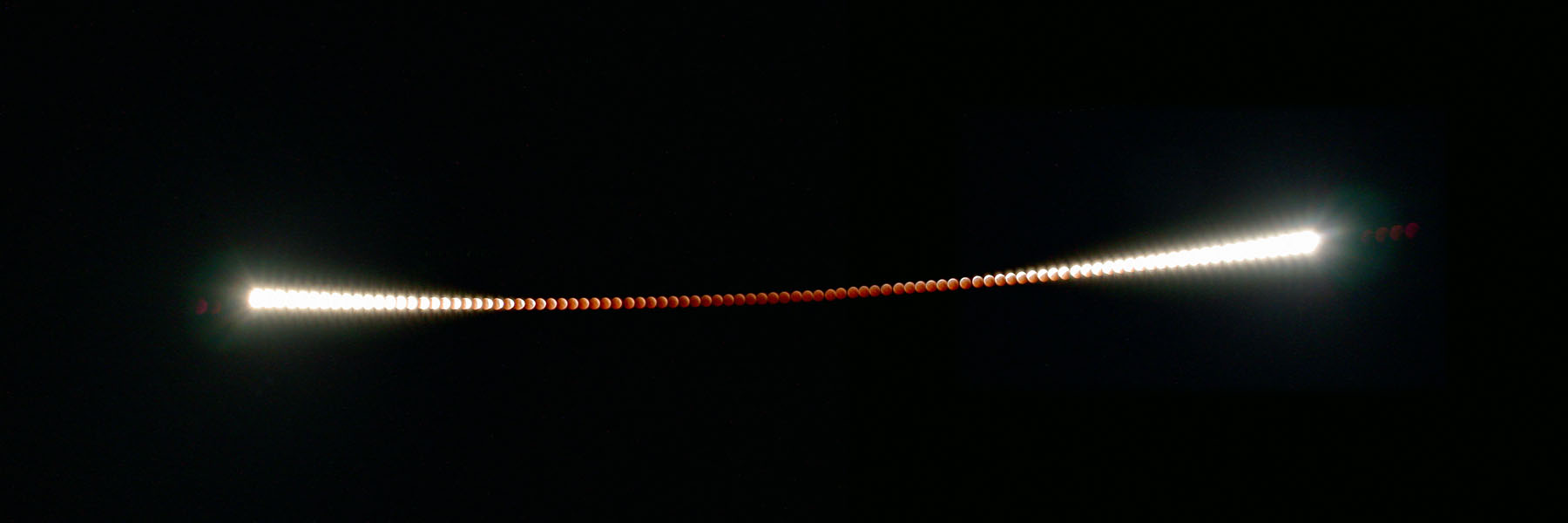
During last week's lunar eclipse, our Moon appeared to disappear. As the Earth moved between the Moon and the Sun, the Earth's shadow fell on the moon, making it quite dark. In the above picture the Earth's rotation, multiple exposures, and digital enhancements are used to create a time-lapse effect that dramatizes how the Moon looked as it faded out and re-appeared during the three hour lunar eclipse. As the Earth's shadow engulfed the Moon, the lunar images became less and less bright, practically disappearing during totality. At this time, the Moon, which normally shines by reflecting direct sunlight, shone only by sunlight refracted through the Earth's atmosphere. The next total lunar eclipse won't be visible from Earth until 2007.
Durante el eclipse lunar de la semana pasada, nuestra Luna pareció desaparecer. Cuando la Tierra se interpuso entre la Luna y el Sol, la sombra de la Tierra cayó sobre la Luna, haciéndola bastante oscura. En la imagen anterior, la rotación terrestre, múltiples exposiciones y mejoras digitales se utilizan para crear un efecto de lapso de tiempo que dramatiza el aspecto de la Luna mientras se desvanecía y reaparecía durante el eclipse lunar de tres horas. Conforme la sombra de la Tierra envolvía la Luna, las imágenes lunares se volvían cada vez menos brillantes, desapareciendo prácticamente durante la totalidad. En este momento, la Luna, que normalmente brilla reflejando la luz solar directa, brillaba únicamente con la luz solar refractada a través de la atmósfera terrestre. El próximo eclipse lunar total visible desde la Tierra no ocurrirá hasta 2007.