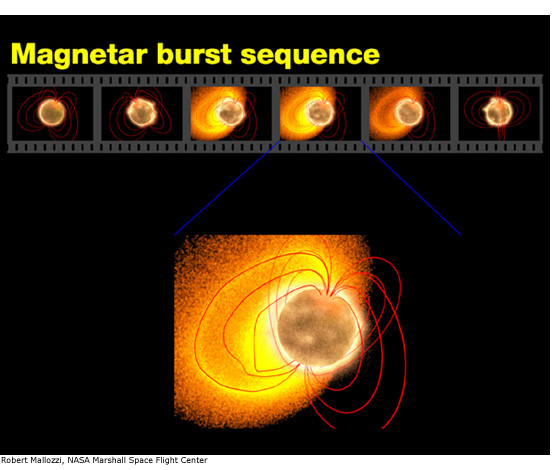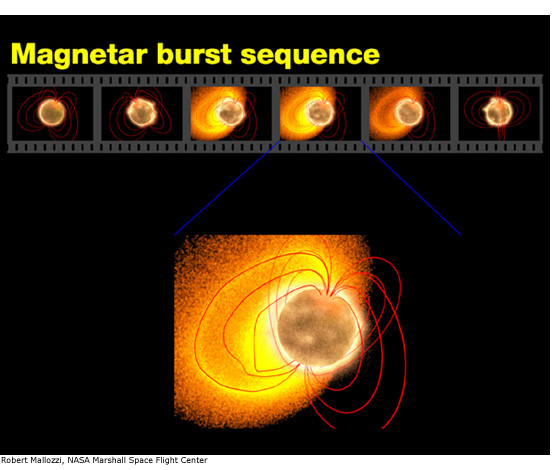
Was the brightest Galactic blast yet recorded a key to connecting two types of celestial explosions? Last December, a dense sheet of gamma rays only a few times wider than the Earth plowed through our Solar System, saturating satellites and noticeably reflecting off the Moon. A magnetar near our Galactic Center, the source of Soft Gamma Repeater (SGR) 1806-20, had unleashed its largest flare on record. The brightness and briefness of the tremendous explosion's initial peak made it look quite similar to another type of tremendous explosion if viewed from further away -- a short duration gamma-ray burst (GRB). Short duration GRBs are thought by many to be fundamentally different than their long duration GRB cousins that are likely related to distant supernovas. Illustrated above is a series of drawings depicting an outgoing explosion during the initial SGR spike. A fast moving wave of radiation is pictured shooting away from a central magnetar. The possible link between SGRs and GRBs should become better understood as more and similar events are detected by the Earth-orbiting Swift satellite.
¿Fue el destello más brillante de la galaxia registrado hasta ahora la clave para conectar dos tipos de explosiones celestes? El mes pasado, una densa capa de rayos gamma, de apenas unas pocas veces el ancho de la Tierra, atravesó nuestro sistema solar, saturando satélites y reflejándose notablemente en la Luna. Un magneto cerca del centro galáctico, la fuente de Repeats Gamma Suaves (SGR) 1806-20, había liberado su mayor explosión registrada. La brillantez y brevedad del pico inicial de la tremenda explosión la hizo parecerse mucho a otro tipo de explosión tremenda si se observara desde más lejos: una explosión de rayos gamma de corta duración (GRB). Muchos consideran que las GRB de corta duración son fundamentalmente diferentes de sus primas de larga duración, que probablemente estén relacionadas con supernovas distantes. En la imagen de arriba se muestra una serie de dibujos que ilustran una explosión saliente durante el pico inicial del SGR. Se muestra una onda rápida de radiación que se aleja de un magneto central. La posible conexión entre SGR y GRB debería entenderse mejor a medida que se detecten más eventos similares por parte del satélite Swift en órbita terrestre.