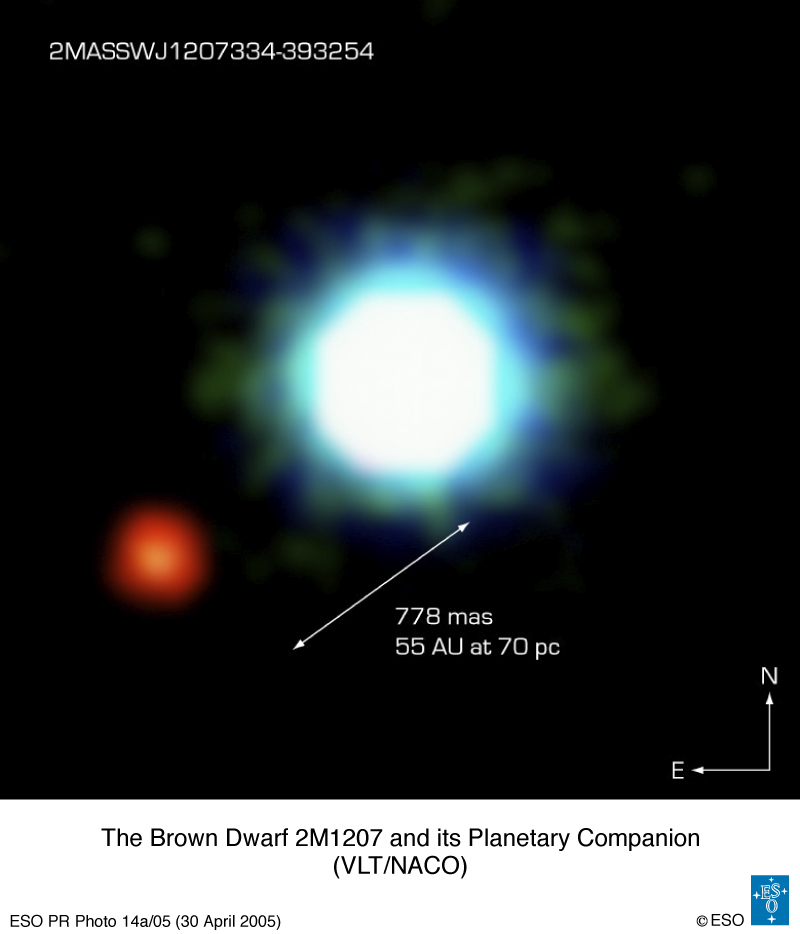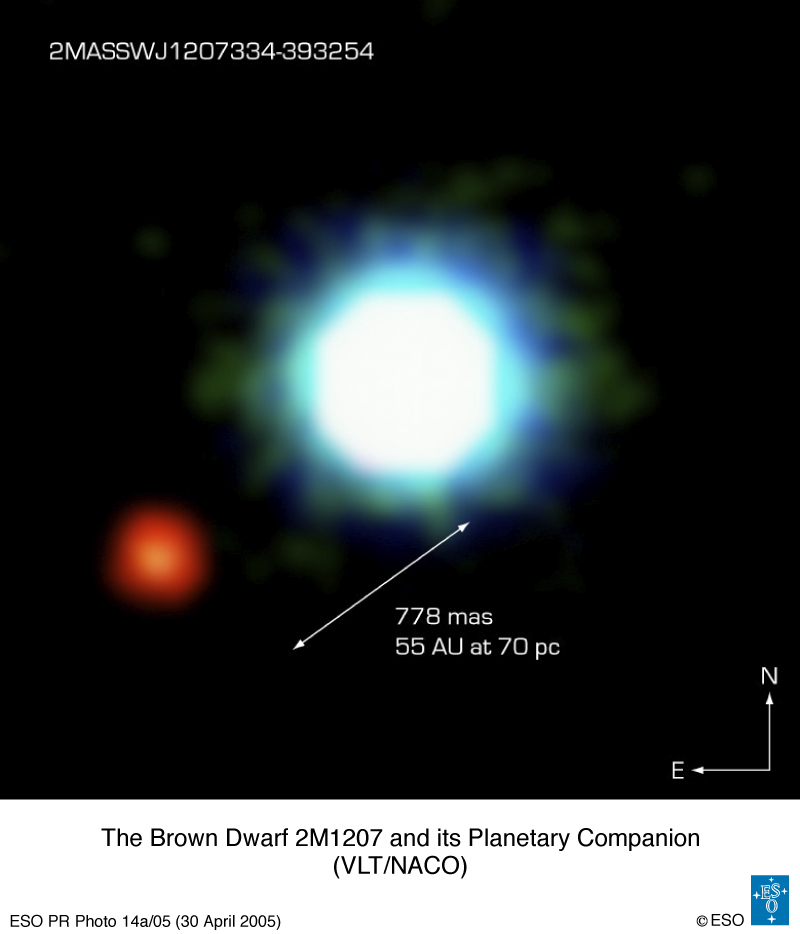
It's the faint red object, not the bright white one that might be a historic find. The white object is surely a brown dwarf star. Quite possibly, however, the red object is the first direct image of a planet beyond our Solar System. The intriguing possibility was first reported last year, but many astronomers weren't then convinced that the "planet" was not just a background star. Earlier this year, the 2M1207 star system was imaged twice more in an effort to resolve the issue. To the delight of the scientific team, the objects kept the same separation, indicating that they are gravitationally bound. The faint red object 2M1207b is therefore 100 times fainter, intrinsically, than the bright white brown dwarf 2M1207a -- a characteristic well explained by a planet roughly five times the mass of Jupiter. The discovery - still subject to further confirmation - is considered a step toward the more ambitious goal of imaging Earth-like planets orbiting distant stars. The above image was taken with the high-resolution adaptive-optic NaCo camera attached to the 8-meter Very Large Telescope Yepun in Chile.
El objeto tenue de color rojo, no el brillante blanco que podría ser un hallazgo histórico. El objeto blanco es seguramente una enana marrón. Sin embargo, es bastante posible que el objeto rojo sea la primera imagen directa de un planeta más allá de nuestro Sistema Solar. Esta intrigante posibilidad fue reportada por primera vez el año pasado, pero muchos astrónomos no estaban convencidos entonces de que el "planeta" no fuera simplemente una estrella de fondo. A principios de este año, el sistema estelar 2M1207 fue observado dos veces más en un esfuerzo por resolver la cuestión. Para delicia del equipo científico, los objetos mantuvieron la misma separación, indicando que están ligados gravitacionalmente. El objeto rojo tenue 2M1207b es, por lo tanto, 100 veces más débil, intrínsecamente, que la brillante enana marrón blanca 2M1207a, una característica bien explicada por un planeta con una masa aproximadamente cinco veces la de Júpiter. El descubrimiento, aún sujeto a confirmación adicional, se considera un paso hacia el objetivo más ambicioso de obtener imágenes de planetas similares a la Tierra orbitando estrellas distantes. La imagen anterior fue tomada con la cámara NaCo de óptica adaptativa de alta resolución conectada al telescopio de 8 metros Very Large Telescope Yepun en Chile.