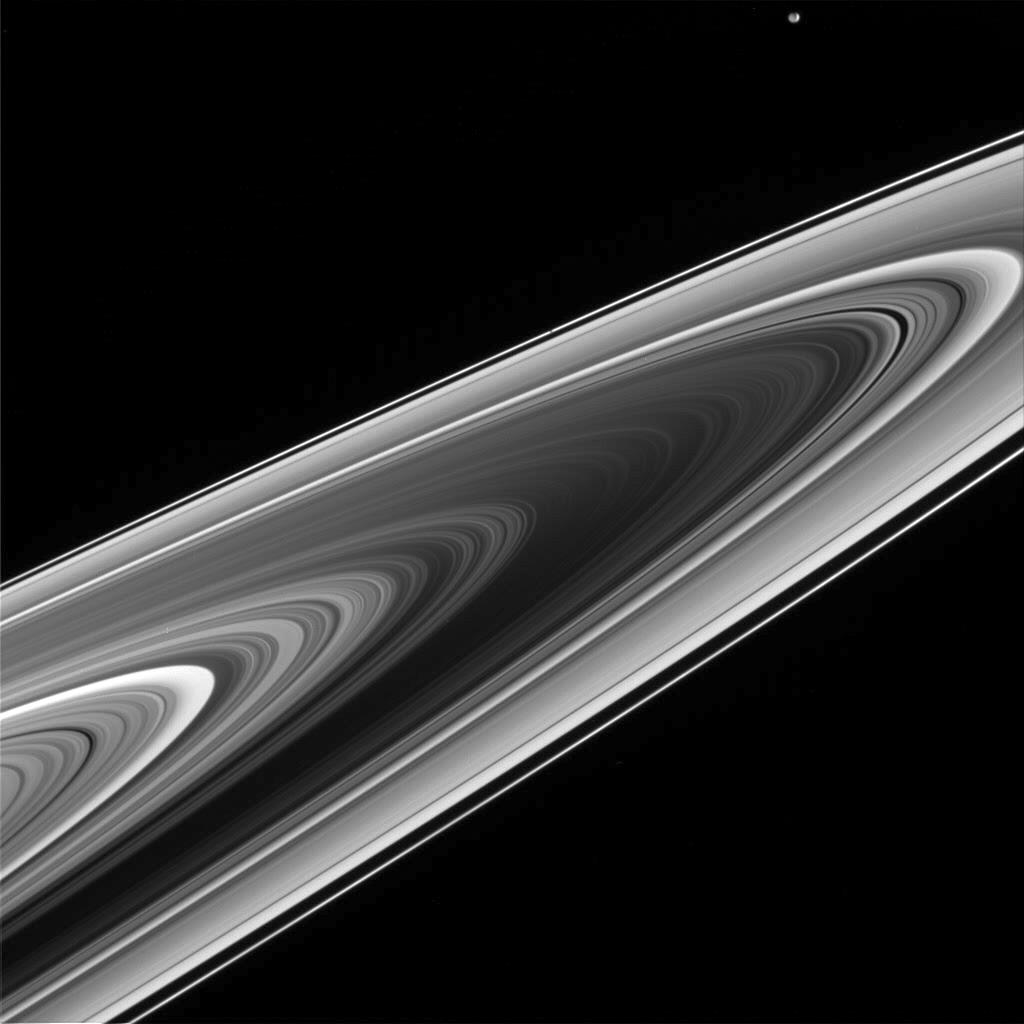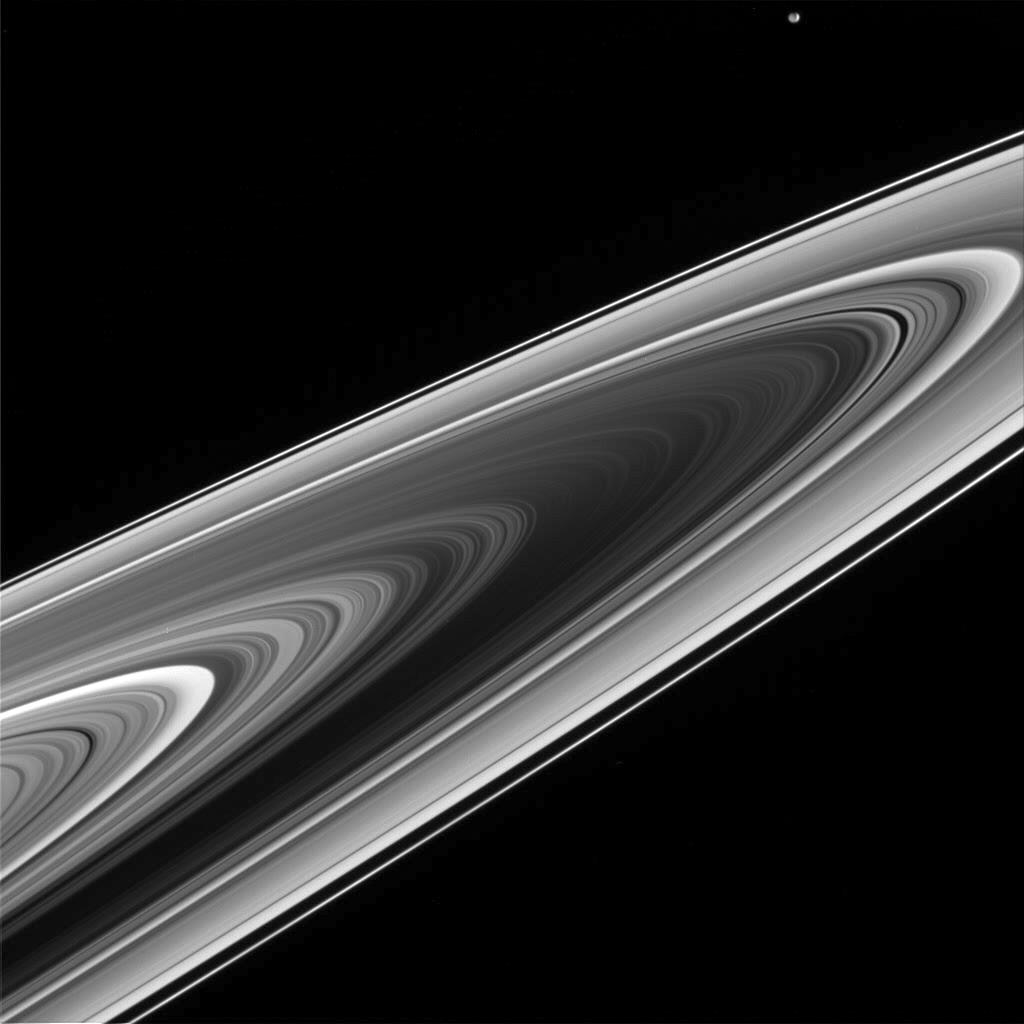
What do Saturn's rings look like from the other side? From Earth, we usually see Saturn's rings from the same side of the ring plane that the Sun illuminates them. Geometrically, in the above picture taken in April by the robot Cassini spacecraft now orbiting Saturn, the Sun is behind the camera but on the other side of the ring plane. Such a vantage point gives a breathtaking views of the most splendid ring system in the Solar System. Strangely, the rings have similarities to a photographic negative of a front view. For example, the dark band in the middle is actually the normally bright B-ring. The ring brightness as recorded from different angles indicates ring thickness and particle density of ring particles. Images like these are also interesting for what they do not show: spokes. The unexpected shadowy regions once recorded by the Voyager missions when they passed Saturn in the early 1980s are not, so far, being seen by Cassini. Extra credit: Can you spot the small moon (Prometheus) among the rings?
¿Cómo se ven los anillos de Saturno desde el otro lado? Desde la Tierra, normalmente observamos los anillos de Saturno desde el mismo lado del plano anular que ilumina el Sol. Geométricamente, en la imagen anterior tomada en abril por la nave robot Cassini que ahora orbita Saturno, el Sol está detrás de la cámara pero al otro lado del plano anular. Este punto de vista proporciona vistas extraordinarias del sistema de anillos más espléndido del Sistema Solar. Extrañamente, los anillos presentan similitudes con un negativo fotográfico de una vista frontal. Por ejemplo, la banda oscura en el medio es en realidad el anillo B normalmente brillante. El brillo de los anillos registrado desde diferentes ángulos indica el grosor de los anillos y la densidad de partículas del material anular. Las imágenes como esta también son interesantes por lo que no muestran: radios. Las regiones sombrías inesperadas una vez registradas por las misiones Voyager cuando pasaron por Saturno a principios de los años 1980 no están siendo vistas, hasta el momento, por Cassini. Crédito extra: ¿Puedes identificar la pequeña luna (Prometeo) entre los anillos?