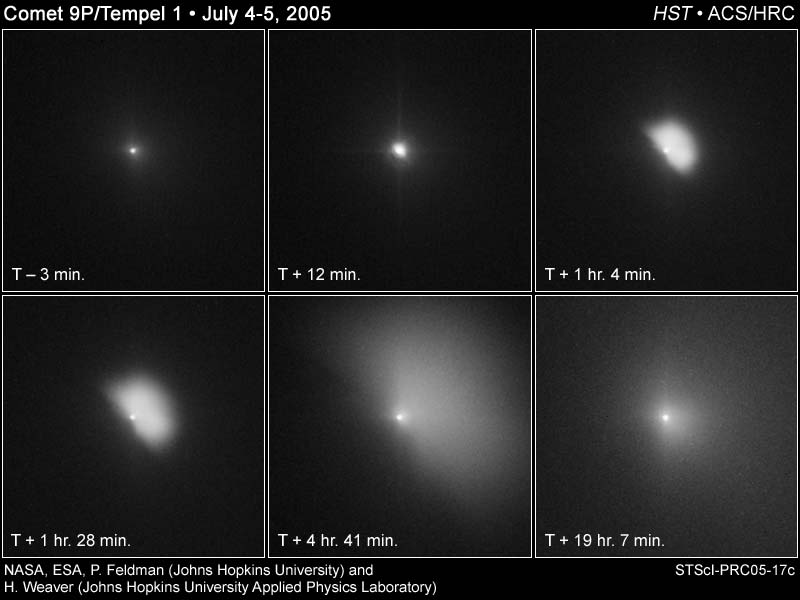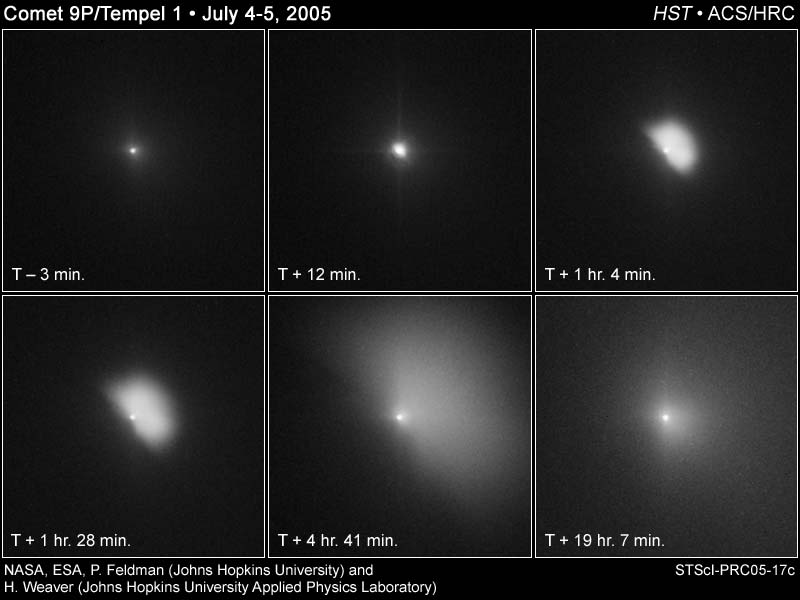
It was a human-made event visible across the Solar System. At the direction of terrestrial scientists, a refrigerator-sized probe from the Deep Impact mission struck Comet Tempel 1 on July 4 at over 35,000 kilometers per hour. The unexpectedly bright explosion was not nuclear but rather originated from a large plume that reflected back sunlight. Pictured above is how the event looked to the Earth-orbiting Hubble Space Telescope. A large cloud of bright material is seen emanating from the comet's nucleus and then dispersing. The area encompassing the comet became over two times brighter in the hours after the impact. Astronomers will continue to study the images and data returned by Deep Impact to better determine the nature of Comet Tempel 1 and discern clues about the formation dynamics of the early Solar System. Norwegian APOD mirror now available
Fue un evento creado por el ser humano visible en todo el Sistema Solar. Bajo la dirección de científicos terrestres, una sonda del tamaño de un refrigerador de la misión Deep Impact colisionó con el Cometa Tempel 1 el 4 de julio a más de 35.000 kilómetros por hora. La explosión inesperadamente brillante no fue nuclear, sino que se originó a partir de una gran columna que reflejaba la luz solar. En la imagen superior se muestra cómo el evento se veía desde el Telescopio Espacial Hubble en órbita terrestre. Se observa una gran nube de material brillante emanando del núcleo del cometa y dispersándose posteriormente. El área que abarcaba el cometa se volvió más de dos veces más brillante en las horas posteriores al impacto. Los astrónomos continuarán estudiando las imágenes y datos devueltos por Deep Impact para determinar mejor la naturaleza del Cometa Tempel 1 y discernir pistas sobre la dinámica de formación del Sistema Solar primitivo.