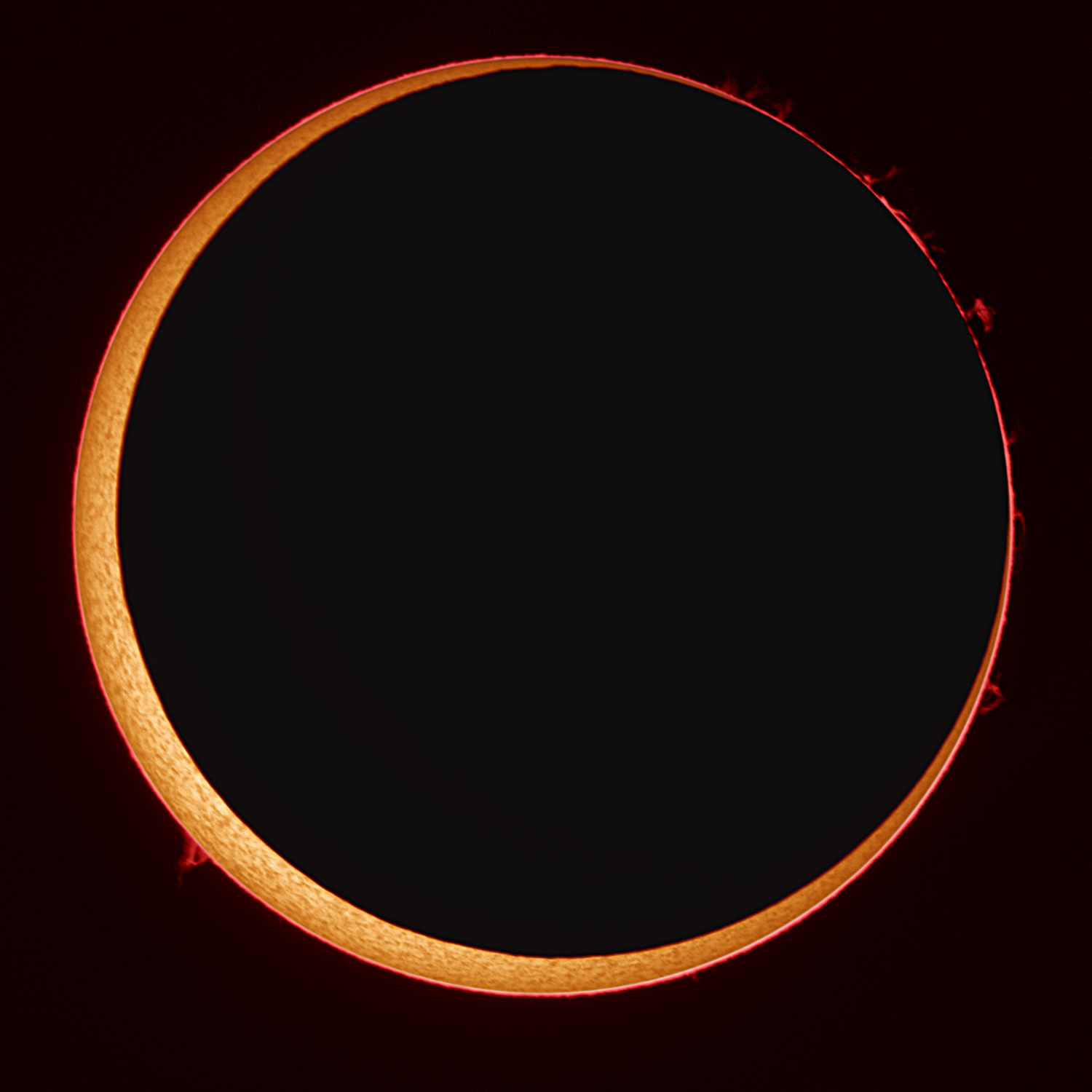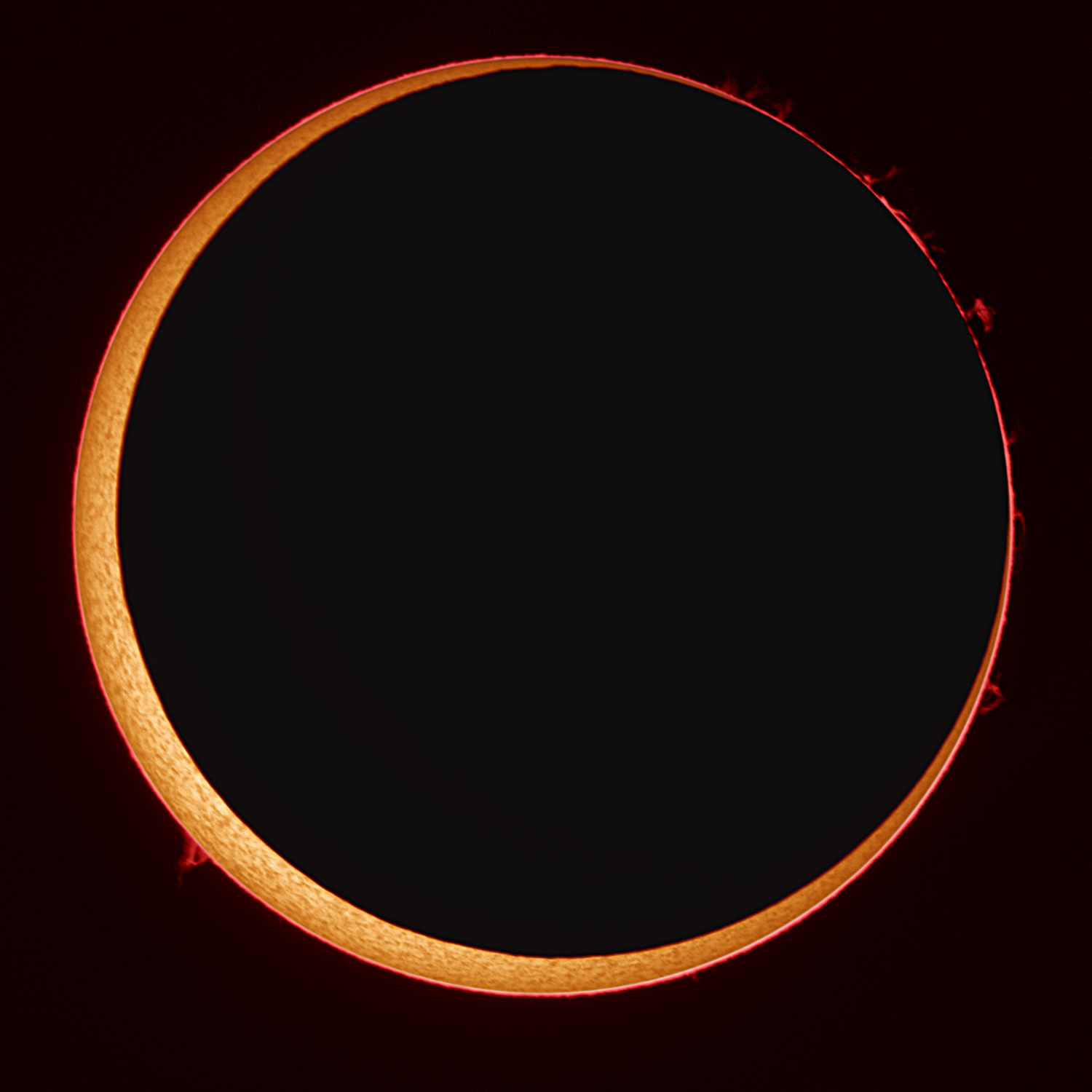
On Monday, part of the Sun went missing. The missing piece was no cause for concern -- the Moon was only momentarily in the way. The event was not a total eclipse of the Sun for any Earth-bound sky enthusiast but rather, at best, an annular eclipse, where the Moon blocked most of the Sun. Because of the relatively large distance to the Moon during this Earth-Moon-Sun alignment, the Moon did not have a large enough angular size to block the entire Sun. Those who witnessed the solar eclipse from a narrow path through Portugal, Spain and Africa, however, were lucky enough to see the coveted Ring of Fire, a dark Moon completely surrounded by the brilliant light of the distant Sun. Pictured above is a Ring of Fire captured two days ago in unusually high resolution above Spain. The resulting image shows details of the granular solar surface as well as many prominences around the Sun.
El lunes, una parte del Sol desapareció. La pieza faltante no fue motivo de preocupación: la Luna solo se interpuso momentáneamente. El evento no fue un eclipse total del Sol para ningún entusiasta del cielo en la Tierra, sino más bien un eclipse anular, donde la Luna bloqueó la mayor parte del Sol. Debido a la distancia relativamente grande a la Luna durante este alineamiento Tierra-Luna-Sol, la Luna no tenía un tamaño angular lo suficientemente grande para bloquear completamente el Sol. Sin embargo, quienes presenciaron el eclipse solar desde una estrecha franja que atravesaba Portugal, España y África tuvieron la suerte de ver el anillo de fuego codiciado: la Luna completamente oscura rodeada por la luz brillante del Sol distante. La imagen anterior muestra un anillo de fuego capturado hace dos días en resolución inusualmente alta por encima de España. La imagen resultante muestra detalles de la superficie solar granular así como muchas prominencias alrededor del Sol.