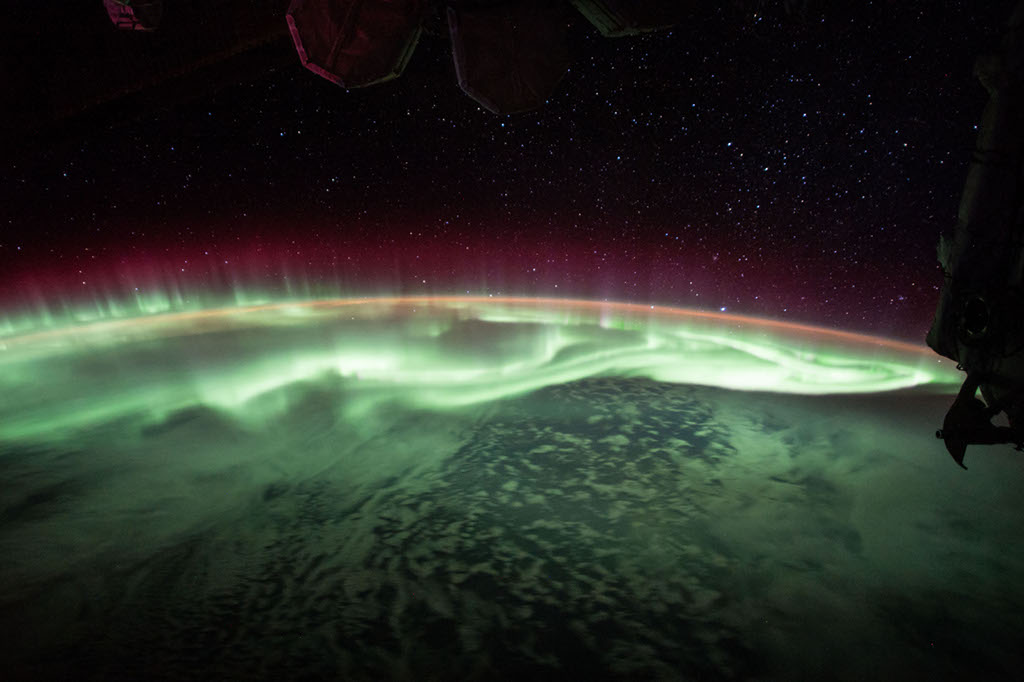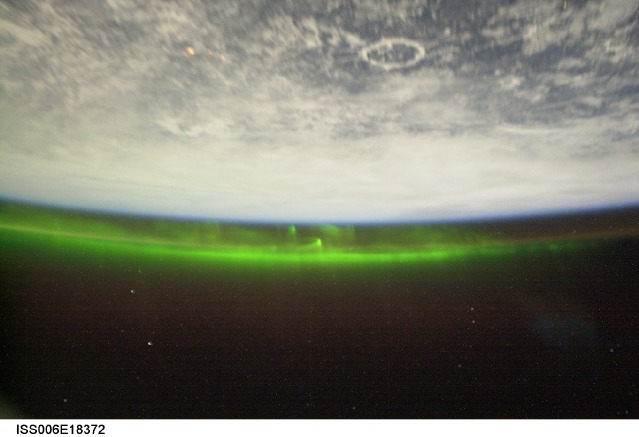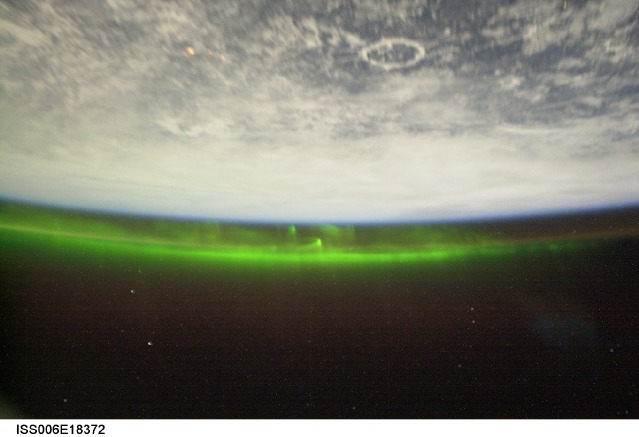
From the ground, spectacular auroras seem to dance high above. But the International Space Station (ISS) orbits at nearly the same height as many auroras, sometimes passing over them, and sometimes right through them. Still, the auroral electron and proton streams pose no direct danger to the ISS. In 2003, ISS Science Officer Don Pettit captured the green aurora, pictured above in a digitally sharpened image. From orbit, Pettit reported that changing auroras appeared to crawl around like giant green amoebas. Over 300 kilometers below, the Manicouagan Impact Crater can be seen in northern Canada, planet Earth.
Desde la superficie terrestre, las auroras especulares parecen danzar muy por encima de nuestras cabezas. Sin embargo, la Estación Espacial Internacional (EEI) orbita a una altura muy similar a la de muchas auroras, a veces pasando sobre ellas e incluso atravesándolas. No obstante, las corrientes de electrones y protones aurorales no representan un peligro directo para la EEI. En 2003, Don Pettit, oficial científico de la EEI, capturó la aurora verde que se muestra arriba en una imagen digitalmente mejorada. Desde la órbita, Pettit informó que las auroras en cambio parecían arrastrarse como amebas verdes gigantes. A más de 300 kilómetros por debajo, se puede observar el Cráter de Impacto Manicouagan en el norte de Canadá, planeta Tierra.