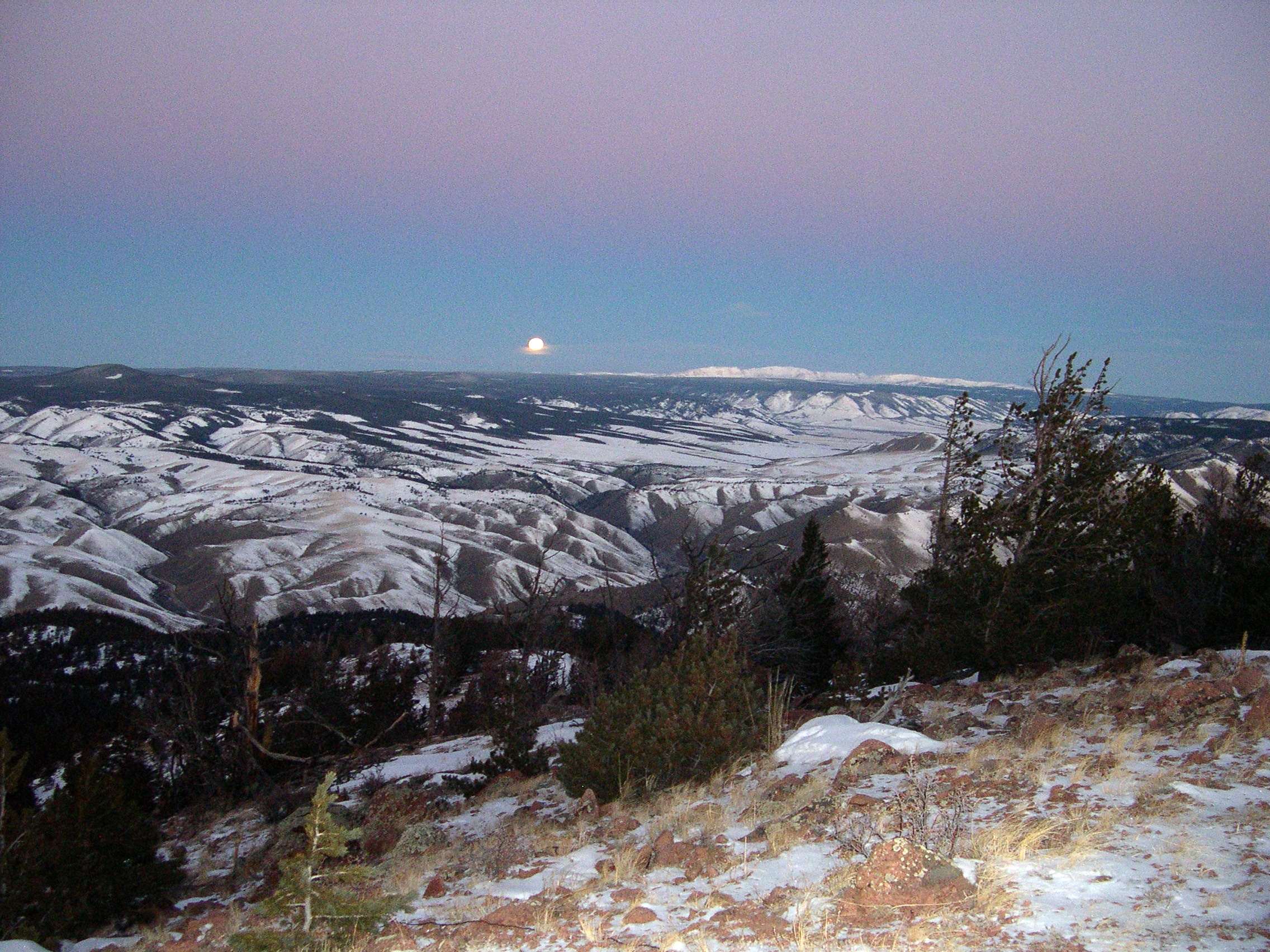
A nearly full Moon and planet Earth's shadow set together in this scene captured on January 13th from snowy Mt. Jelm, home of the Wyoming Infrared Observatory. For early morning risers (and late to bed astronomers), shadow set in the western sky is a daily apparition whose subtle beauty is often overlooked in favor of the more colorful eastern horizon. Extending through the dense atmosphere, Earth's setting shadow is seen in this picture as a dark blue band along the distant horizon, bounded above by a pinkish glow or antitwilight arch. Known as the Belt of Venus, the arch's lovely color is due to backscattering of reddened light from the rising Sun. The setting Moon's light is also reddened by the long sight-line through the atmosphere.
Una Luna casi llena y la sombra de la Tierra se ponen juntas en esta escena capturada el 13 de enero desde la nevada montaña Jelm, hogar del Observatorio Infrarrojo de Wyoming. Para los madrugadores (y astrónomos que se acuestan tarde), la puesta de sombra en el cielo occidental es un fenómeno diario cuya belleza sutil a menudo se pasa por alto en favor del horizonte oriental más colorido. Extendiéndose a través de la densa atmósfera, la sombra que se pone en la Tierra se ve en esta imagen como una banda azul oscuro a lo largo del horizonte distante, limitada arriba por un brillo rosáceo o arco anticrepuscular. Conocido como el Cinturón de Venus, el color encantador del arco se debe a la dispersión hacia atrás de la luz enrojecida del Sol naciente. La luz de la Luna que se pone también se ve enrojecida por la larga línea de vista a través de la atmósfera.