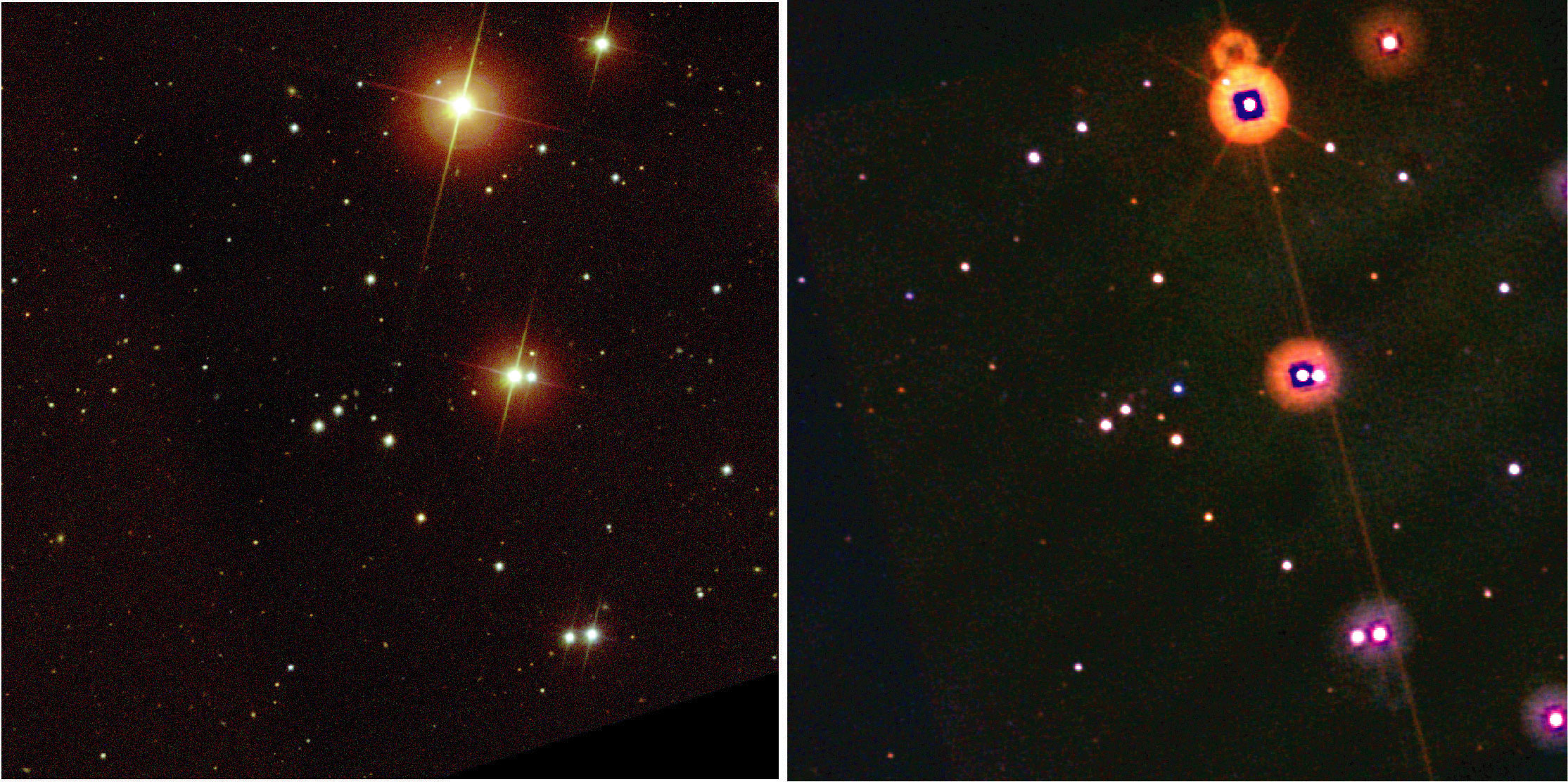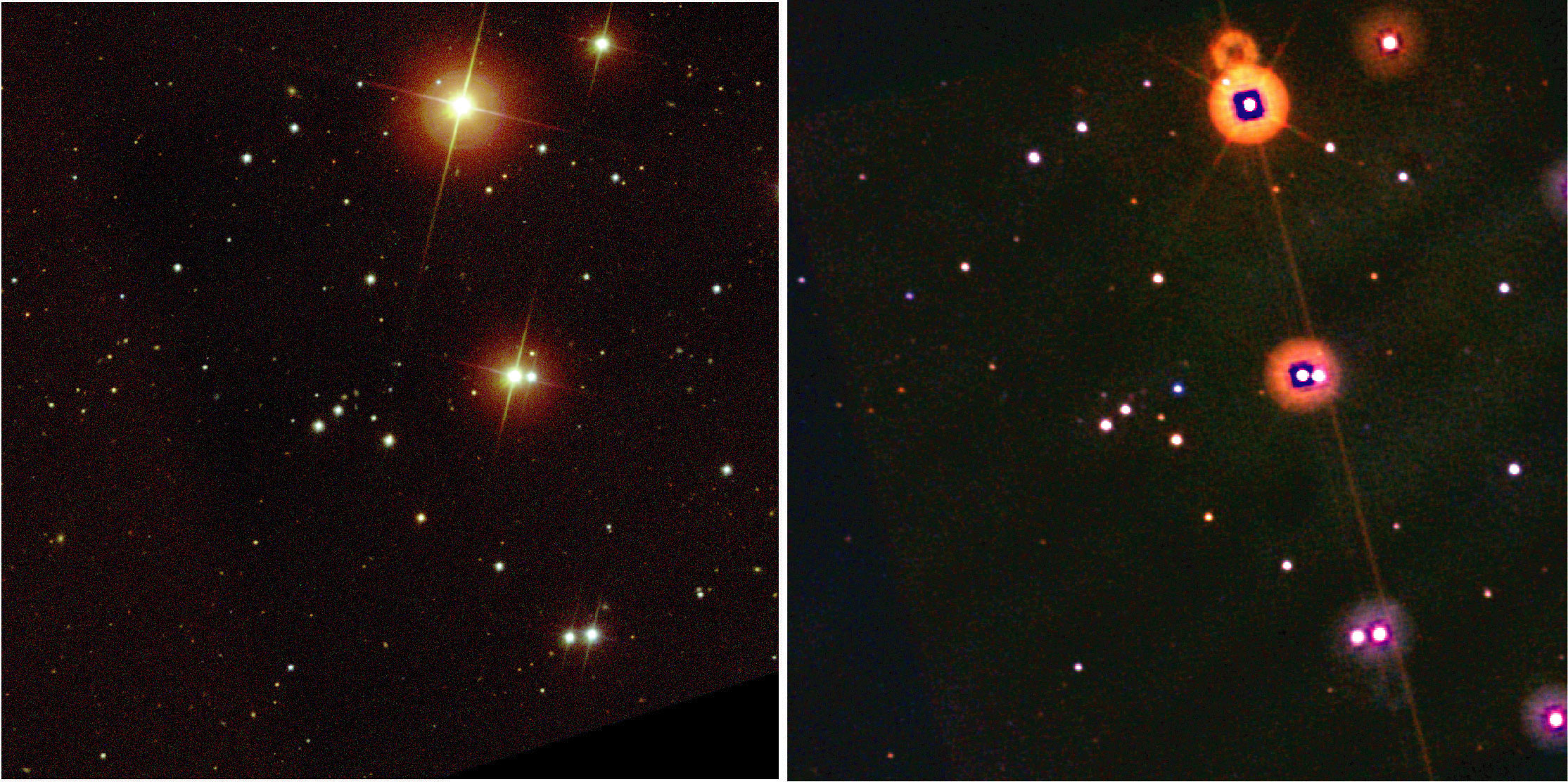
What is it? Something is happening in a small portion of the sky toward the constellation of Aries. Telescopes around the globe are tracking an unusual transient there as it changes day by day. No one is sure what it will do next. The entire space mystery began on February 18 when the Earth-orbiting robot Swift satellite noticed an unusual transient began to glow dimly in gamma rays. Dubbed GRB 060218, the object is a type of gamma ray burst (GRB) but the way its brightness changes is very unusual. Since detection, GRB 060218 has been found to emit light across the electromagnetic spectrum, including radio waves and visible light. Pictured above, the Sloan Digital Sky Survey (SDSS) image of the field of GRB 060218 well prior to its Swift trigger is shown on the left, while the same field, taken by the orbiting Swift satellites' ultraviolet telescope after the Swift trigger, is shown on the right. The oddball GRB is visible in the center of the right image. Subsequent observations found a redshift for the transient of z=0.033, showing it to be only about 440 million light years away, relatively nearby compared to typical GRBs. Whether GRB 060218 represents a new type of gamma ray burst, a new type of supernova, or an unusual link between the GRBs and supernovas has become an instant topic of research.
¿Qué es? Algo está ocurriendo en una pequeña porción del cielo hacia la constelación de Aries. Los telescopios de todo el mundo están rastreando un transiente inusual allí mientras cambia día a día. Nadie está seguro de qué hará a continuación. Todo el misterio espacial comenzó el 18 de febrero cuando el satélite robótico Swift, en órbita alrededor de la Tierra, detectó un transiente inusual que comenzó a brillar débilmente en rayos gamma. Designado como GRB 060218, el objeto es un tipo de explosión de rayos gamma (GRB), pero la forma en que cambia su brillo es muy inusual. Desde su detección, se ha encontrado que GRB 060218 emite luz en todo el espectro electromagnético, incluyendo ondas de radio y luz visible. En la imagen anterior, se muestra la imagen del Sloan Digital Sky Survey (SDSS) del campo de GRB 060218 bien antes de su activación por Swift en la izquierda, mientras que el mismo campo, capturado por el telescopio ultravioleta del satélite Swift en órbita después de la activación de Swift, se muestra en la derecha. El extraño GRB es visible en el centro de la imagen derecha. Las observaciones posteriores encontraron un corrimiento al rojo para el transiente de z=0,033, mostrando que está a solo unos 440 millones de años luz de distancia, relativamente cercano en comparación con los GRBs típicos. Si GRB 060218 representa un nuevo tipo de explosión de rayos gamma, un nuevo tipo de supernova, o un vínculo inusual entre los GRBs y las supernovas se ha convertido en un tema de investigación instantáneo.