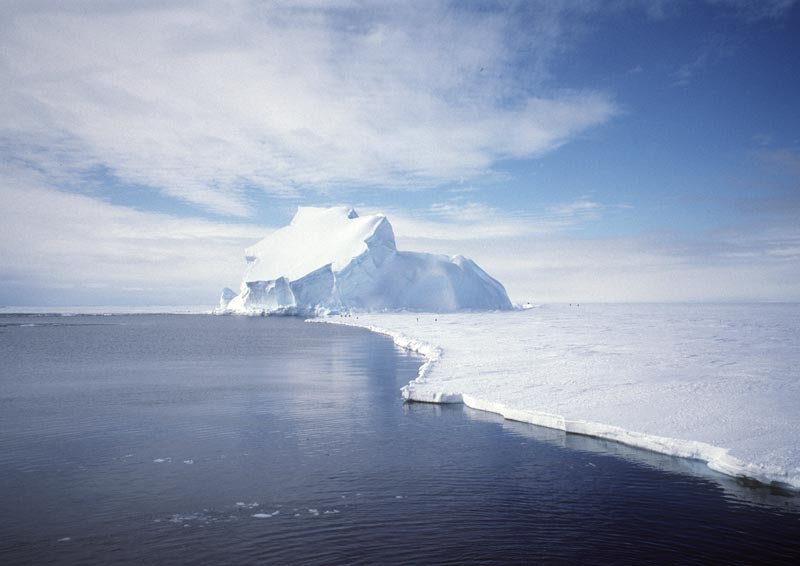
Is the continent at the end of the Earth slowly melting? For millions of years, Antarctica, the frozen continent at the southern end of planet Earth, has been encased in a gigantic sheet of ice. Recently, the orbiting robotic GRACE satellite has been taking sensitive measurements of the gravity for the entire Earth, including Antarctica. Recent analysis of Gravity Recovery and Climate Experiment (GRACE) data indicate that the Antarctic ice sheet might have lost enough mass to cause the worlds' oceans to rise about 1.2 millimeters, on the average, from between 2002 and 2005. Although this may not seem like much, the equivalent amount of water is about 150 trillion liters, equivalent to the amount of water used by US residents in three months. Uncertainties in the measurement make the mass loss uncertain by about 80 trillion liters. Pictured above is an iceberg that is a small part of the Antarctic ice sheet. The picture was taken on the Riiser-Larsen ice shelf in December 1995. Future research will likely focus on trying to better understand the data, take more data, predict future trends, and understand possible effects of these trends on the future climate of our entire home planet.
¿Se está fundiendo lentamente el continente al final de la Tierra? Durante millones de años, la Antártida, el continente helado en el extremo sur del planeta Tierra, ha estado cubierto por una gigantesca capa de hielo. Recientemente, el satélite robótico orbital GRACE ha estado realizando mediciones sensibles de la gravedad de toda la Tierra, incluida la Antártida. Los análisis recientes de datos del Experimento de Recuperación de la Gravedad y Clima (GRACE) indican que la capa de hielo antártica podría haber perdido suficiente masa para causar que los océanos del mundo se eleven aproximadamente 1,2 milímetros, en promedio, entre 2002 y 2005. Aunque esto podría no parecer mucho, la cantidad equivalente de agua es aproximadamente 150 billones de litros, equivalente a la cantidad de agua utilizada por los residentes estadounidenses en tres meses. Las incertidumbres en la medición hacen que la pérdida de masa sea incierta en aproximadamente 80 billones de litros. La imagen anterior muestra un iceberg que es una pequeña parte de la capa de hielo antártica. La fotografía fue tomada en la plataforma de hielo Riiser-Larsen en diciembre de 1995. La investigación futura probablemente se enfocará en tratar de comprender mejor los datos, recopilar más datos, predecir tendencias futuras y comprender los posibles efectos de estas tendencias en el clima futuro de nuestro planeta hogar.