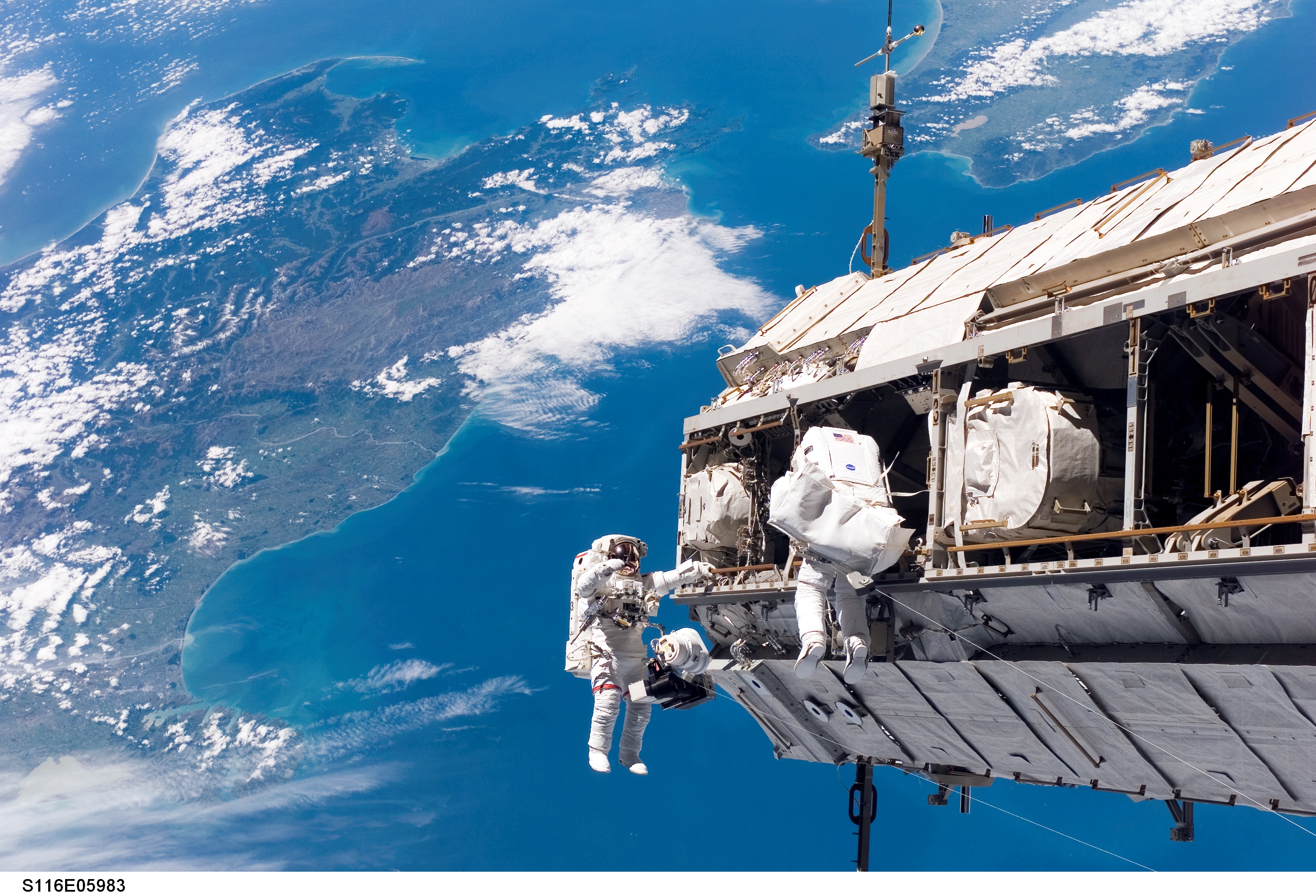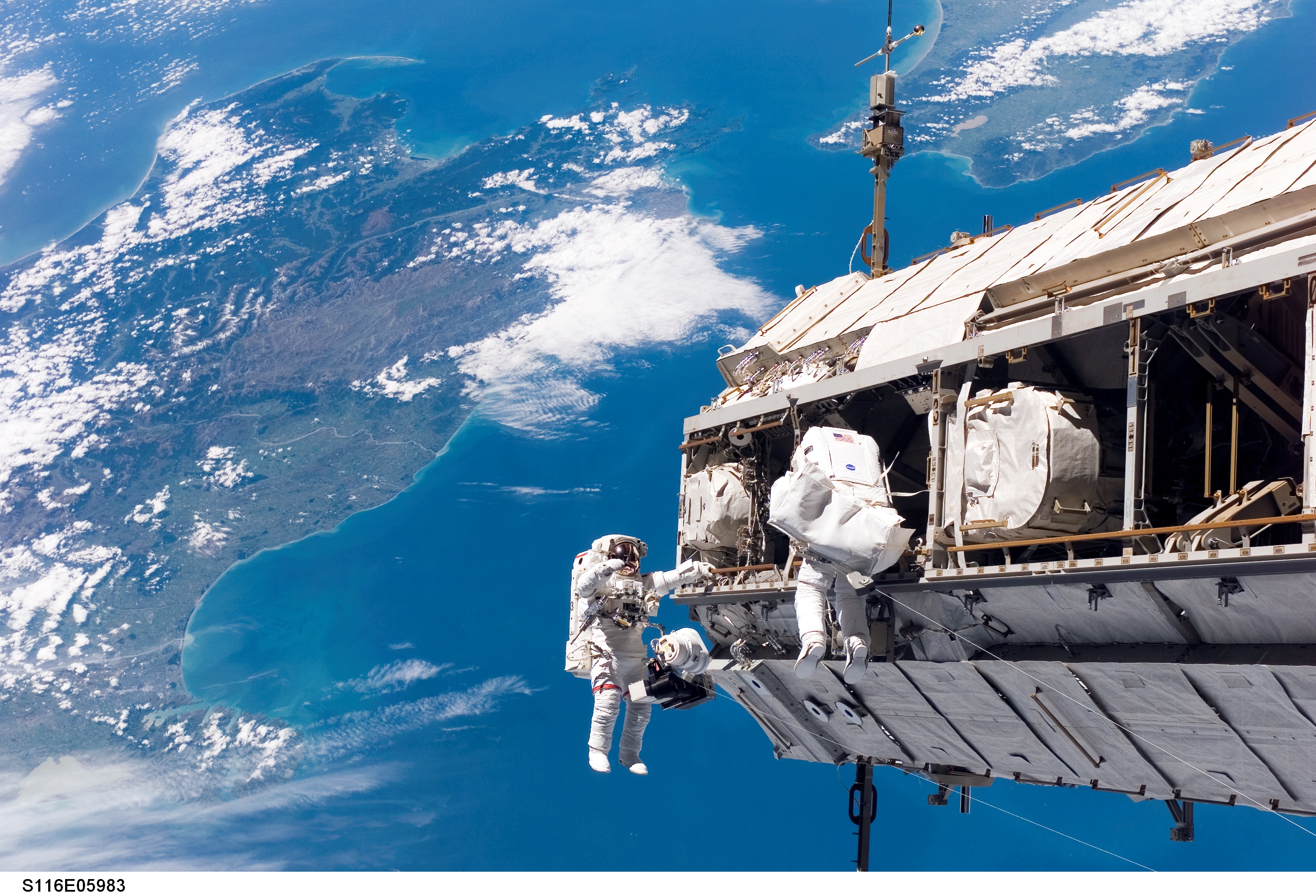
The International Space Station (ISS) will be the largest human-made object ever to orbit the Earth. The station is so large that it could not be launched all at once -- it is being built piecemeal with large sections added continually by flights of the Space Shuttle. To function, the ISS needs trusses to keep it rigid and to route electricity and liquid coolants. These trusses are huge, extending over 15 meters long, and with masses over 10,000 kilograms. Pictured above earlier this month, astronauts Robert L. Curbeam (USA) and Christer Fuglesang (Sweden) work to attach a new truss segment to the ISS and begin to upgrade the power grid.
La Estación Espacial Internacional (ISS) será el objeto hecho por el hombre más grande jamás orbitado alrededor de la Tierra. La estación es tan grande que no podía ser lanzada de una sola vez; se está construyendo pieza por pieza, añadiendo continuamente grandes secciones mediante vuelos de la nave espacial transbordador espacial. Para funcionar, la ISS necesita estructuras de soporte para mantener su rigidez y para distribuir electricidad y líquidos refrigerantes. Estas estructuras son enormes, con más de 15 metros de longitud y con masas superiores a los 10.000 kilogramos. En la imagen de arriba, tomada hace unas semanas, los astronautas Robert L. Curbeam (EE.UU.) y Christer Fuglesang (Suecia) trabajan para unir un nuevo segmento estructural a la ISS y comenzar a modernizar la red de energía.