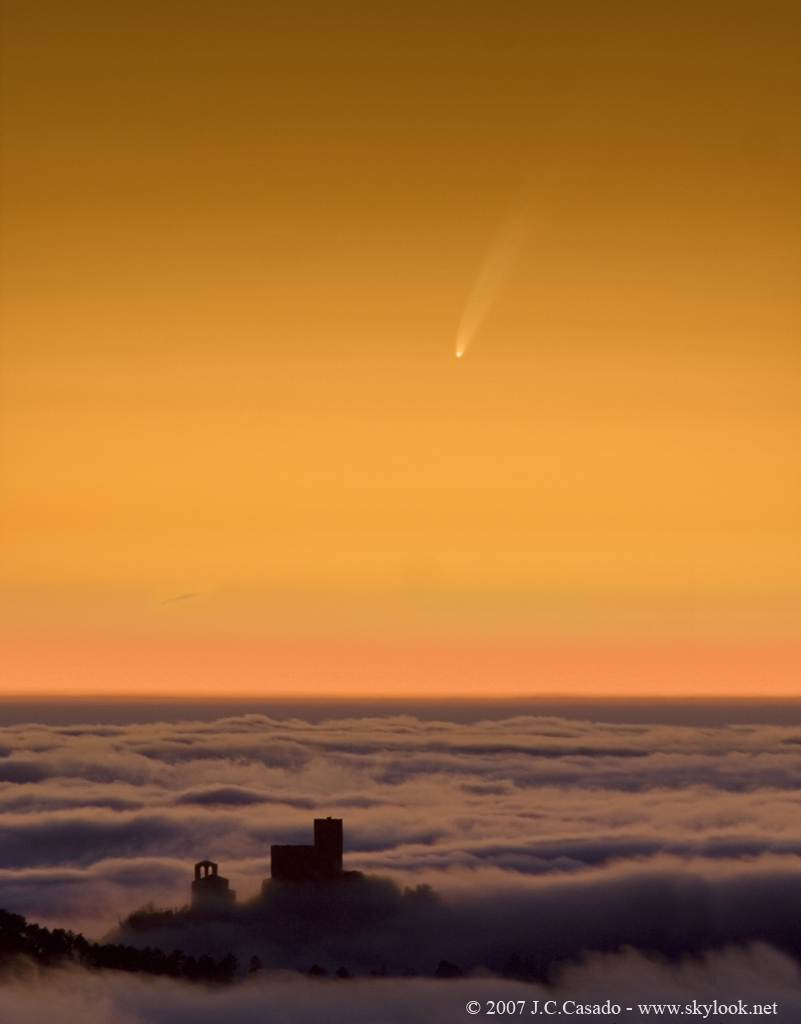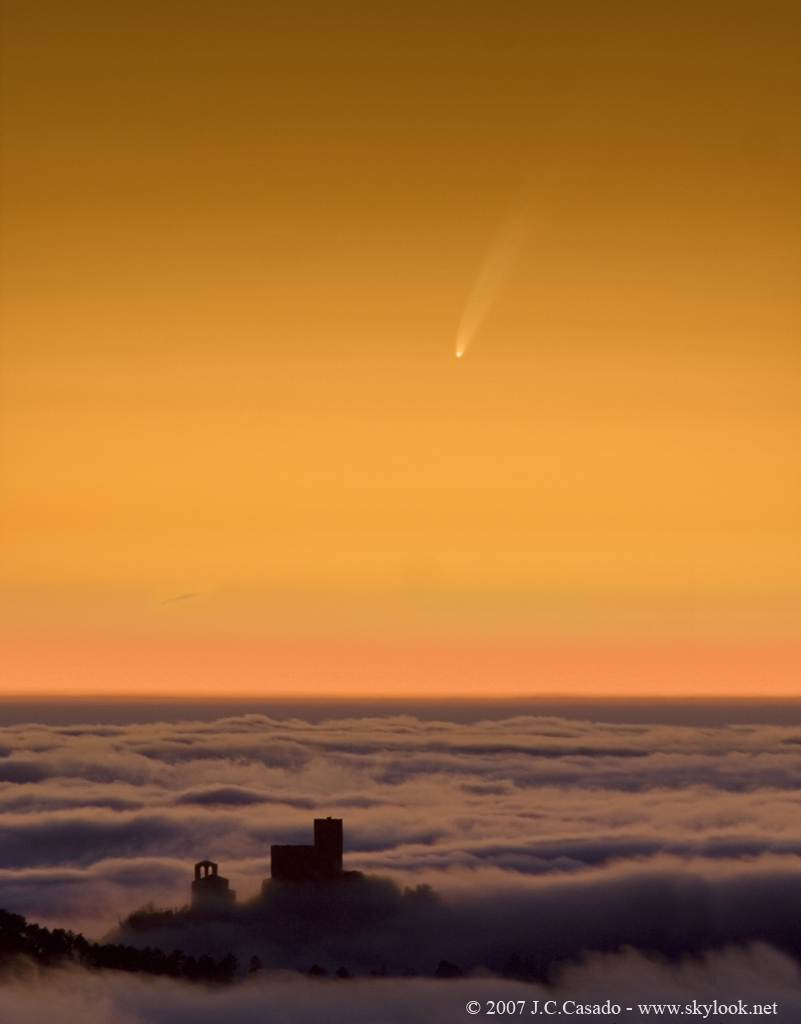
This past weekend Comet McNaught peaked at a brightness that surpassed even Venus. Fascinated sky enthusiasts in the Earth's northern hemisphere were treated to an instantly visible comet head and a faint elongated tail near sunrise and sunset. Recent brightness estimates had Comet McNaught brighter than magnitude -5 (minus five) over this past weekend, making it the brightest comet since Comet Ikeya-Seki in 1965, which was recorded at -7 (minus seven). The Great Comet of 2007 reached its brightest as it rounded the Sun well inside the orbit of Mercury. Over the next week Comet McNaught will begin to fade as it moves south and away from the Sun. The unexpectedly bright comet should remain visible to observers in the southern hemisphere with unaided eyes for the rest of January. The above image, vertically compressed, was taken at sunset last Friday from mountains above Catalonia, Spain.
Durante el fin de semana pasado, el Cometa McNaught alcanzó un brillo que superó incluso el de Venus. Los entusiastas del cielo en el hemisferio norte de la Tierra fueron tratados con la visión de una cabeza de cometa instantáneamente visible y una cola alargada y tenue cerca del amanecer y el atardecer. Las estimaciones recientes de brillo situaron al Cometa McNaught más brillante que la magnitud -5 (menos cinco) durante el fin de semana pasado, lo que lo convierte en el cometa más brillante desde el Cometa Ikeya-Seki en 1965, que fue registrado en -7 (menos siete). El Gran Cometa de 2007 alcanzó su máximo brillo cuando se acercó al Sol bien dentro de la órbita de Mercurio. Durante la próxima semana, el Cometa McNaught comenzará a desvanecerse mientras se desplaza hacia el sur y se aleja del Sol. El cometa inesperadamente brillante debería permanecer visible para los observadores en el hemisferio sur sin necesidad de instrumentos ópticos durante el resto de enero. La imagen anterior, comprimida verticalmente, fue capturada al atardecer el viernes pasado desde las montañas sobre Cataluña, España.