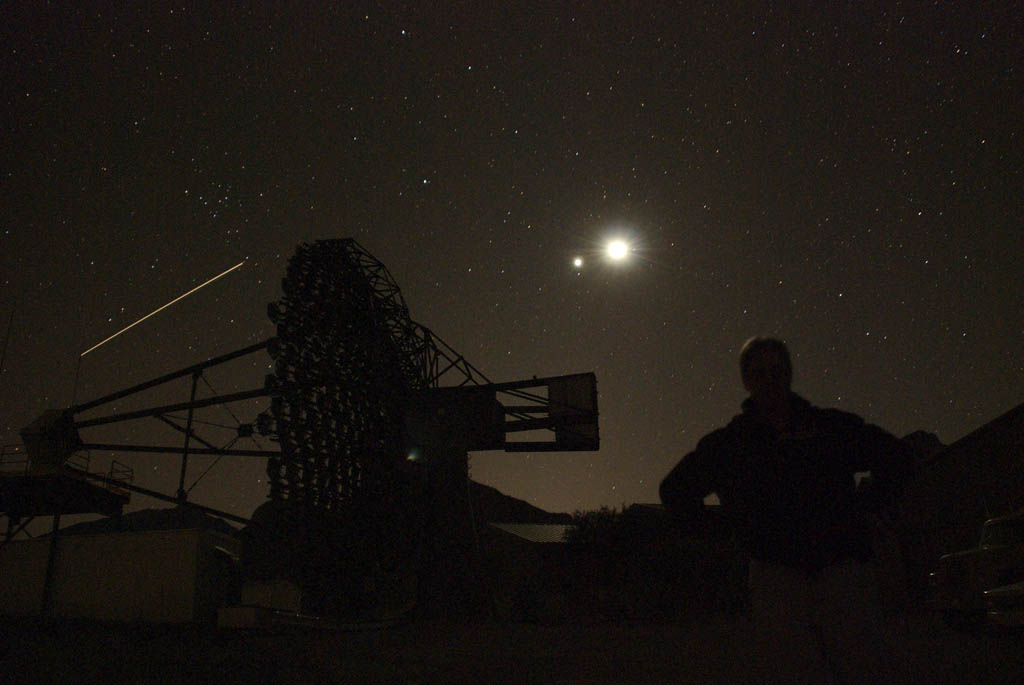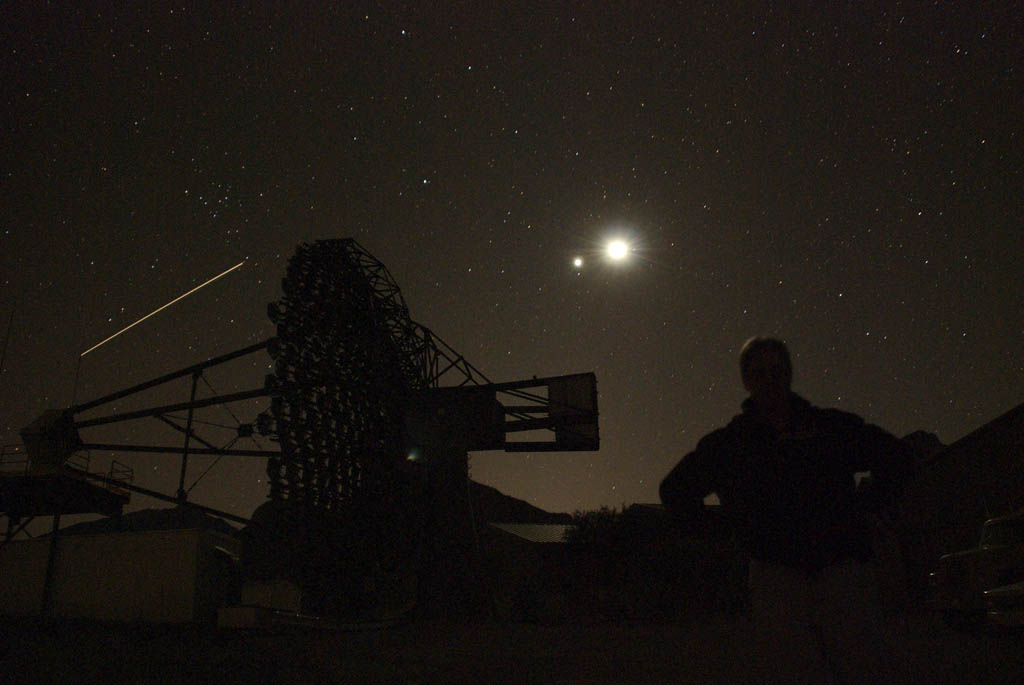
rly morning risers and late to bed astronomers have recently enjoyed bright planets in predawn skies, with brilliant Venus above the eastern horizon. On November 5, Venus was joined by the waning crescent Moon. This self-portrait by astronomer Larry Ciupik captures the lovely pairing of the two brightest celestial beacons on the scene, though the Moon, right of Venus, is strongly over exposed. Included at the far left in the 30 second exposure is the bright streak of the International Space Station still docked with shuttle orbiter Discovery. Together in Earth orbit, the spacefaring combination was momentarily the third brightest sky light in view. In dim silhouette, a multi-mirrored unit of the Very Energetic Radiation Imaging Telescope Array System (VERITAS) is also visible in the foreground. VERITAS operates at the Whipple Observatory near Tucson, Arizona to detect high-energy gamma-rays from the cosmos.
Los madrugadores y astrónomos nocturnos han disfrutado recientemente de planetas brillantes en los cielos previos al amanecer, con la brillante Venus por encima del horizonte oriental. El 5 de noviembre, Venus fue acompañada por la Luna en cuarto menguante. Este autorretrato del astrónomo Larry Ciupik captura el hermoso emparejamiento de los dos faros celestes más brillantes en la escena, aunque la Luna, a la derecha de Venus, está fuertemente sobreexpuesta. Incluida en el extremo izquierdo en la exposición de 30 segundos se encuentra la brillante estela de la Estación Espacial Internacional aún acoplada con el transbordador Discovery. Juntos en órbita terrestre, esta combinación de exploración espacial fue momentáneamente la tercera luz celeste más brillante en vista. En una silueta tenue, una unidad de espejos múltiples del Sistema de Conjunto de Telescopios de Imagen de Radiación Muy Energética (VERITAS) también es visible en el primer plano. VERITAS opera en el Observatorio Whipple cerca de Tucson, Arizona para detectar rayos gamma de alta energía provenientes del cosmos.