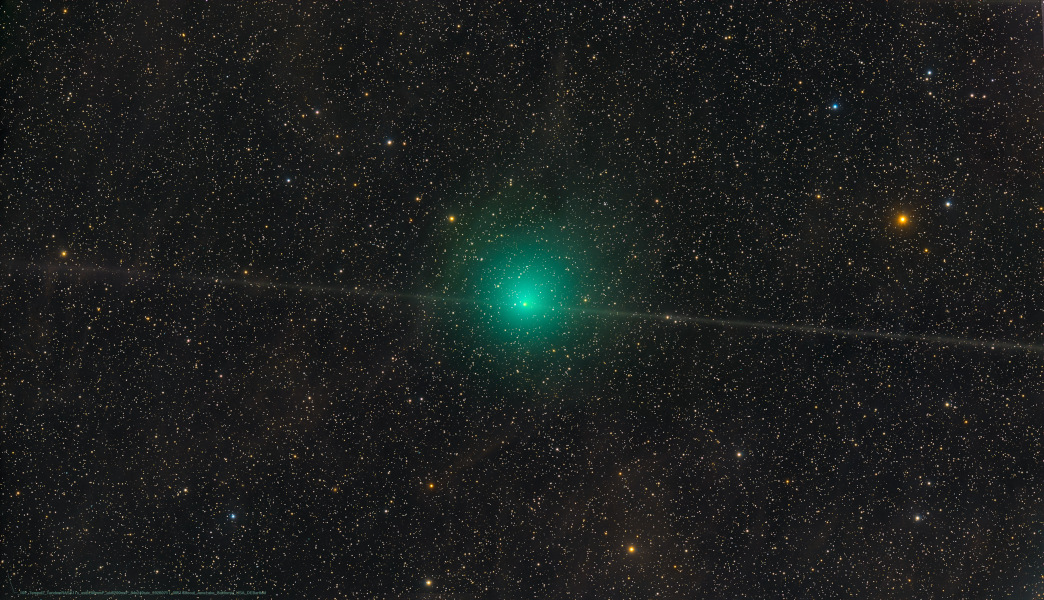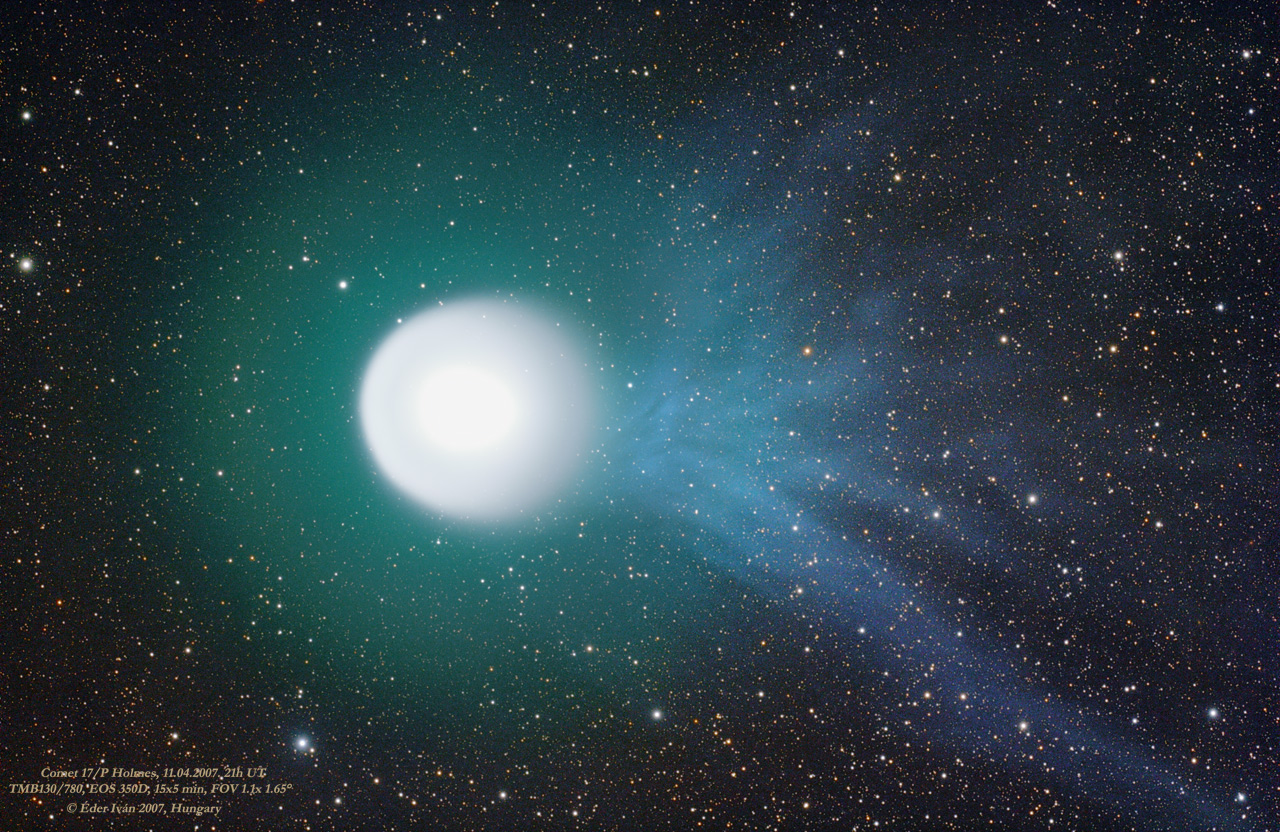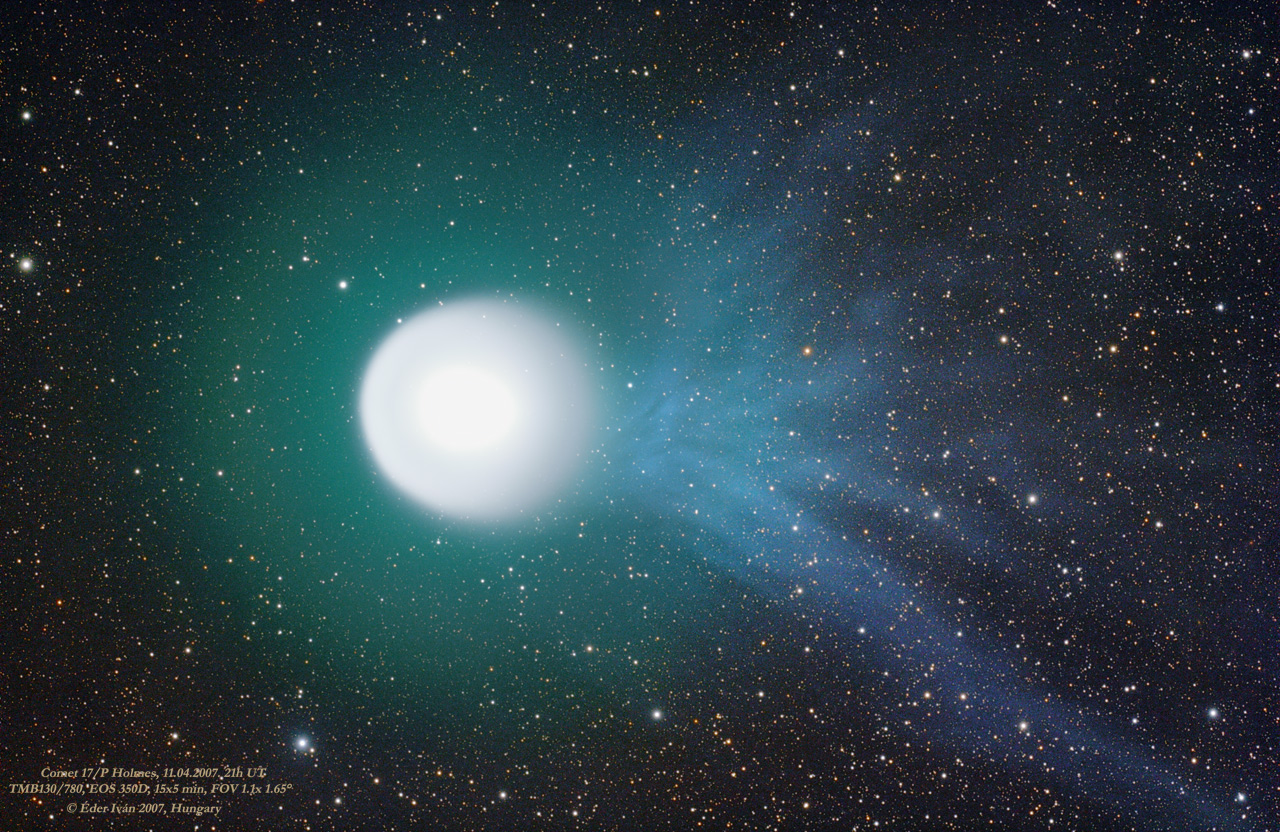
A beautiful blue ion tail has become visible in deep telescopic images of Comet Holmes. Pointing generally away from the Sun and also planet Earth, the comet's ion tail is seriously foreshortened by our extreme viewing angle. Still, enthusiastic comet watchers have remarked that on the whole, the compact but tentacled appearance suggests a jellyfish or even a cosmic calamari. This stunning view of the comet's greenish coma and blue tail was recorded on November 4 in clear skies near Budapest, Hungary. The colors are caused by molecules in the tenuous gas, like C2 (green) and CO+ (blue), fluorescing in sunlight. In a more recent development, the dramatic inset is a deep image from L'Aquila in central Italy on November 8, showing the ion tail disconnecting from the comet.
Una hermosa cola iónica azul se ha hecho visible en imágenes telescópicas profundas del Cometa Holmes. Apuntando generalmente hacia afuera del Sol y también del planeta Tierra, la cola iónica del cometa está seriamente acortada por nuestro ángulo de visión extremo. Sin embargo, los entusiastas observadores de cometas han señalado que, en general, su apariencia compacta pero con tentáculos sugiere una medusa o incluso un calamar cósmico. Esta vista impresionante de la coma verduzca del cometa y su cola azul fue registrada el 4 de noviembre en cielos despejados cerca de Budapest, Hungría. Los colores son causados por moléculas en el gas tenue, como C2 (verde) y CO+ (azul), fluoresciendo bajo la luz solar. En un desarrollo más reciente, la imagen profunda espectacular del recuadro fue tomada desde L'Aquila en Italia central el 8 de noviembre, mostrando la cola iónica desconectándose del cometa.