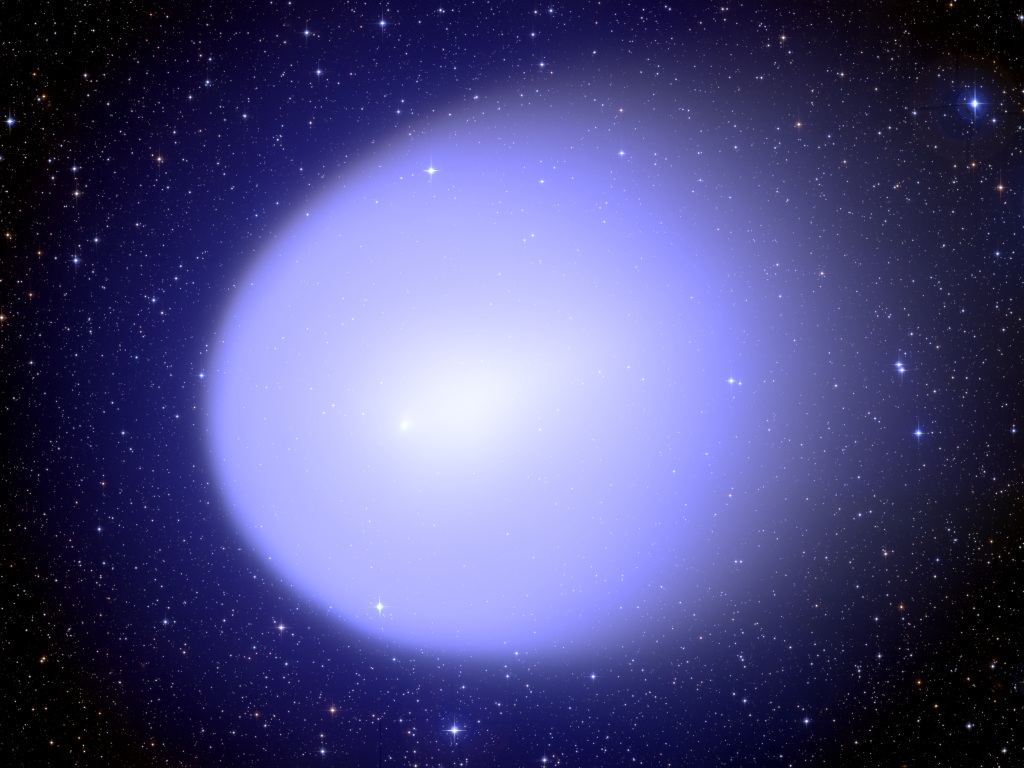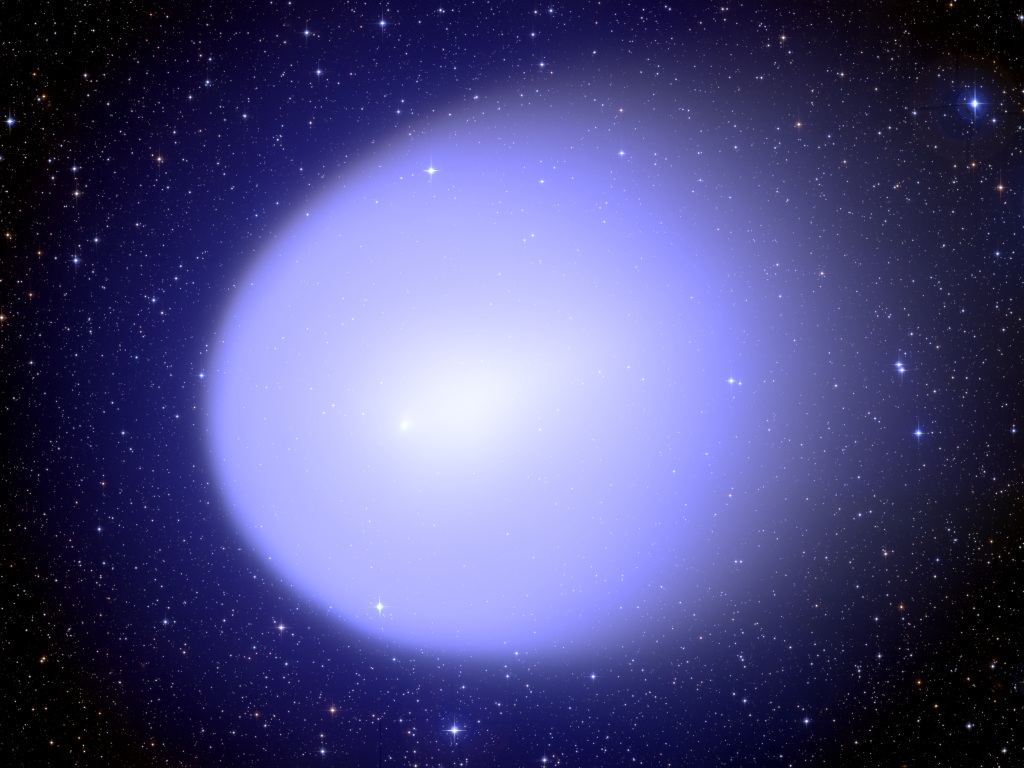
The spherical coma of Comet Holmes has swollen to a diameter of over 1.4 million kilometers, making the tenuous, dusty cloud even bigger than the Sun. Scattering sunlight, all that dust and gas came from the comet's remarkably active nucleus, whose diameter before the late October outburst was estimated to be a mere 3.4 kilometers. In this sharp image, recorded on November 14 with the Canada-France-Hawaii Telescope, stars are easily visible right through the outer coma, while the nucleus is buried inside the condensed, bright region. The bright region of the coma seems offset from the center, consistent with the idea that a large fragment drifted away from the nucleus and disintegrated, producing the comet's spectacular outburst. Of course, more recent images of Holmes also show the bright star Mirfak (Alpha Persei) shining through as the comet sweeps slowly through the constellation Perseus.
La coma esférica del Cometa Holmes se ha hinchado hasta un diámetro superior a 1,4 millones de kilómetros, haciendo que la nube tenue y polvorosa sea aún más grande que el Sol. Dispersando la luz solar, todo ese polvo y gas provinieron del núcleo notablemente activo del cometa, cuyo diámetro antes del estallido de finales de octubre se estimaba en apenas 3,4 kilómetros. En esta imagen nítida, registrada el 14 de noviembre con el Telescopio Canadiense-Francés-Hawaiano, las estrellas son fácilmente visibles a través de la coma exterior, mientras que el núcleo está enterrado en la región condensada y brillante. La región brillante de la coma parece estar desplazada del centro, lo que es consistente con la idea de que un fragmento grande se alejó del núcleo y se desintegró, produciendo el espectacular estallido del cometa. Por supuesto, imágenes más recientes de Holmes también muestran la brillante estrella Mirfak (Alfa Persei) brillando a través de la coma mientras el cometa se desplaza lentamente a través de la constelación de Perseo.