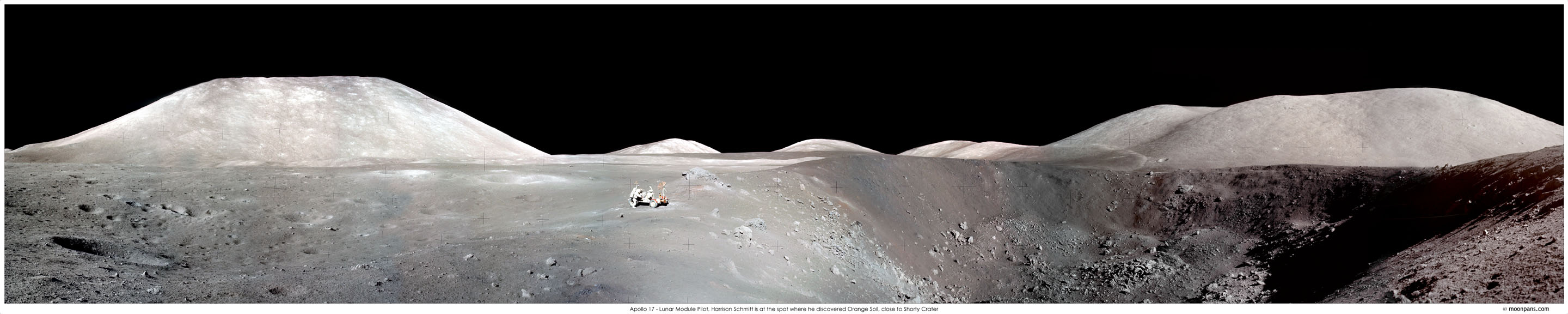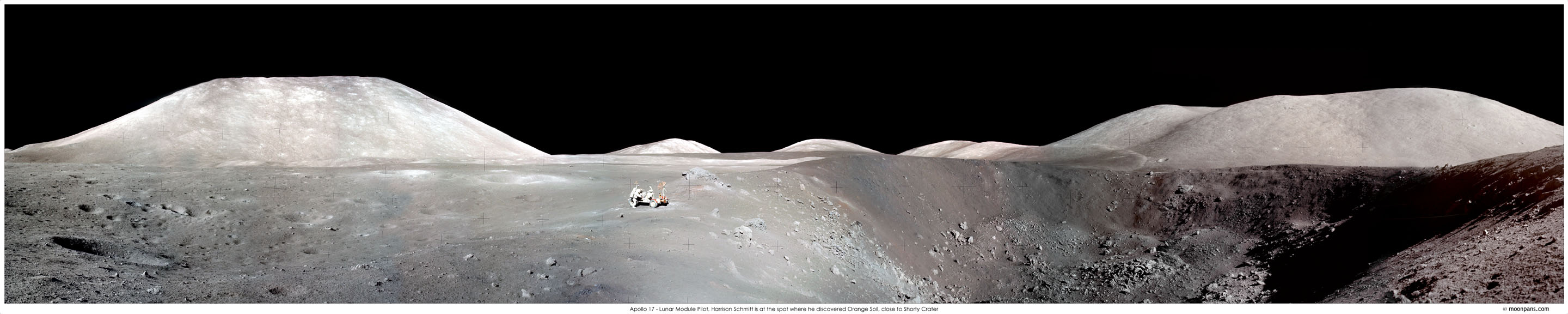
In December of 1972, Apollo 17 astronauts Eugene Cernan and Harrison Schmitt spent about 75 hours on the Moon in the Taurus-Littrow valley, while colleague Ronald Evans orbited overhead. This sharp panorama is digitally stitched together from pictures taken by Cernan as he and Schmitt roamed the valley floor. Starting with a view of the imposing South Massif, scrolling the panorama to the right will reveal Schmitt and the lunar rover at the edge of Shorty Crater, near the spot where geologist Schmitt discovered orange lunar soil. The Apollo 17 crew returned with 110 kilograms of rock and soil samples, more than was returned from any of the other lunar landing sites. Now thirty five years later, Cernan and Schmitt are still the last to walk on the Moon.
En diciembre de 1972, los astronautas del Apolo 17 Eugene Cernan y Harrison Schmitt pasaron aproximadamente 75 horas en la Luna en el valle de Taurus-Littrow, mientras que su colega Ronald Evans orbitaba por encima. Este panorama de gran nitidez fue ensamblado digitalmente a partir de imágenes tomadas por Cernan mientras él y Schmitt recorrían el piso del valle. Comenzando con una vista de la imponente Meseta Sur, al desplazarse el panorama hacia la derecha se revelará a Schmitt y el vehículo lunar en el borde del Cráter Shorty, cerca del lugar donde el geólogo Schmitt descubrió suelo lunar de color naranja. La tripulación del Apolo 17 regresó con 110 kilogramos de muestras de roca y suelo, más de lo que fue traído de cualquier otro sitio de alunizaje lunar. Treinta y cinco años después, Cernan y Schmitt siguen siendo los últimos en caminar sobre la Luna.