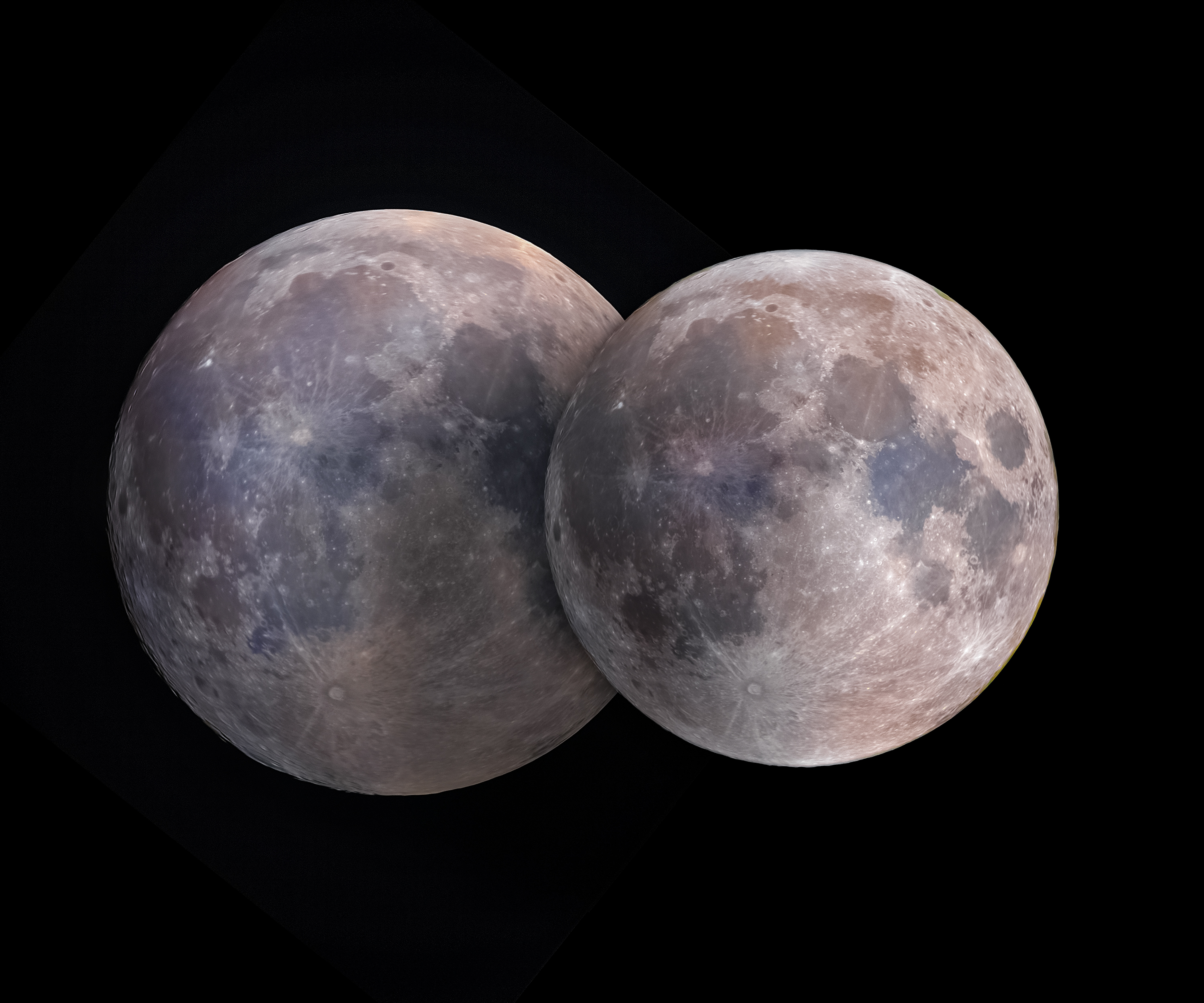
What is so micro about tonight's blue micromoon? Just after sunset, a full moon will appear slightly smaller and dimmer than usual. The reason is that the Moon's fully illuminated phase occurs within a short time of apogee - when the Moon is farthest from the Earth in its elliptical orbit. In fact, tonight's micromoon will be the farthest, smallest, and dimmest Moon this year. But tonight's micromoon is notable for yet another reason: it is also a blue moon, meaning that it is the second full moon in the same month (moon-th). Pictured here, a supermoon -- when the full moon appears near its largest -- is compared to a micromoon as photographed from Kolkata, India in May and December of 2021. Although the next micromoon occurs next month, and the next blue moon at the end of 2028, the next blue micromoon will not occur until 2053.
¿Qué tiene de especial la microluna azul de esta noche? Poco después del ocaso, la Luna llena aparecerá ligeramente más pequeña y tenue de lo habitual. La razón es que la fase de luna llena ocurre muy cerca del apogeo, el momento en que la Luna se encuentra más alejada de la Tierra en su órbita elíptica. De hecho, la microluna de esta noche será la más lejana, pequeña y tenue del año. Sin embargo, la microluna de esta noche es notable por otro motivo: también es una luna azul, es decir, la segunda luna llena del mismo mes (mes/moon). En la imagen, tomada desde Kolkata, India, en mayo y diciembre de 2021, se compara una superluna —cuando la luna llena aparece cerca de su tamaño máximo— con una microluna. Aunque la próxima microluna ocurrirá el mes que viene, y la próxima luna azul a finales de 2028, la siguiente luna azul y microluna coincidentes no se producirá hasta 2053.