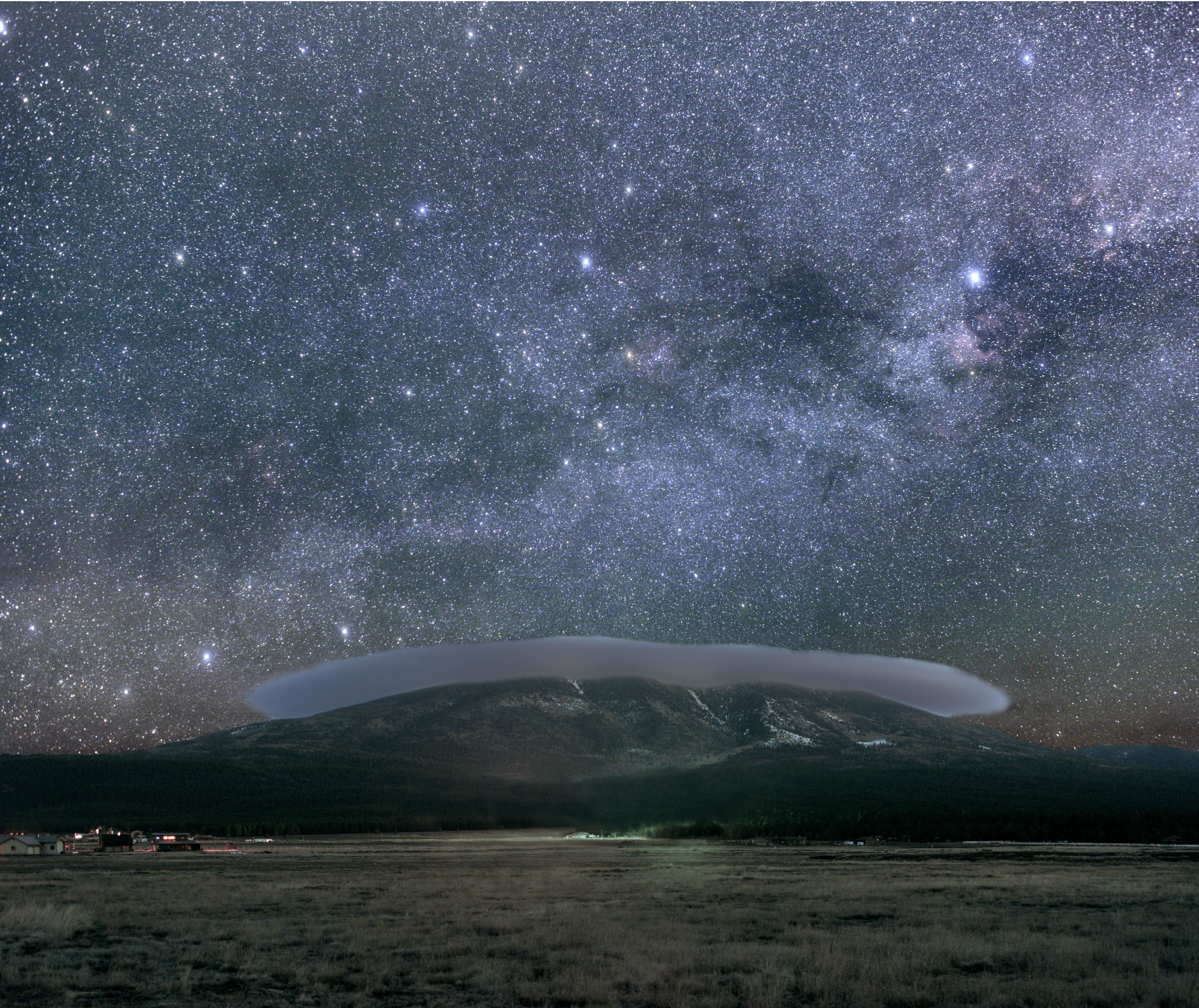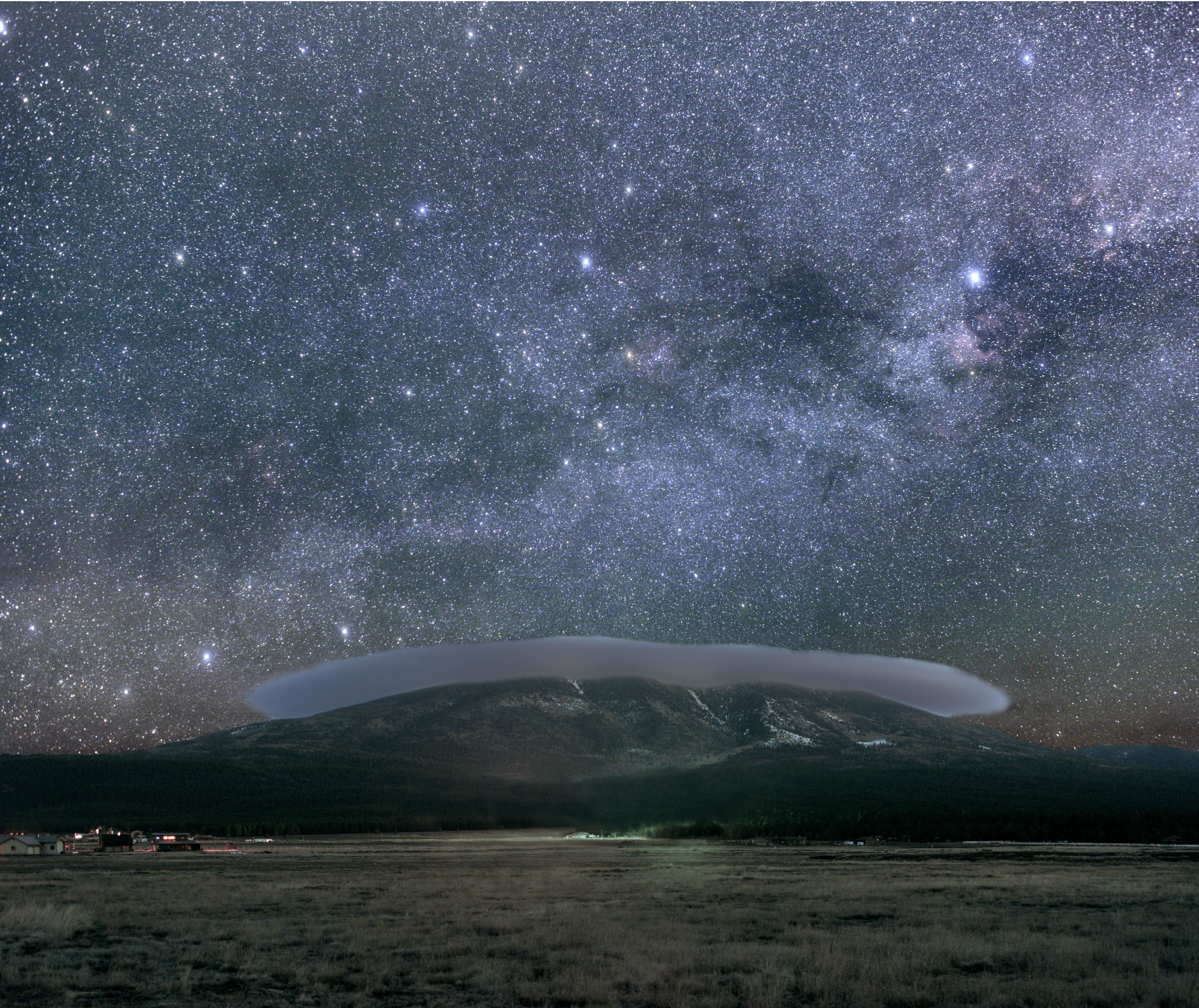
This sky is protected. Yesterday marked the 50 year anniversary of the first lighting ordinance ever enacted, which restricted searchlight advertisements from sweeping the night skies above Flagstaff, Arizona, USA. Flagstaff now enjoys the status of being the first International Dark Sky City, and maintains a lighting code that limits lights from polluting this majestic nighttime view. The current dark skies over Flagstaff not only enable local astronomers to decode the universe but allow local sky enthusiasts to see and enjoy a tapestry contemplated previously by every human generation. The above image, pointing just east of north, was taken two weeks ago at 3 am from Fort Valley, only 10 kilometers from central Flagstaff. Visible in the above spectacular panorama are the San Francisco Peaks caped by a lenticular cloud. Far in the distance, the plane of the Milky Way Galaxy arcs diagonally from the lower left to the upper right, highlighted by the constellations of Cassiopeia, Cepheus, and Cygnus. On the far right, the North America Nebula is visible just under the very bright star Deneb.
Este cielo está protegido. Ayer se conmemoró el 50 aniversario de la primera ordenanza de iluminación jamás promulgada, que restringía los anuncios con focos de búsqueda de barrer los cielos nocturnos sobre Flagstaff, Arizona, EE.UU. Flagstaff ahora disfruta del estatus de ser la primera Ciudad Internacional del Cielo Oscuro, y mantiene un código de iluminación que limita las luces de contaminar esta magnífica vista nocturna. Los cielos oscuros actuales sobre Flagstaff no solo permiten a los astrónomos locales descifrar el universo, sino que también permiten a los entusiastas del cielo local ver y disfrutar de un tapiz contemplado previamente por cada generación humana. La imagen anterior, apuntando justo al este del norte, fue tomada hace dos semanas a las 3 am desde Fort Valley, a solo 10 kilómetros del centro de Flagstaff. Visibles en el panorama espectacular anterior están los Picos de San Francisco coronados por una nube lenticular. A lo lejos, el plano de la Galaxia de la Vía Láctea se arquea diagonalmente de la esquina inferior izquierda a la superior derecha, destacado por las constelaciones de Casiopea, Cefeo y Cisne. En el extremo derecho, la Nebulosa de América del Norte es visible justo debajo de la estrella muy brillante Deneb.