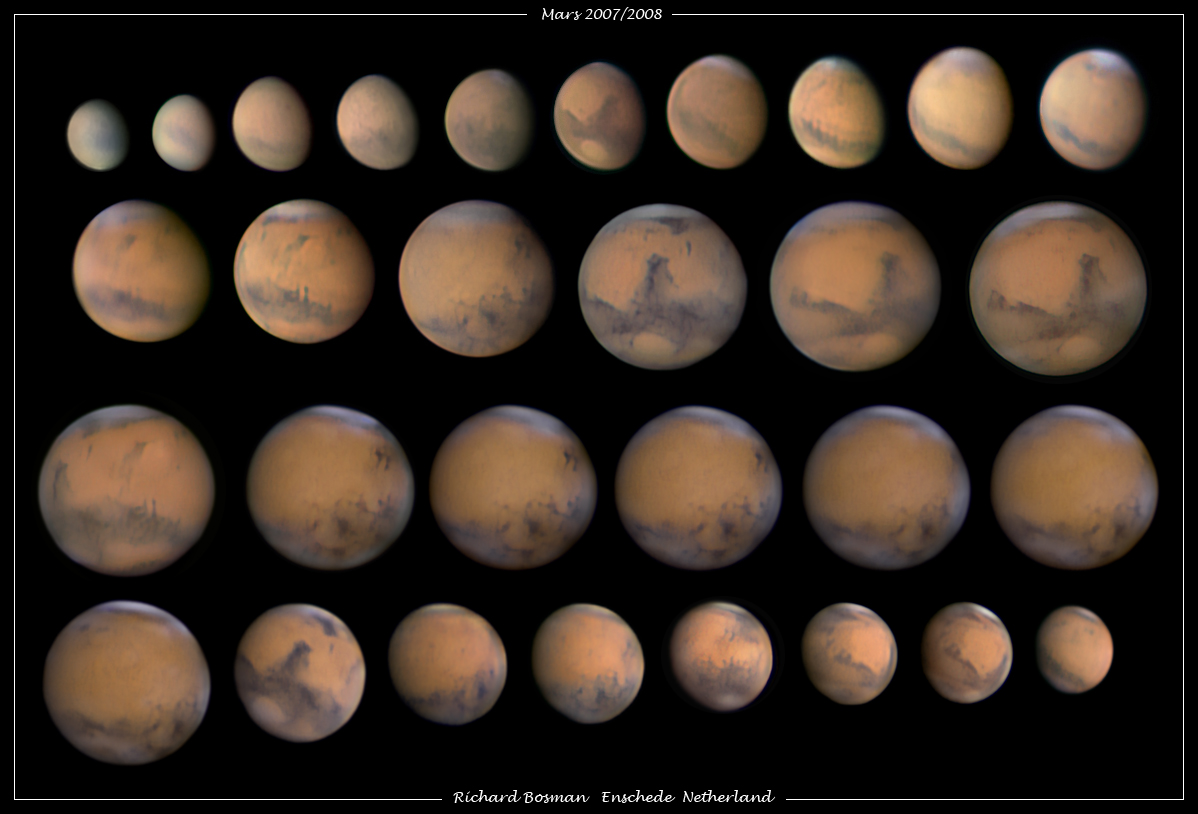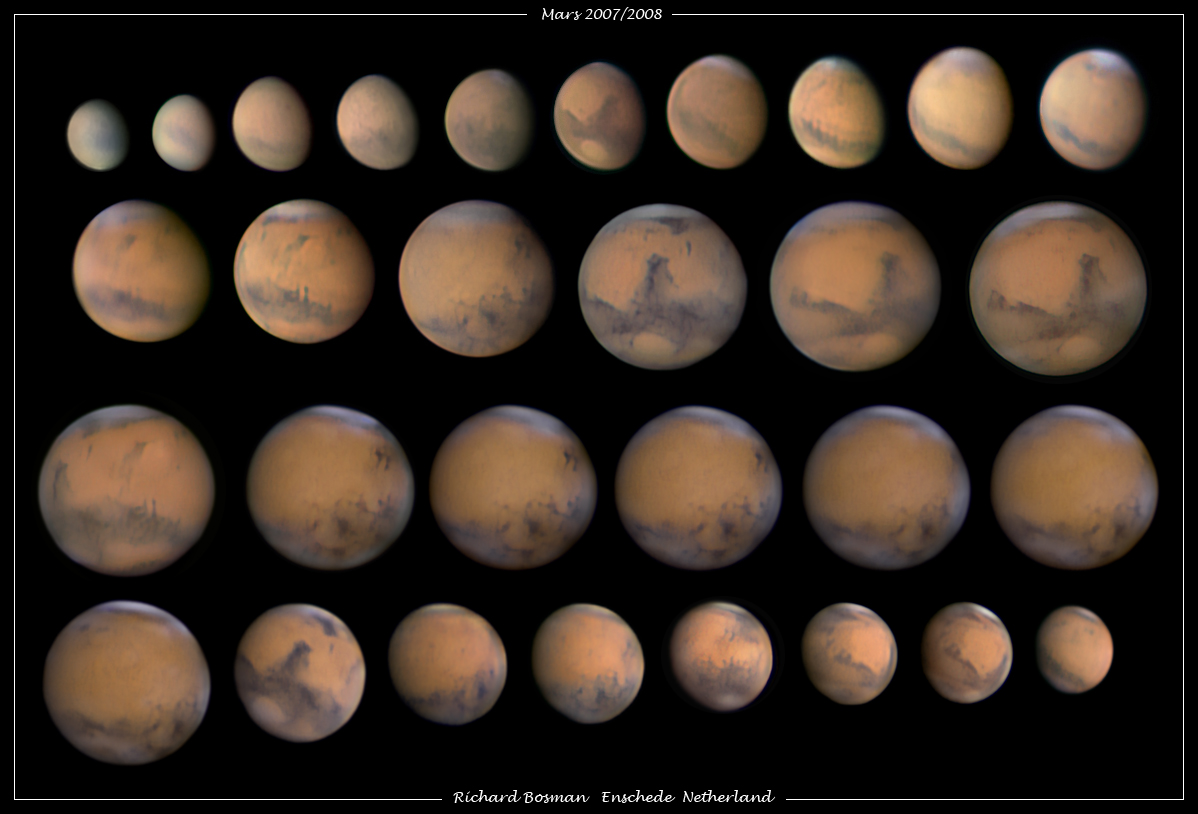
Does Mars always appear the same? No. As both Earth and Mars orbit the Sun, the apparent angular size of Mars changes as viewed from the Earth. Pictured above from Enschede, Holland, Mars was captured in 2007 and 2008 with 30 separate images, all taken with the same magnification. When Earth and Mars are on opposite sides of the Sun, Mars appears relatively small. Conversely, when Earth and Mars are near each other, Mars looms large and bright. The largest Mars has appeared in recent history was the opposition of August 2003. Since Mars is always more distant from the Sun than the Earth, Mars never shows a crescent phase to Earthlings. Visible also in the above images are the north polar cap of Mars, dark and light soil, clouds, and, in the early images, a global dust storm. The next opposition, when Earth again passes near to Mars, will occur in early 2010.
¿Marte siempre parece igual? No. Conforme tanto la Tierra como Marte orbitan alrededor del Sol, el tamaño angular aparente de Marte cambia cuando se observa desde la Tierra. En la imagen superior, capturada desde Enschede, Holanda, Marte fue fotografiado en 2007 y 2008 con 30 imágenes separadas, todas tomadas con el mismo aumento. Cuando la Tierra y Marte se encuentran en lados opuestos del Sol, Marte aparece relativamente pequeño. Por el contrario, cuando la Tierra y Marte están cerca uno del otro, Marte se ve grande y brillante. El tamaño más grande que Marte ha presentado en la historia reciente fue la oposición de agosto de 2003. Dado que Marte siempre está más distante del Sol que la Tierra, Marte nunca muestra una fase de cuarto creciente para los observadores terrestres. También visibles en las imágenes anteriores son la calota polar norte de Marte, suelo oscuro y claro, nubes y, en las imágenes iniciales, una tormenta de polvo global. La siguiente oposición, cuando la Tierra nuevamente pase cerca de Marte, ocurrirá a principios de 2010.