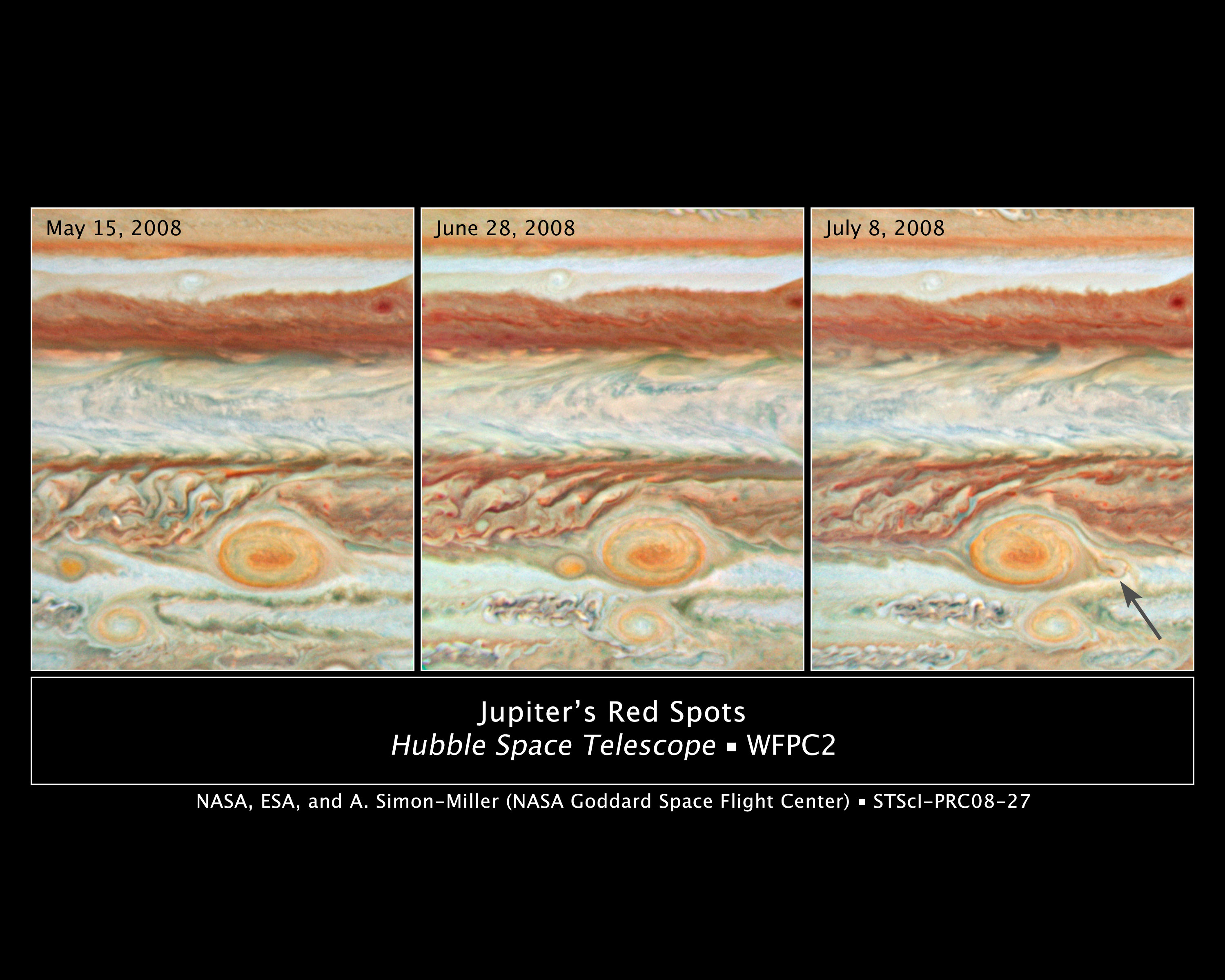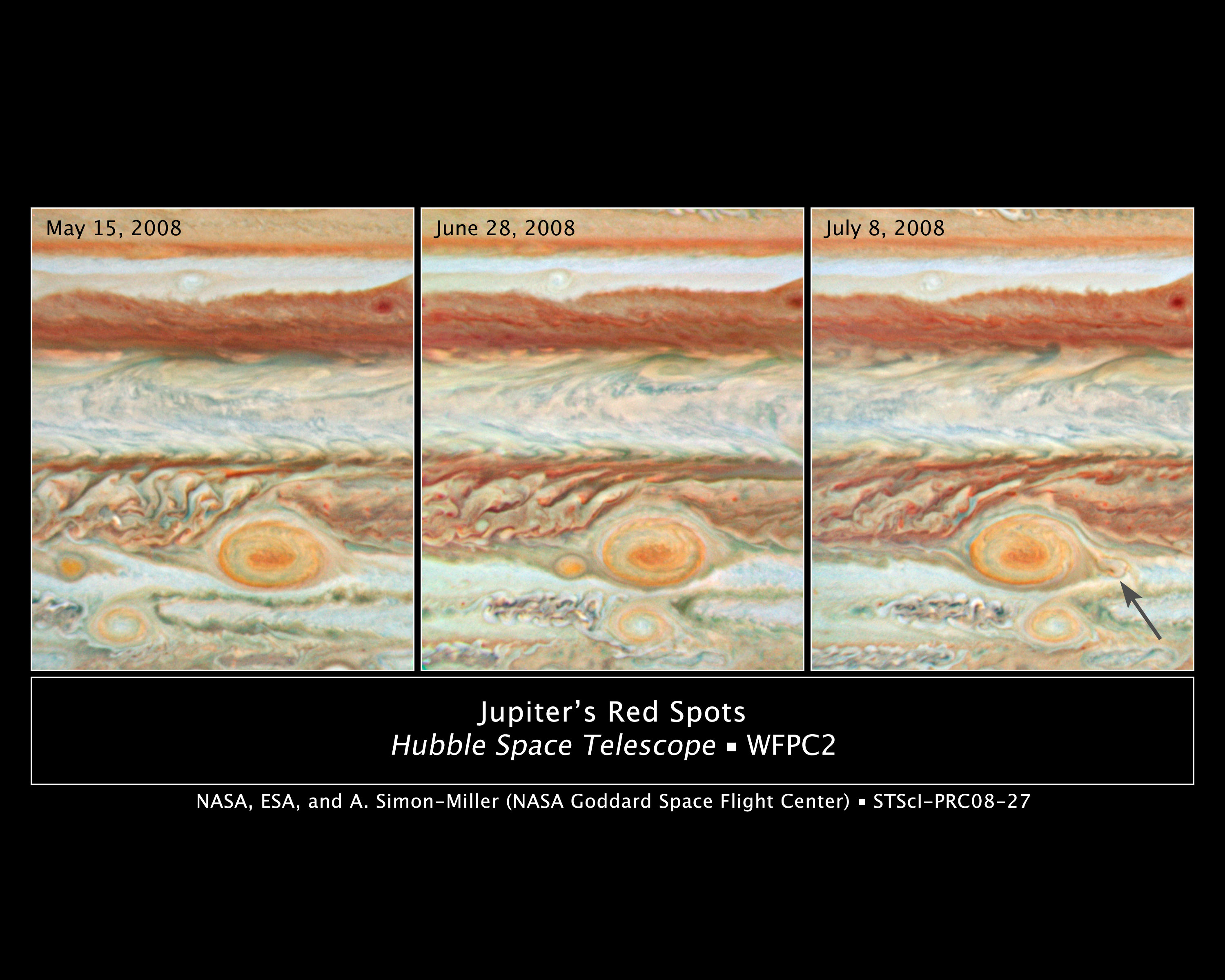
These detailed Hubble Space Telescope close-ups feature Jupiter's ancient swirling storm system known as the Great Red Spot. They also follow the progress of two newer storm systems that have grown to take on a similar reddish hue: the smaller "Red Spot Jr." (bottom), and smaller still, a "baby red spot". Red Spot Jr. was seen to form in 2006, while the smaller spot was just identified earlier this year. For scale, the Great Red Spot has almost twice the diameter of planet Earth. Moving horizontally from left to right past the Great Red Spot, Red Spot Jr. clearly went below the larger storm, but the smaller spot was pulled in. Emerging on the right, the baby spot's stretched and now paler shape is indicated by the arrow in the frame from July 8. It is expected that the baby red spot will be pulled back and merge, becoming part of the giant storm system.
Estos primeros planos detallados del Telescopio Espacial Hubble presentan el antiguo sistema de tormentas arremolinadas de Júpiter conocido como la Gran Mancha Roja. También documentan el progreso de dos sistemas de tormentas más nuevos que han adquirido un matiz rojizo similar: la más pequeña "Mancha Roja Jr." (abajo) y una "mancha roja bebé" aún más pequeña. La Mancha Roja Jr. se observó que se formaba en 2006, mientras que la mancha más pequeña fue identificada hace poco este año. Para tener una escala, la Gran Mancha Roja tiene casi el doble del diámetro del planeta Tierra. Moviéndose horizontalmente de izquierda a derecha más allá de la Gran Mancha Roja, la Mancha Roja Jr. claramente pasó por debajo de la tormenta más grande, pero la mancha más pequeña fue arrastrada hacia ella. Emergiendo por la derecha, la forma de la mancha bebé, estirada y ahora más pálida, se indica con la flecha en la imagen del 8 de julio. Se espera que la mancha roja bebé sea arrastrada nuevamente y se fusione, convirtiéndose en parte del sistema de tormentas gigante.