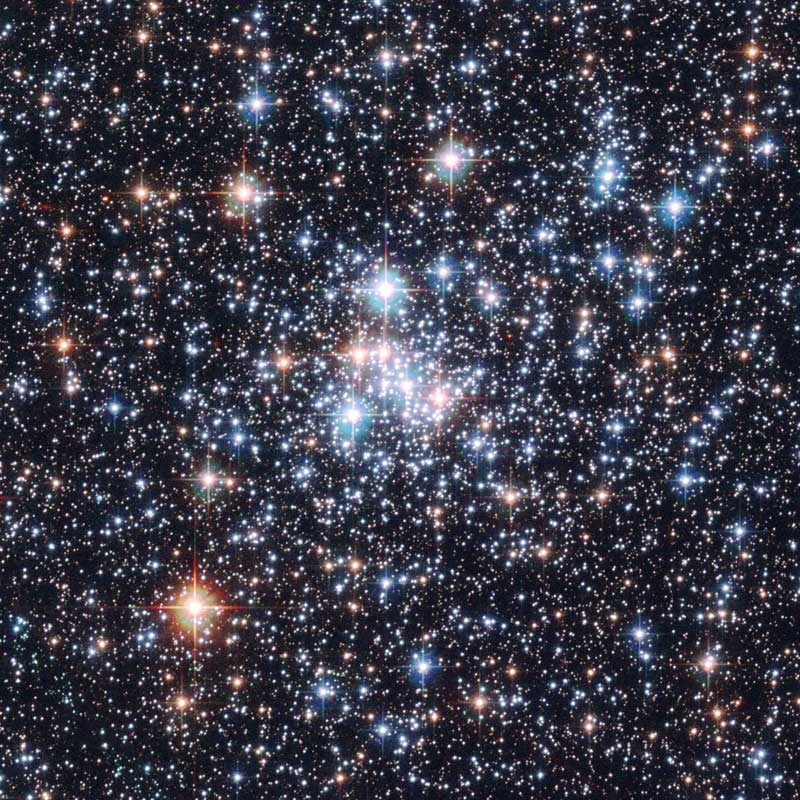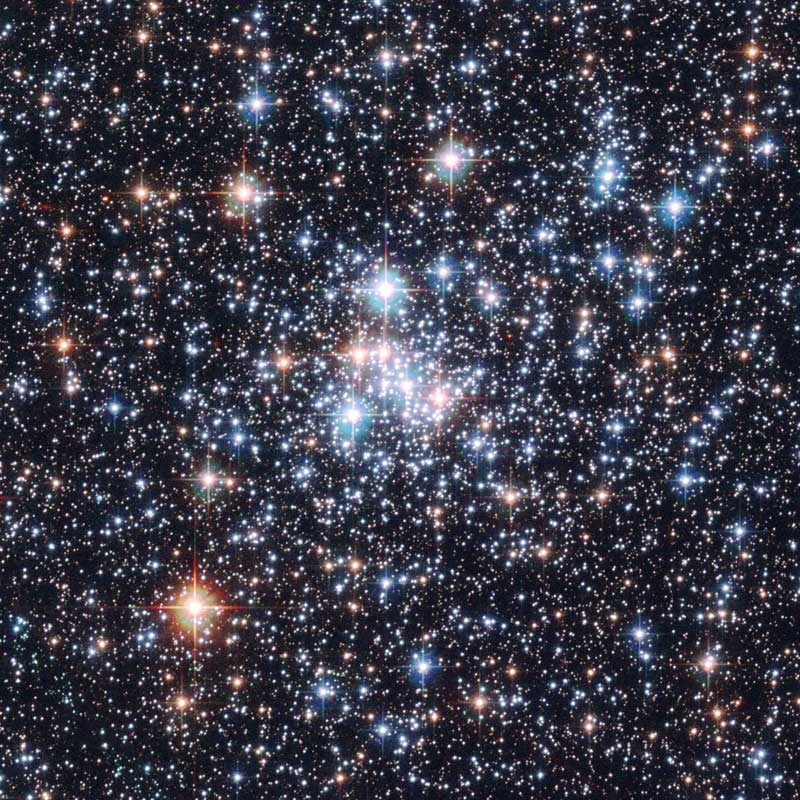
Jewels don't shine this bright -- only stars do. Like gems in a jewel box, though, the stars of open cluster NGC 290 glitter in a beautiful display of brightness and color. The photogenic cluster, pictured above, was captured recently by the orbiting Hubble Space Telescope. Open clusters of stars are younger, contain few stars, and contain a much higher fraction of blue stars than do globular clusters of stars. NGC 290 lies about 200,000 light-years distant in a neighboring galaxy called the Small Cloud of Magellan (SMC). The open cluster contains hundreds of stars and spans about 65 light years across. NGC 290 and other open clusters are good laboratories for studying how stars of different masses evolve, since all the open cluster's stars were born at about the same time.
Las joyas no brillan así de intensamente, solo las estrellas lo hacen. Sin embargo, como gemas en una caja de joyas, las estrellas del cúmulo abierto NGC 290 centellean en un hermoso despliegue de brillo y color. El fotogénico cúmulo, mostrado arriba, fue capturado recientemente por el telescopio espacial Hubble en órbita. Los cúmulos abiertos de estrellas son más jóvenes, contienen pocas estrellas y albergan una proporción mucho mayor de estrellas azules que los cúmulos globulares. NGC 290 se encuentra a aproximadamente 200.000 años luz de distancia en una galaxia vecina llamada la Nube Menor de Magallanes (SMC). El cúmulo abierto contiene cientos de estrellas y se extiende aproximadamente 65 años luz de diámetro. NGC 290 y otros cúmulos abiertos son buenos laboratorios para estudiar cómo evolucionan estrellas de diferentes masas, ya que todas las estrellas del cúmulo abierto nacieron aproximadamente al mismo tiempo.