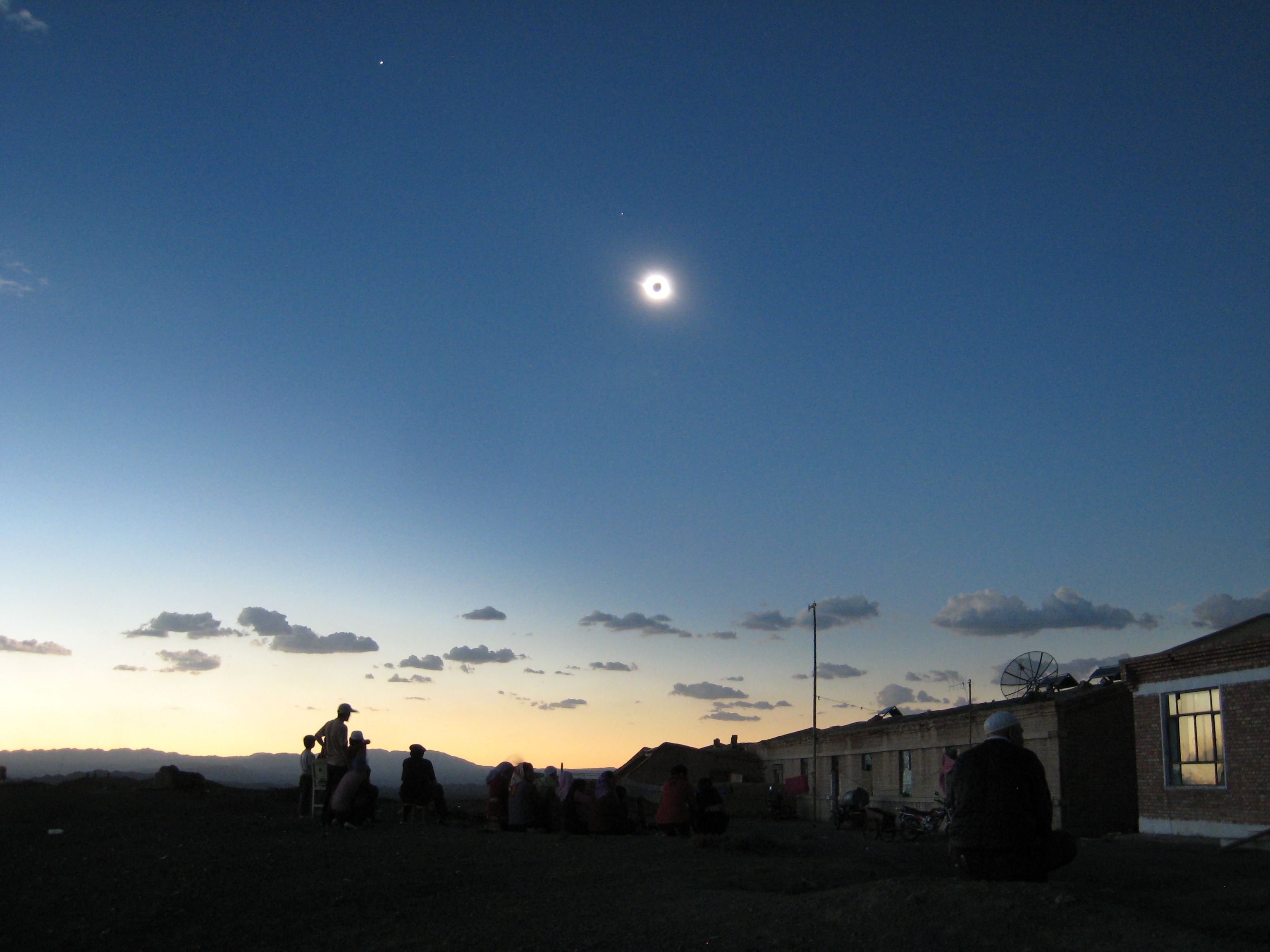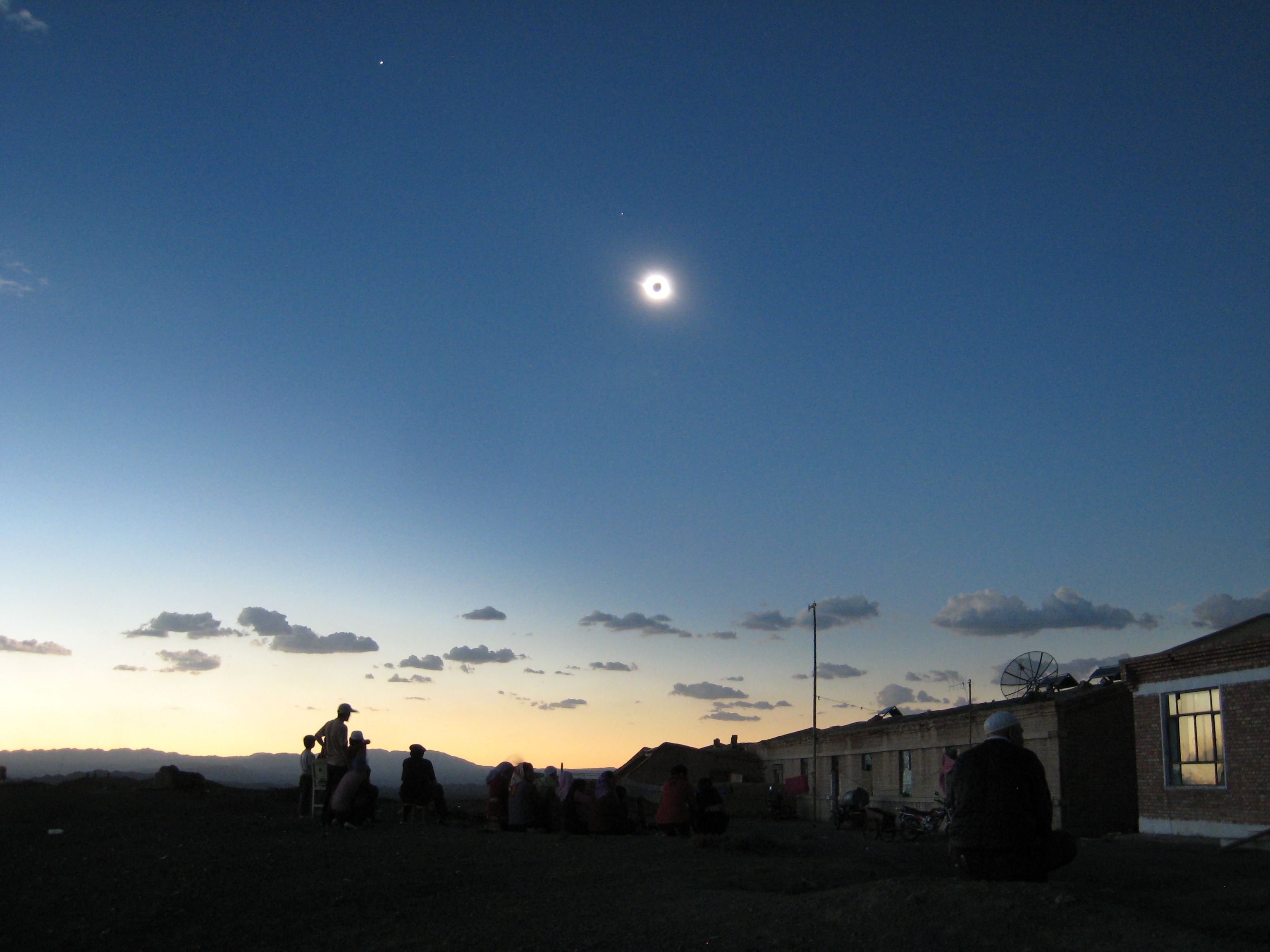
What's that black dot over the Sun? The Moon. This past weekend, the Sun went dark during the day as the Moon completely covered it. The total solar eclipse was visible over a thin swath of Earth extending from northern Canada to China. As shown above, many sky enthusiasts gathered to witness the total or partial solar eclipse, which lasted only a few minutes. The above image was taken during totality near Barkol in Xinjiang, China, with the Barkol Shan mountain range visible on the horizon. Although the brightest parts of the Sun are covered, the normally invisible corona of hot gas surrounding the Sun became prominent. Just to the upper left of the Moon darkened Sun are planets Mercury and Venus. The increased darkening of the sky toward the right indicates the darkened atmosphere created by the passing shadow cone of the total solar eclipse. The next total solar eclipse will occur next July and be visible in parts of India and China.
¿Qué es ese punto negro sobre el Sol? La Luna. Este fin de semana pasado, el Sol se oscureció durante el día cuando la Luna lo cubrió completamente. El eclipse solar total fue visible sobre una franja delgada de la Tierra que se extendía desde el norte de Canadá hasta China. Como se muestra arriba, muchos entusiastas del cielo se reunieron para presenciar el eclipse solar total o parcial, que duró solo algunos minutos. La imagen anterior fue tomada durante la totalidad cerca de Barkol en Xinjiang, China, con la cordillera montañosa de Barkol Shan visible en el horizonte. Aunque las partes más brillantes del Sol están cubiertas, la corona normalmente invisible de gas caliente que rodea al Sol se volvió prominente. Justo a la izquierda superior del Sol oscurecido por la Luna se encuentran los planetas Mercurio y Venus. El oscurecimiento aumentado del cielo hacia la derecha indica la atmósfera oscurecida creada por el cono de sombra que se desplaza del eclipse solar total.