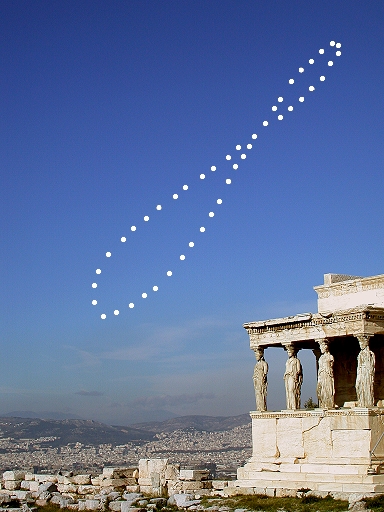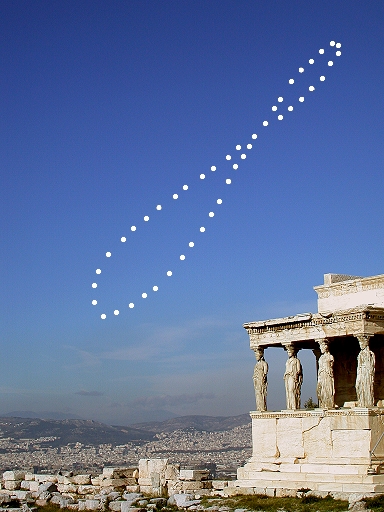
If you took a picture of the Sun at the same time each day, would it remain in the same position? The answer is no, and the shape traced out by the Sun over the course of a year is called an analemma. The Sun's apparent shift is caused by the Earth's motion around the Sun when combined with the tilt of the Earth's rotation axis. The Sun will appear at its highest point of the analemma during summer and at its lowest during winter. Today, the Winter Solstice day in Earth's northern hemisphere, the Sun is at the bottom of the analemma. Analemmas created from different latitudes would appear at least slightly different, as well as analemmas created at a different time each day. This particular analemma was built up by 46 separate Sun photographs taken during 2003 in Athens, Greece. Pictured in the foreground of this composite image are pillars called the Porch of Maidens, part of the ancient Erechtheum which was completed in 407 BC. Note : APOD Editor to Speak in New York on Jan. 2
Si tomaras una fotografía del Sol a la misma hora cada día, ¿permanecería en la misma posición? La respuesta es no, y la forma trazada por el Sol a lo largo de un año se llama analema. El desplazamiento aparente del Sol es causado por el movimiento de la Tierra alrededor del Sol combinado con la inclinación del eje de rotación terrestre. El Sol aparecerá en su punto más alto del analema durante el verano y en su punto más bajo durante el invierno. Hoy, día del solsticio de invierno en el hemisferio norte de la Tierra, el Sol se encuentra en la parte inferior del analema. Los analemas creados desde diferentes latitudes aparecerían al menos ligeramente diferentes, así como los analemas creados a una hora diferente cada día. Este analema en particular fue construido a partir de 46 fotografías separadas del Sol tomadas durante 2003 en Atenas, Grecia. En primer plano de esta imagen compuesta se ven pilares llamados el Pórtico de las Doncellas, parte del antiguo Erecteión que fue completado en 407 a.C.