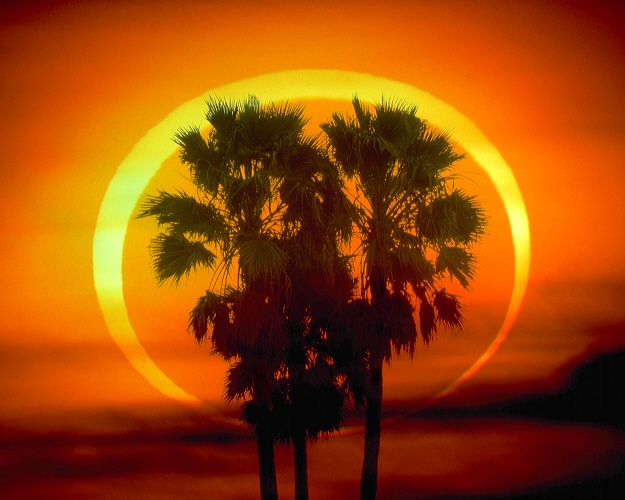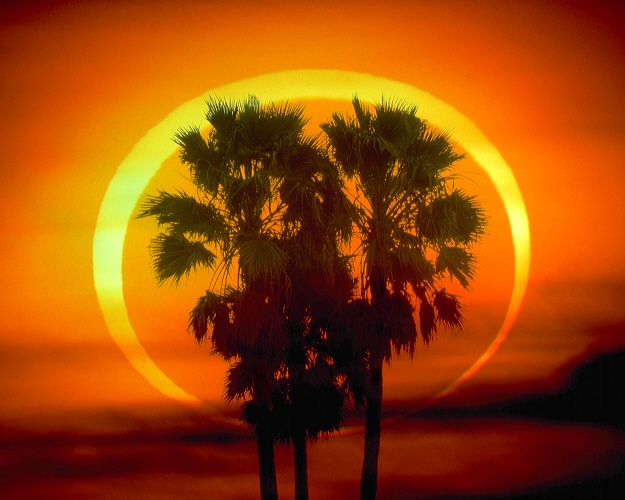
Tomorrow, a few lucky people may see a "ring of fire." That's a name for the central view of an annular eclipse of the Sun by the Moon. At the peak of this eclipse, the middle of the Sun will appear to be missing and the dark Moon will appear to be surrounded by the bright Sun. This will only be visible, however, from a path that crosses the southern Indian Ocean. From more populated locations, southern Africa and parts of Australia, most of the Moon will only appear to take a bite out the Sun. Remember to never look directly at the Sun even during an eclipse. An annular eclipse occurs instead of a total eclipse when the Moon is on the far part of its elliptical orbit around the Earth. The next annular eclipse of the Sun will take place in 2010 January, although a total solar eclipse will occur this July. Pictured above, a spectacular annular eclipse was photographed behind palm trees on 1992 January.
Mañana, algunas personas afortunadas podrán ver un «anillo de fuego». Ese es el nombre para la vista central de un eclipse anular del Sol por la Luna. En el apogeo de este eclipse, el centro del Sol parecerá estar ausente y la Luna oscura parecerá estar rodeada por el Sol brillante. Sin embargo, esto solo será visible desde un camino que cruza el sur del océano Índico. Desde ubicaciones más pobladas, el sur de África y partes de Australia, la mayor parte de la Luna solo parecerá tomar un bocado del Sol. Recuerde nunca mirar directamente al Sol, incluso durante un eclipse. Un eclipse anular ocurre en lugar de un eclipse total cuando la Luna se encuentra en la parte lejana de su órbita elíptica alrededor de la Tierra. El próximo eclipse anular del Sol tendrá lugar en enero de 2010, aunque ocurrirá un eclipse solar total en julio. En la imagen superior, un espectacular eclipse anular fue fotografiado detrás de palmeras el 1 de enero de 1992.