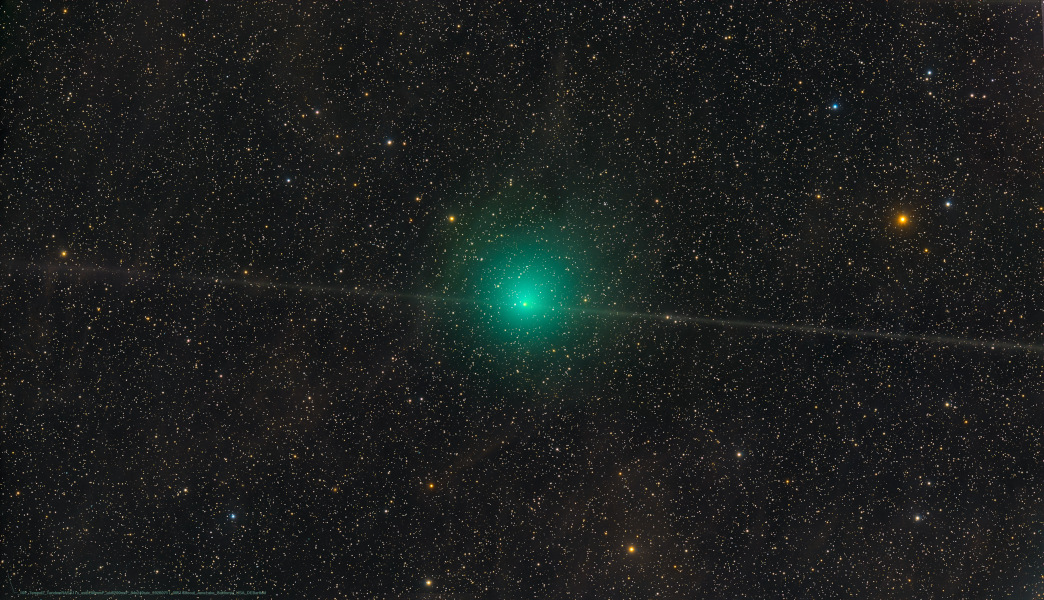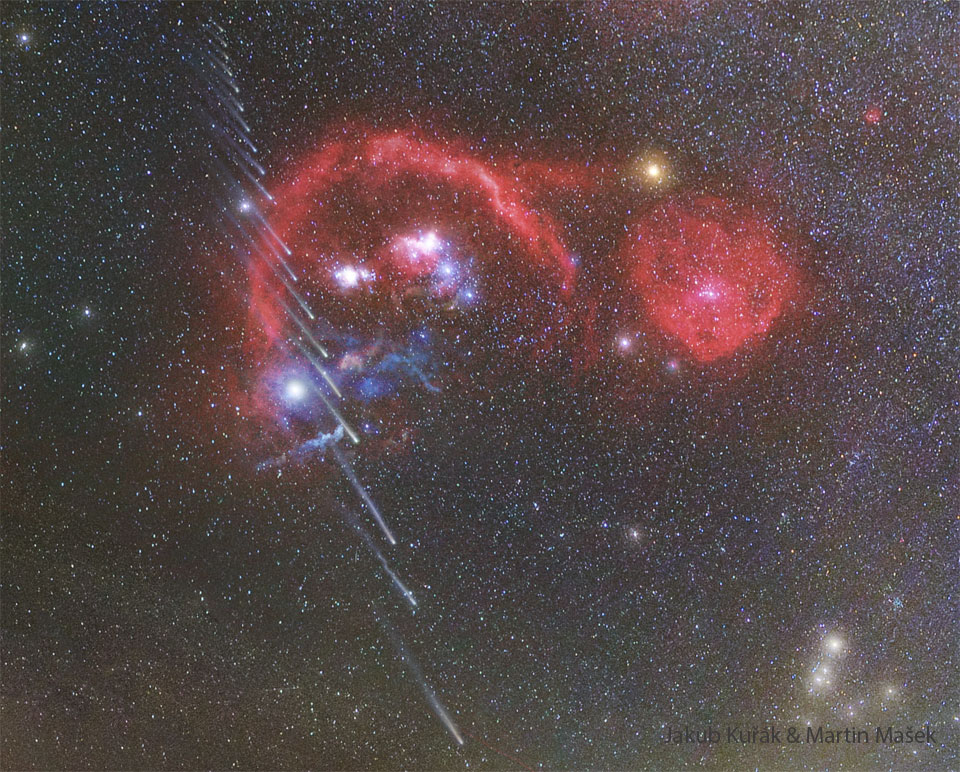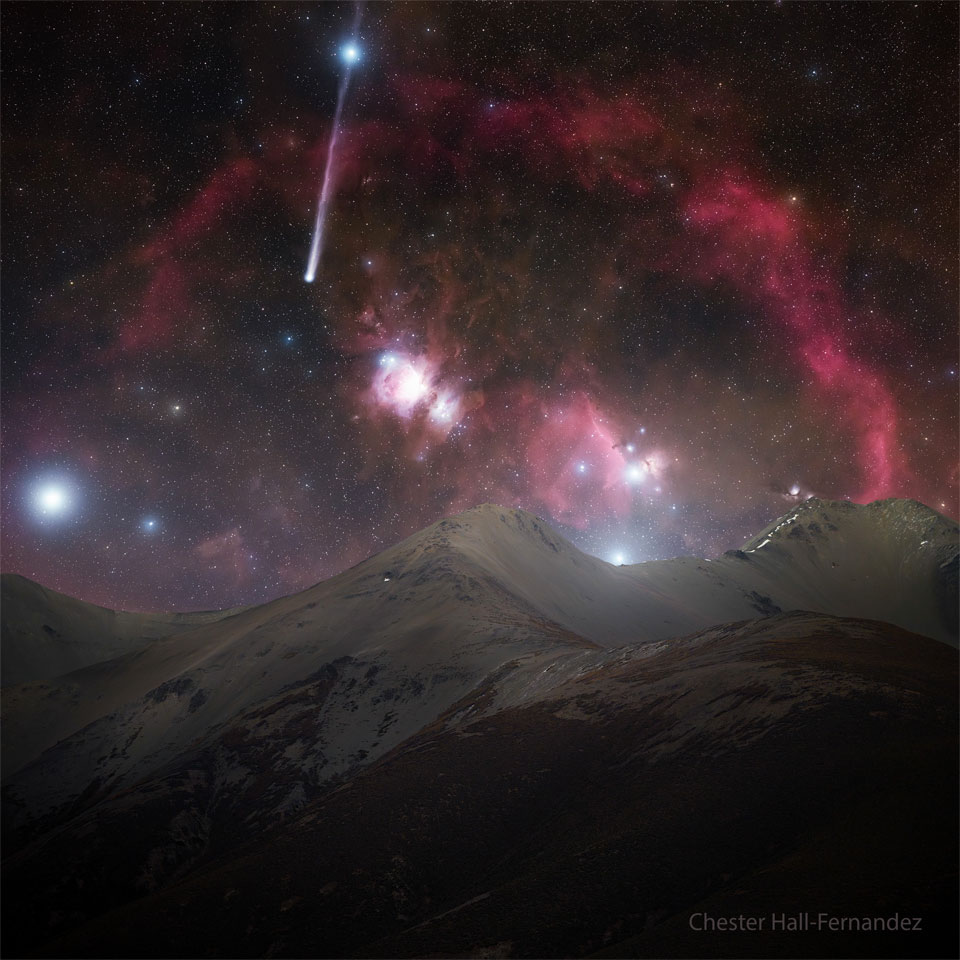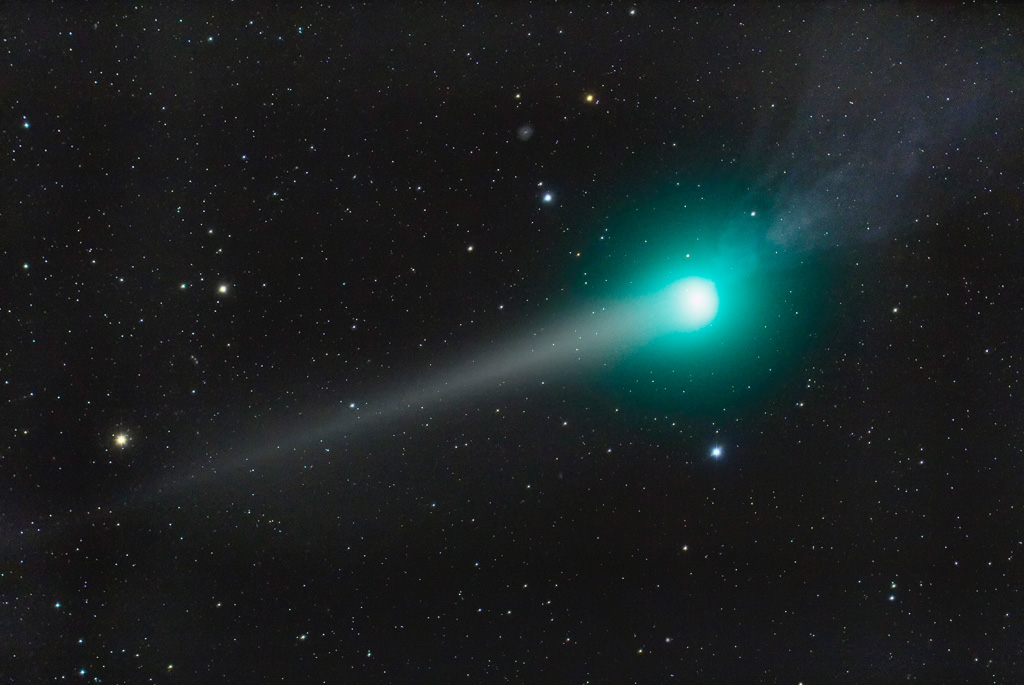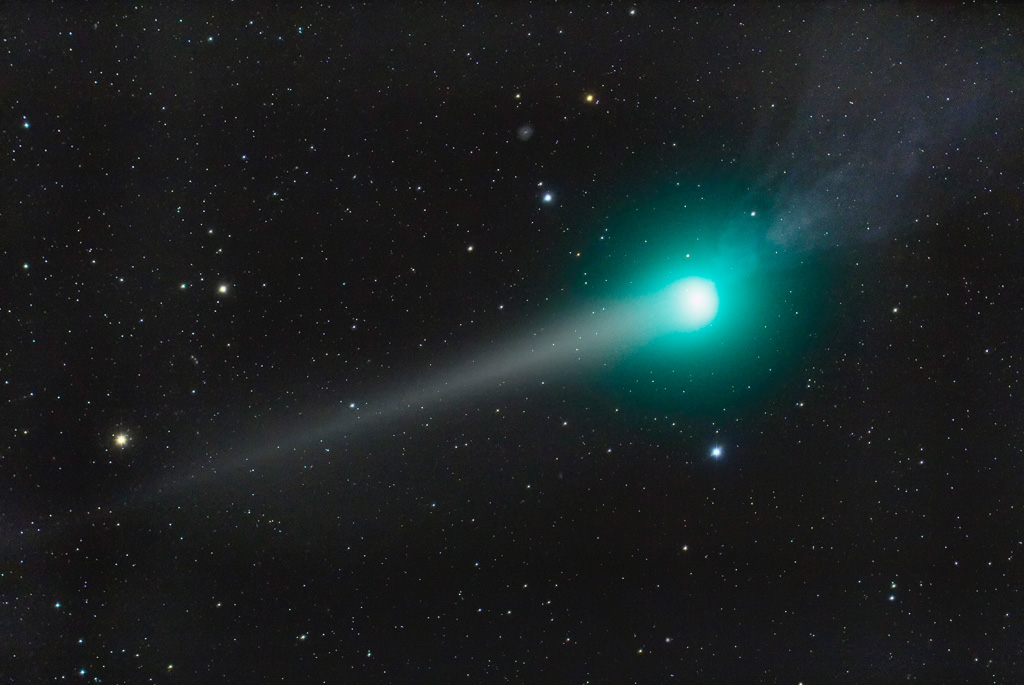
Go outside tonight and see Comet Lulin. From a dark location, you should need only a good star map and admirable perseverance -- although wide-field binoculars might help. Yesterday, Comet Lulin passed its closest to Earth, so that the comet will remain near its brightest over the next few days. The comet is currently almost 180 degrees around from the Sun and so visible nearly all night long, but will appear to move on the sky about 10 full moons a night. In this image, Comet Lulin was captured in spectacular form two nights ago from New Mexico, USA. The central coma of the comet is appearing quite green, a color likely indicating glowing molecular carbon gasses. Bright stars and a distant spiral galaxy are clearly visible in the image background. The yellow dust tail, reflecting sunlight, is visible sprawling to the coma's left trailing behind the comet, while the textured bluish-glowing ion tail is visible to the coma's right, pointing away from the Sun. Over the past few weeks, from the current vantage point of Earth, these two tails appeared to point in opposite directions. Comet Lulin is expected to slowly fade over the next few weeks.
Salga esta noche y observe el Cometa Lulin. Desde una ubicación oscura, necesitará solo un buen mapa estelar y una perseverancia admirable, aunque binoculares de gran campo podrían serle útiles. Ayer, el Cometa Lulin pasó más cerca de la Tierra, por lo que el cometa permanecerá cerca de su máximo brillo durante los próximos días. El cometa se encuentra actualmente casi 180 grados alejado del Sol y, por lo tanto, es visible casi toda la noche, pero aparecerá moviéndose en el cielo aproximadamente 10 lunas llenas por noche. En esta imagen, el Cometa Lulin fue capturado en forma espectacular hace dos noches desde Nuevo México, EE.UU. La coma central del cometa presenta un color bastante verde, un color que probablemente indica gases moleculares de carbono incandescente. Estrellas brillantes y una galaxia espiral distante son claramente visibles en el fondo de la imagen. La cola de polvo amarilla, que refleja la luz solar, es visible extendiéndose a la izquierda de la coma siguiendo el rastro del cometa, mientras que la cola de iones azulada texturizada y luminosa es visible a la derecha de la coma, señalando en dirección opuesta al Sol. Durante las últimas semanas, desde la posición actual de la Tierra, estas dos colas parecían apuntar en direcciones opuestas. Se espera que el Cometa Lulin se desvanezca lentamente durante las próximas semanas.