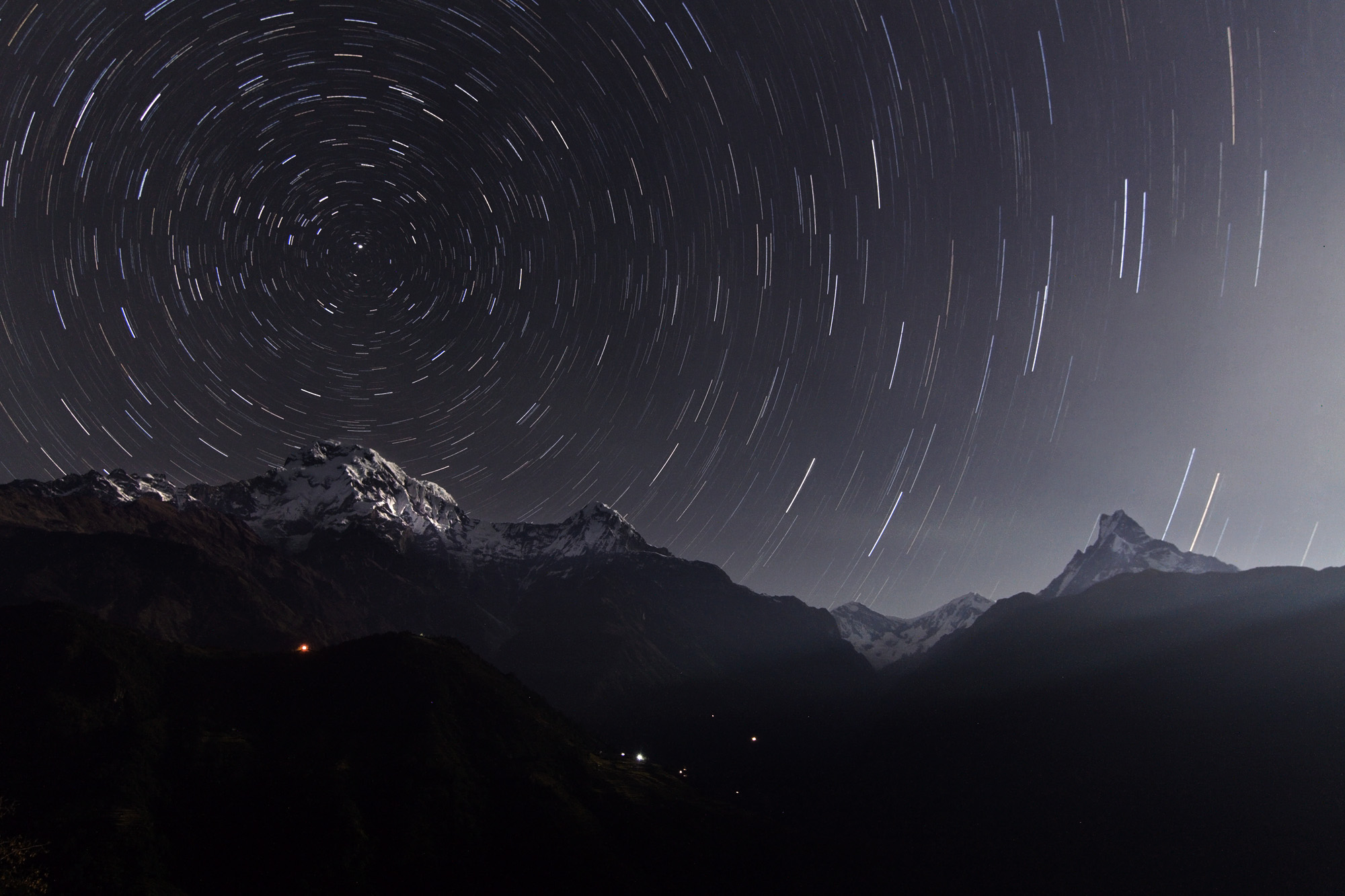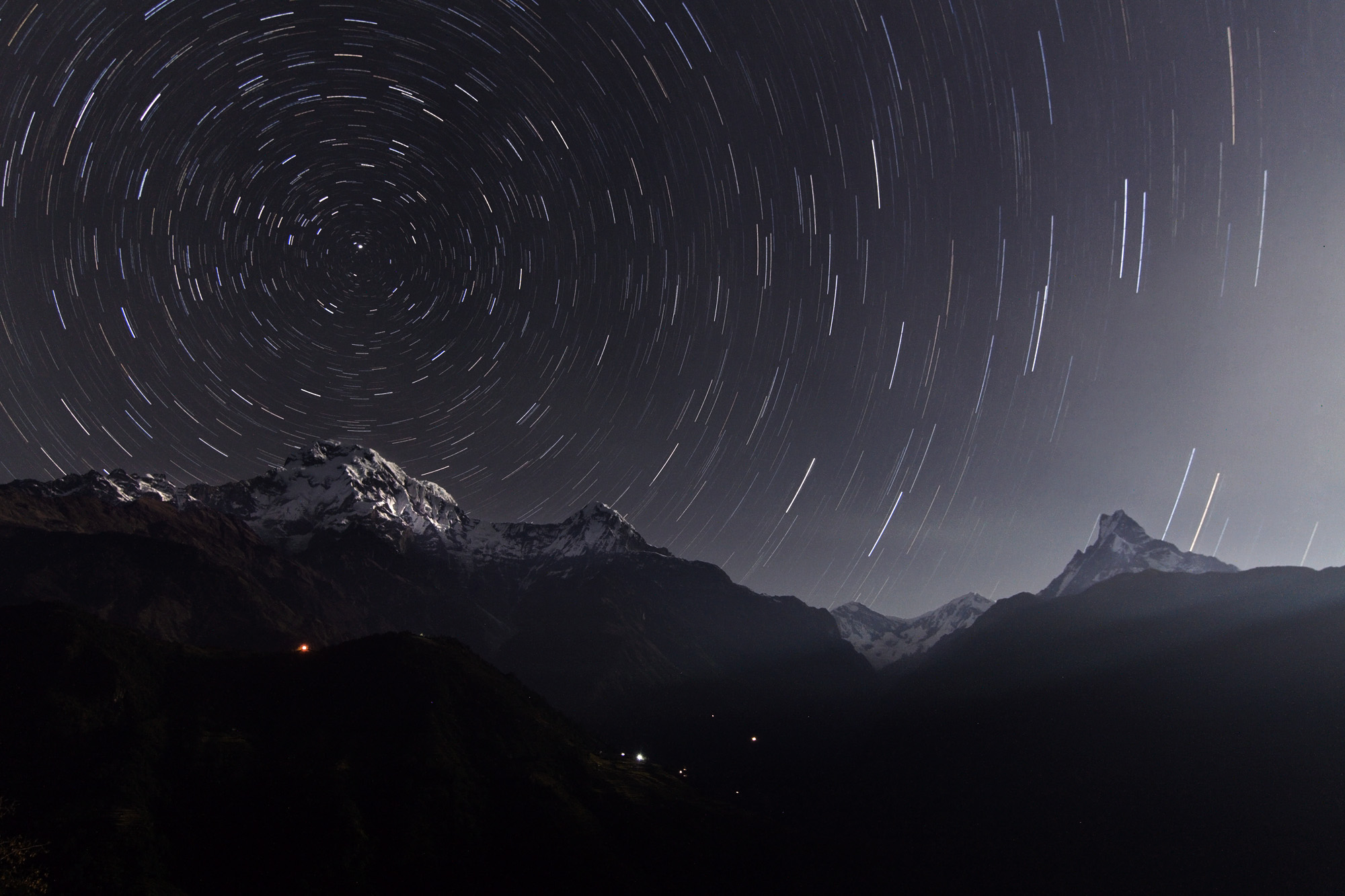
In myth, Atlas holds up the heavens. But in this moonlit mountainscape, peaks of the Himalayan Annapurna Range appear to prop up the sky as seen from Ghandruk, Nepal. From left to right the three main peaks are Annapurna South (7,219 meters), Hiunchuli (6,441 meters), and Machapuchare (6,995 meters). Of course the mountains are moving not the stars, the Earth's rotation about its axis causing the concentric star trails recorded in the time exposure. Positioned above Annapurna South, the North Celestial Pole is easily identified as the point at the center of all the star trail arcs. The star Polaris, also known as the North Star, made the very short and bright arc closest to the North Celestial Pole.
En la mitología, Atlas sostiene los cielos. Pero en esta paisaje montañoso iluminado por la luna, las cumbres de la cordillera del Himalaya Annapurna parecen sostenes del cielo visto desde Ghandruk, Nepal. De izquierda a derecha, las tres cumbres principales son Annapurna Sur (7.219 metros), Hiunchuli (6.441 metros) y Machapuchare (6.995 metros). Por supuesto, son las montañas las que no se mueven, sino las estrellas; la rotación de la Tierra sobre su eje causa los rastros estelares concéntricos registrados en la exposición prolongada. Posicionado sobre Annapurna Sur, el Polo Celeste Norte se identifica fácilmente como el punto central de todos los arcos de rastros estelares. La estrella Polaris, también conocida como la Estrella del Norte, produjo el arco muy corto y brillante más cercano al Polo Celeste Norte.