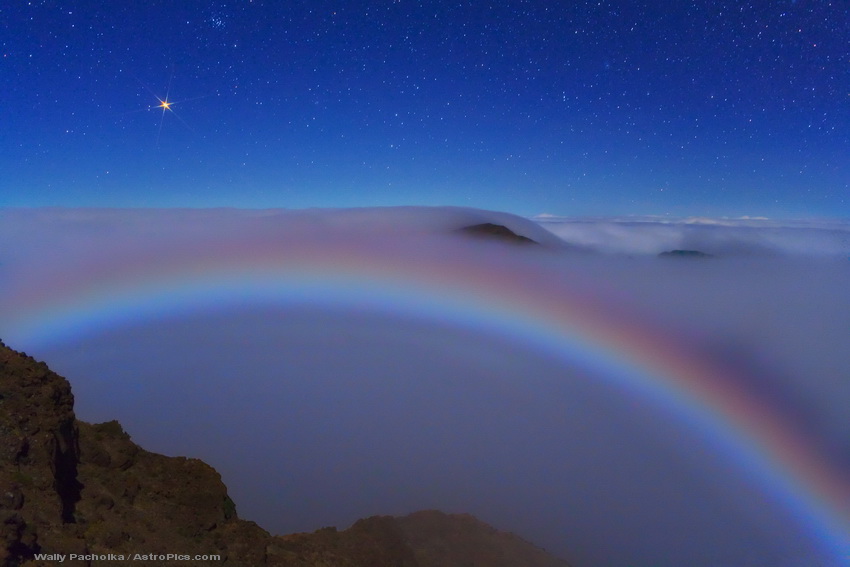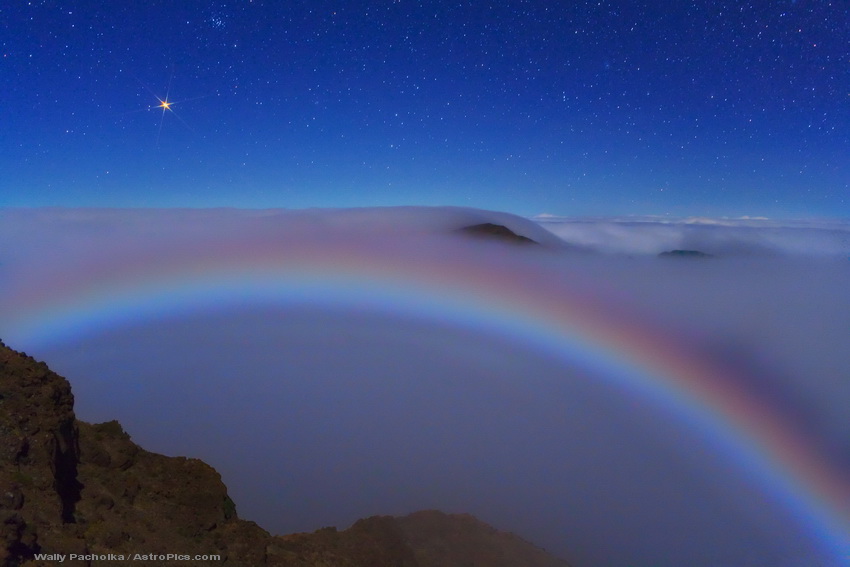
ven from the top of a volcanic crater, this vista was unusual. For one reason, Mars was dazzlingly bright two weeks ago, when this picture was taken, as it was nearing its brightest time of the entire year. Mars, on the far upper left, is the brightest object in the above picture. The brightness of the red planet peaked last week near when Mars reached opposition, the time when Earth and Mars are closest together in their orbits. Arching across the lower part of the image is a rare lunar fog bow. Unlike a more commonly seen rainbow, which is created by sunlight reflected prismatically by falling rain, this fog bow was created by moonlight reflected by the small water drops that compose fog. Although most fog bows appear white, all of the colors of the rainbow were somehow visible here. The above image was taken from high atop Haleakala, a huge volcano in Hawaii, USA.
Vista desde la cima de un cráter volcánico, esta escena era inusual. Una razón es que Marte estaba deslumbrantemente brillante hace dos semanas, cuando se tomó esta imagen, ya que se acercaba a su momento más brillante del año entero. Marte, en la parte superior izquierda lejana, es el objeto más brillante en la imagen anterior. La brillantez del planeta rojo alcanzó su punto máximo la semana pasada, cerca del momento en que Marte alcanzó la oposición, el tiempo en que la Tierra y Marte están más cercanos entre sí en sus órbitas. Arqueándose a través de la parte inferior de la imagen hay un raro arco iris lunar de neblina. A diferencia de un arco iris más común, que es creado por la luz solar reflejada de manera prismática por la lluvia que cae, este arco de neblina fue creado por la luz de la luna reflejada por las pequeñas gotas de agua que componen la neblina. Aunque la mayoría de los arcos de neblina aparecen blancos, aquí de alguna manera se podían ver todos los colores del arco iris. La imagen anterior fue tomada desde la cima elevada de Haleakala, un gran volcán en Hawái, EE. UU.