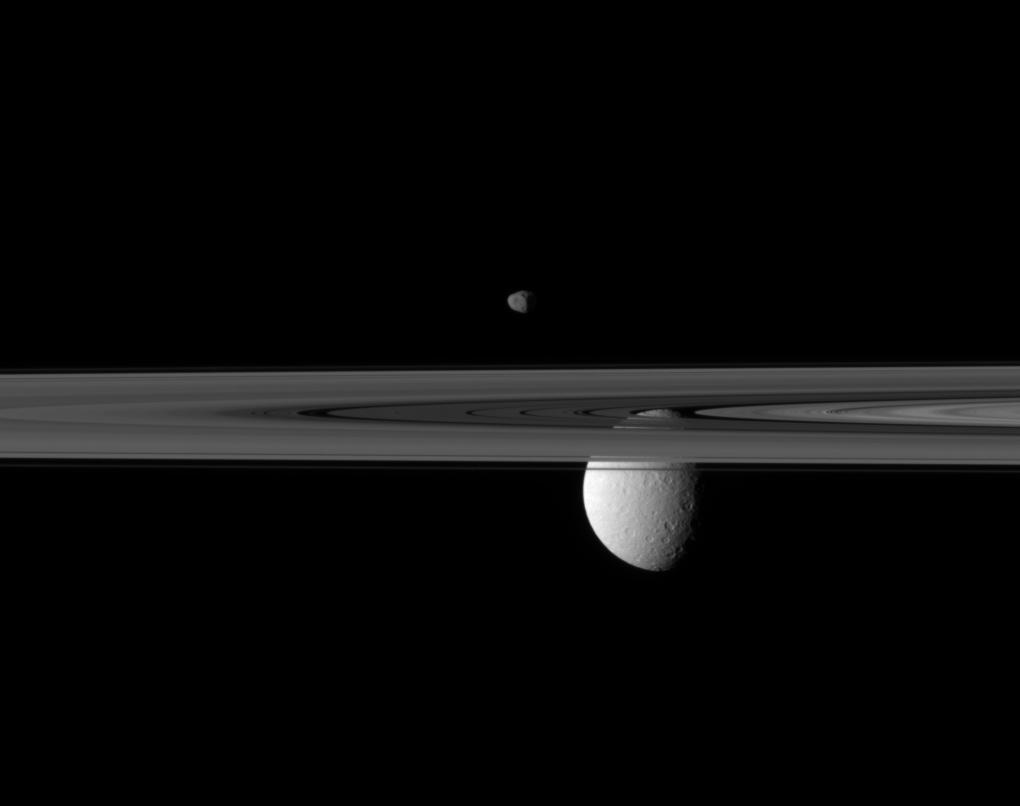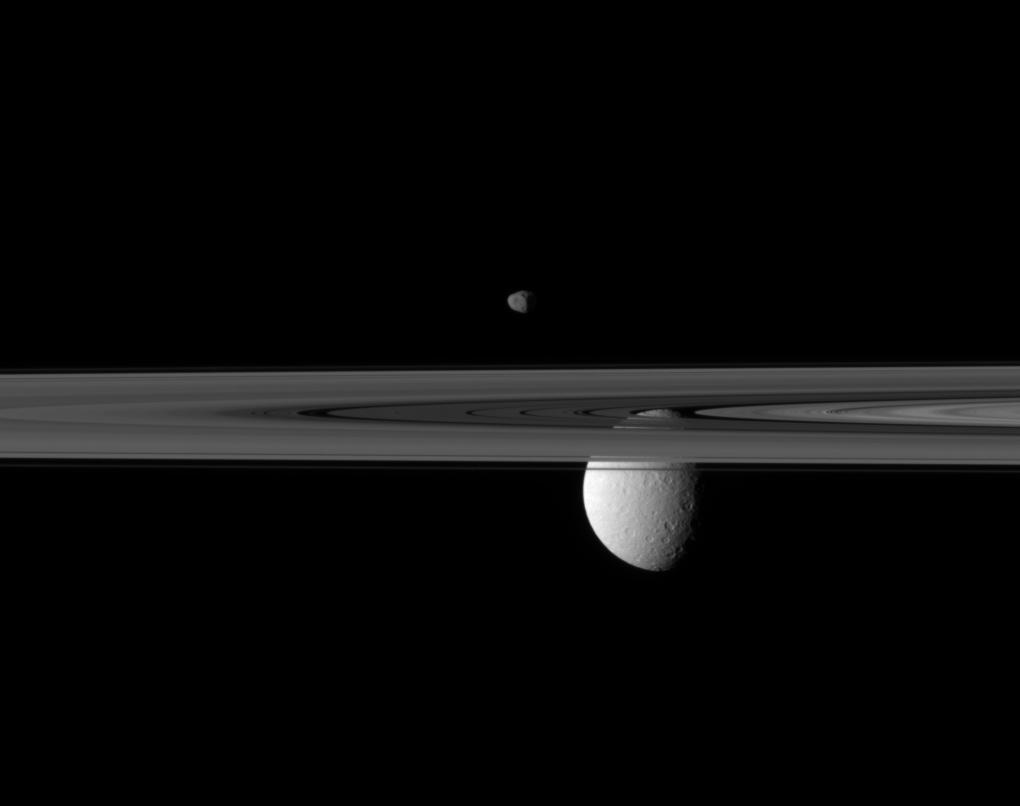
What's happened to that moon of Saturn? Nothing -- Saturn's moon Rhea is just partly hidden behind Saturn's rings. In April, the robotic Cassini spacecraft now orbiting Saturn took this narrow-angle view looking across the Solar System's most famous rings. Rings visible in the foreground include the thin F ring on the outside and the much wider A and B rings just interior to it. Although it seems to be hovering over the rings, Saturn's moon Janus is actually far behind them. Janus is one of Saturn's smaller moons and measures only about 180 kilometers across. Farther out from the camera is the heavily cratered Rhea, a much larger moon measuring 1,500 kilometers across. The top of Rhea is visible only through gaps in the rings. The Cassini mission around Saturn has been extended to 2017 to better study the complex planetary system as its season changes from equinox to solstice.
¿Qué le ha sucedido a esa luna de Saturno? Nada en absoluto — la luna de Saturno Rhea simplemente está parcialmente oculta detrás de los anillos de Saturno. En abril, la nave espacial robotizada Cassini, que ahora orbita Saturno, tomó esta imagen de ángulo estrecho mirando a través de los anillos más famosos del Sistema Solar. Los anillos visibles en primer plano incluyen el delgado anillo F en el exterior y los mucho más anchos anillos A y B justo interior a él. Aunque parece que está flotando sobre los anillos, la luna de Saturno Janus en realidad está mucho más atrás. Janus es una de las lunas más pequeñas de Saturno y tiene un diámetro de aproximadamente 180 kilómetros. Más lejos de la cámara está Rhea, una luna mucho más grande con un diámetro de 1.500 kilómetros, cuya parte superior es visible solo a través de los huecos en los anillos. La misión Cassini alrededor de Saturno ha sido extendida hasta 2017 para estudiar mejor el complejo sistema planetario a medida que cambia de equinoccio a solsticio.