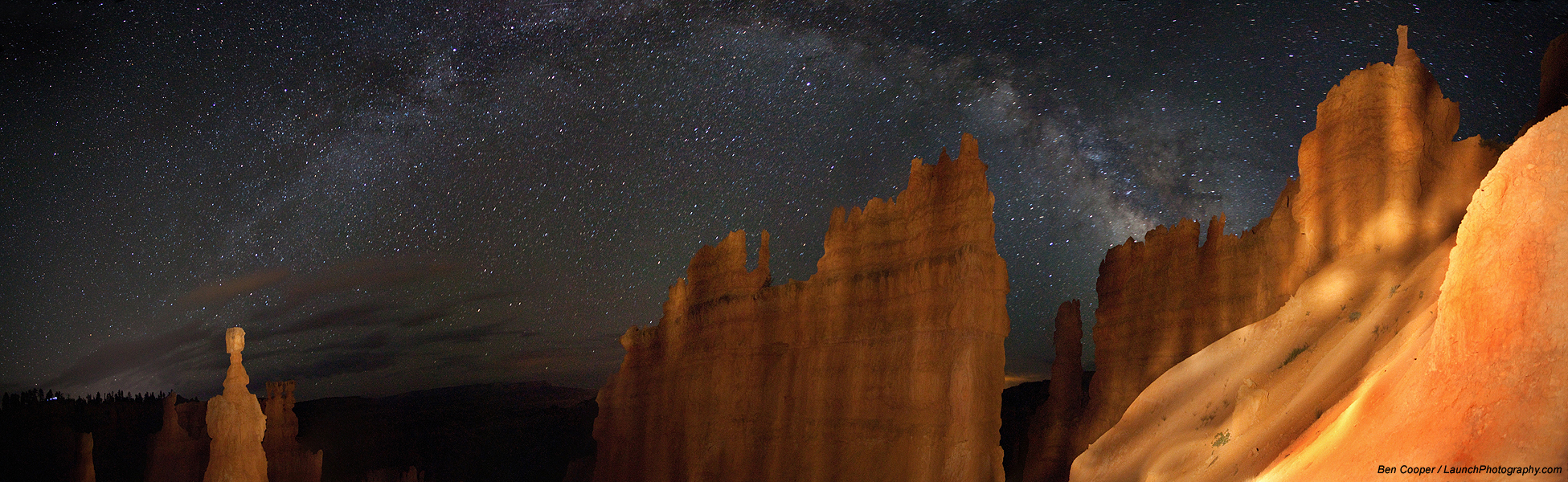
What are those strange rock structures? They are towers and walls of sedimentary rock that are particularly plentiful in Bryce Canyon in Utah, USA. The rock columns may rise higher than 50 meters and are called hoodoos. On the far left is Thor's Hammer, perhaps the most famous hoodoo. The tall rock columns were carved, most typically, when a unusually dense cap of rock provided a layer of protection to rock underneath from rain-based erosion. In the above panoramic picture taken earlier this month and compressed horizontally, the foreground rocks were momentarily illuminated by a roving spotlight. Visible in the background are a few water clouds a few kilometers away hovering over the nearby Earth. Visible well beyond that are thousands of individually discernible stars averaging a few hundred light years away in the nearby Milky Way Galaxy. Far in the distance lie billions of stars that are thousands of light years away and compose the faintly glowing arch that is the visible central band of the flat disk of our Milky Way. Over many years, wind and rain will eventually cause the tops of the hoodoos to topple, whereafter the underlying column will likely completely erode away.
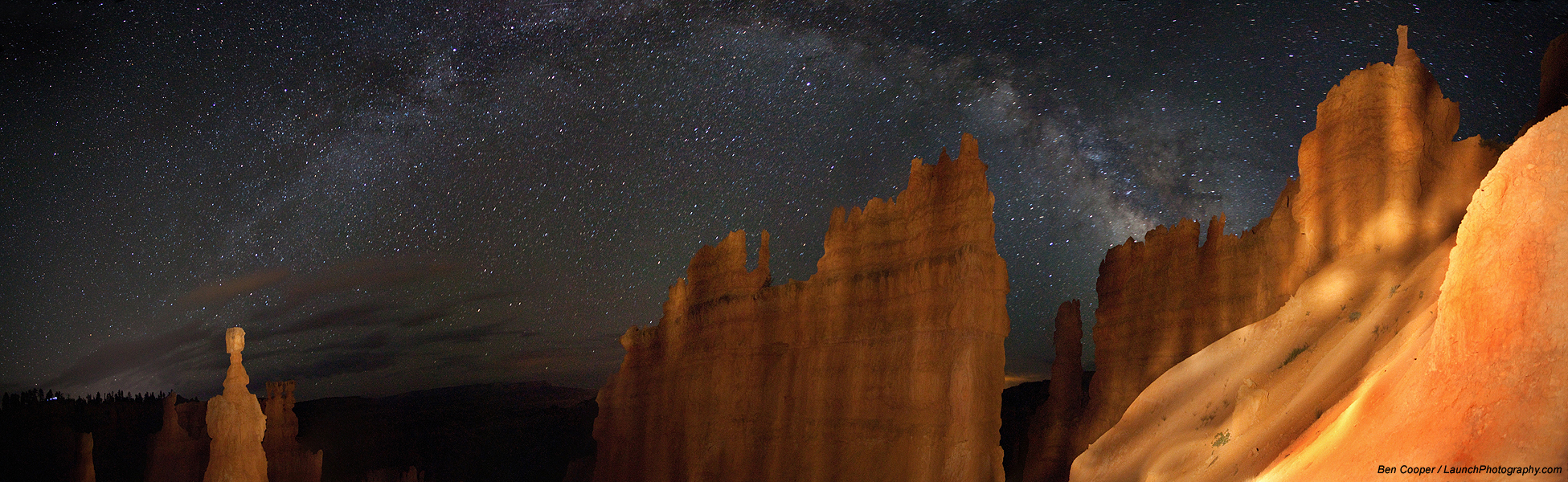
¿Qué son esas extrañas estructuras rocosas? Son torres y paredes de roca sedimentaria que son particularmente abundantes en el Cañón de Bryce, en Utah, Estados Unidos. Las columnas de roca pueden elevarse más de 50 metros y se llaman hoodoos. En la parte más a la izquierda se encuentra el Martillo de Thor, quizás el hoodoo más famoso. Las altas columnas rocosas se formaron típicamente cuando una capa especialmente densa de roca proporcionó una capa de protección a la roca subyacente contra la erosión causada por la lluvia. En la imagen panorámica horizontalmente comprimida tomada hace unos días, las rocas del primer plano fueron momentáneamente iluminadas por una luz móvil. En el fondo se ven algunas nubes de agua a unos pocos kilómetros de distancia, flotando sobre la Tierra cercana. Más allá de ellas se ven miles de estrellas individuales discernibles, en promedio a unos pocos cientos de años luz de distancia, en la galaxia Vía Láctea cercana. Muy lejos, en el horizonte, se encuentran miles de millones de estrellas que se hallan a miles de años luz de distancia y que forman el arco tenue que es la banda central visible del disco plano de nuestra Vía Láctea. Con el tiempo, el viento y la lluvia harán que las cimas de los hoodoos se derrumben, y posteriormente la columna subyacente probablemente se erosionará por completo.