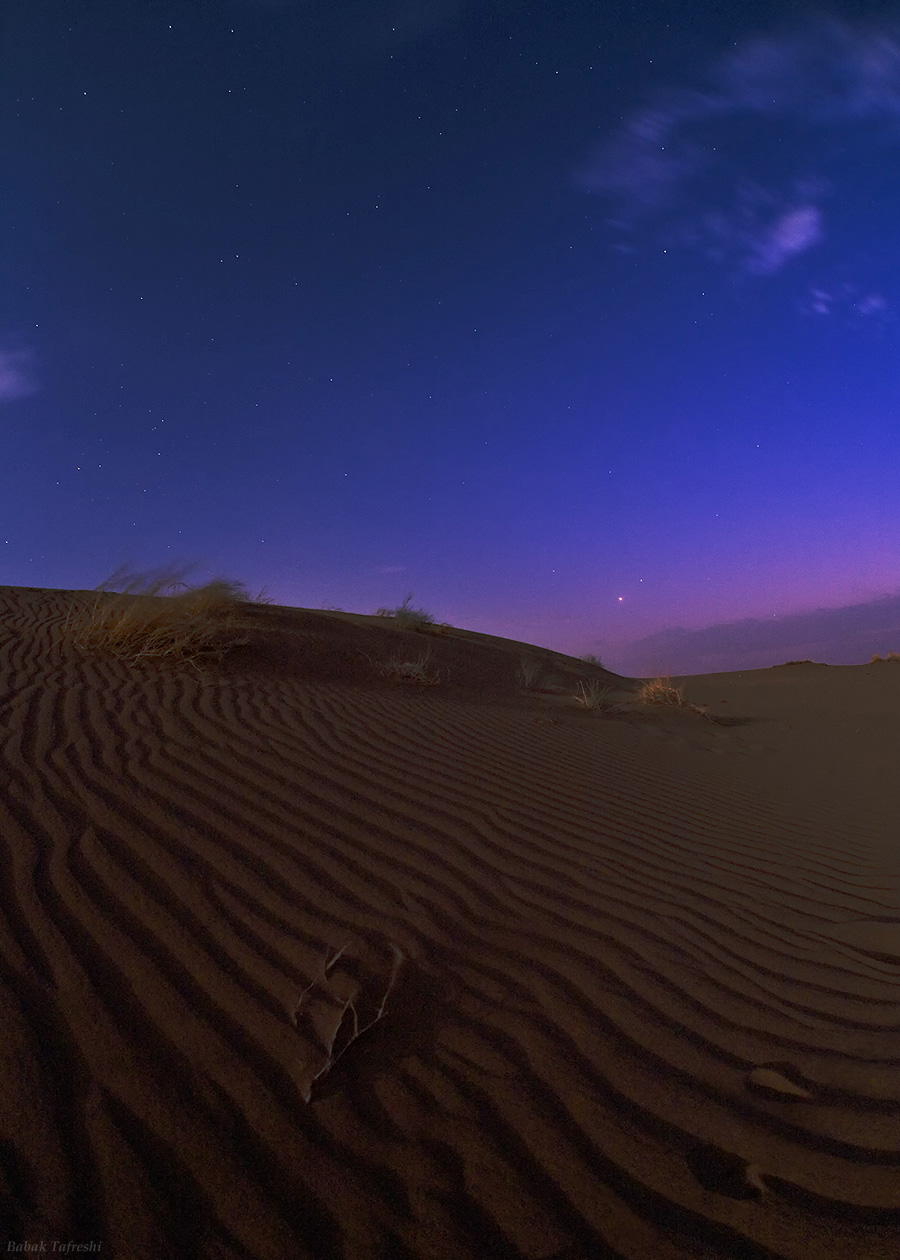
ven though you may have just read an email claiming Mars will be incredibly bright tonight, the brightest star on the horizon is not Mars. From central Iran on August 24th, the brightest star in this twilight desert skyview is Venus, aka the Evening Star. But a bright Mars is in the picture, just above and right of more brilliant Venus. Despite claims in the internet's annually returning Mars Hoax that Mars will be as big and bright as the Full Moon, this celestial scenario is very similar to the western sky you can see tonight. Along with Mars, the still beautiful vista includes Spica, alpha star of the constellation Virgo, above and left of Venus. Farther right of Venus, Saturn peeks through the sunset's fading glow just above the clouds. Near the opposite horizon, the Full Moon illuminating the desert is about 400,000 times brighter than Mars.
Aunque es posible que hayas leído un correo electrónico afirmando que Marte será increíblemente brillante esta noche, la estrella más brillante en el horizonte no es Marte. Desde el centro de Irán el 24 de agosto, la estrella más brillante en este cielo desértico de crepúsculo es Venus, también conocido como la Estrella del Oeste. Pero Marte también aparece en la imagen, justo encima y a la derecha de Venus, que es aún más brillante. A pesar de las afirmaciones del engaño anual sobre Marte en internet, que asegura que Marte será tan grande y brillante como la Luna Llena, esta escena celeste es muy similar a la que puedes ver en el cielo occidental esta noche. Junto con Marte, esta hermosa vista incluye a Spica, la estrella alfa de la constelación de Virgo, ubicada encima y a la izquierda de Venus. Más allá de Venus, Saturno asoma a través del desvanecido resplandor del atardecer, justo encima de las nubes. Cerca del horizonte opuesto, la Luna Llena que ilumina el desierto es aproximadamente 400,000 veces más brillante que Marte.