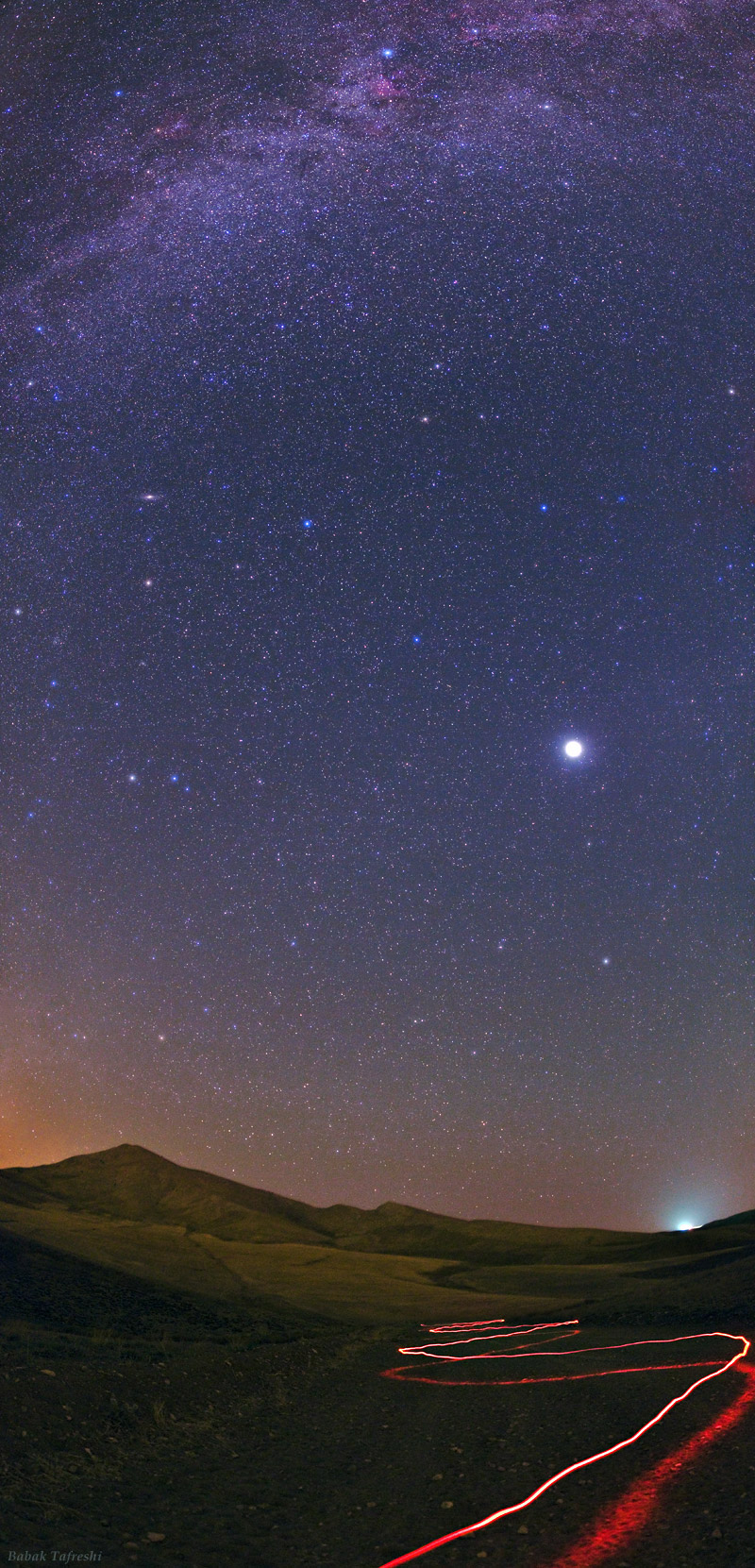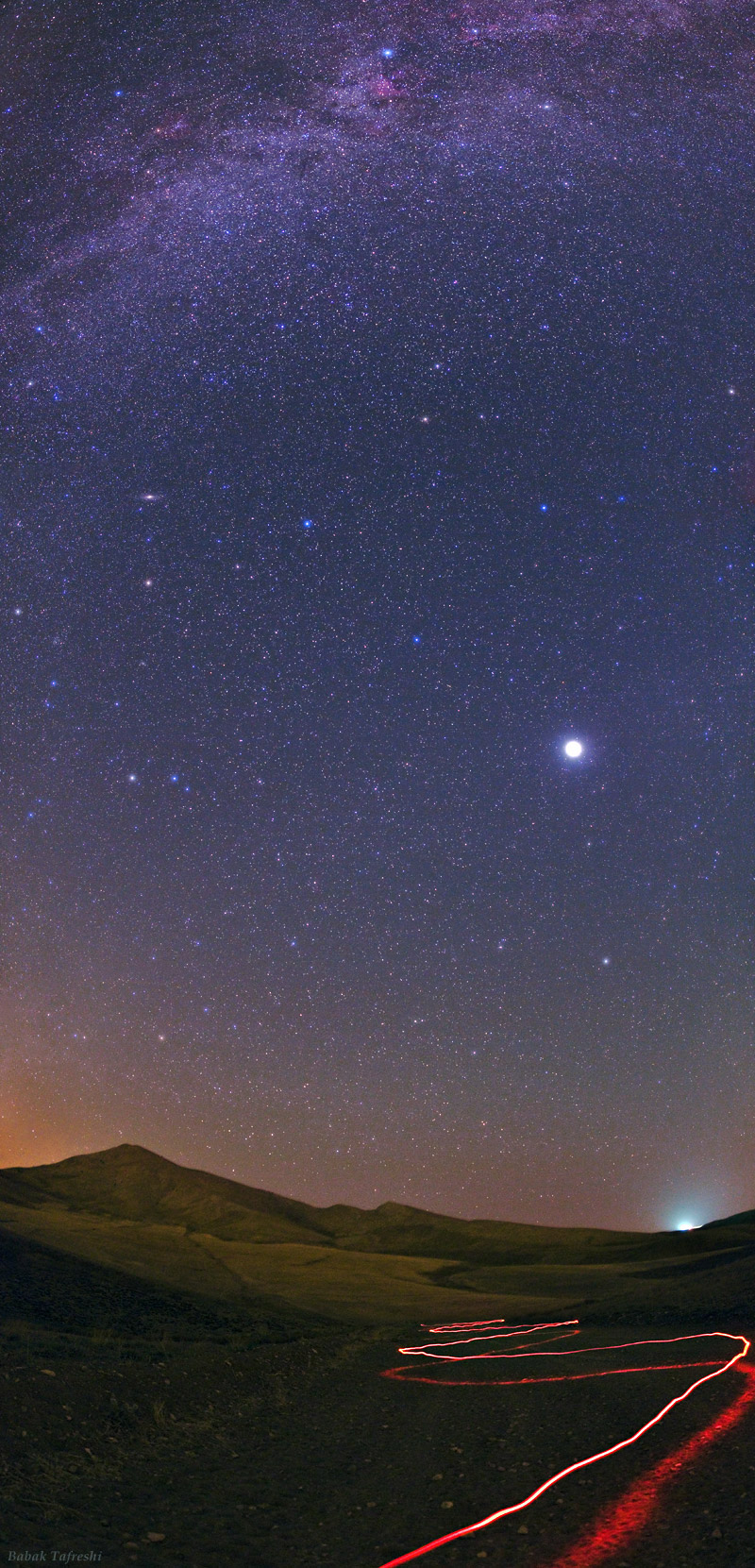
Chances are the brightest star you've seen lately is actually planet Jupiter. Jupiter rules the sky in this labeled view of a starry September night from the Alborz mountains in Iran, complete with the trail of a red flashlight illuminating the mountain road. On September 21st (Universal Time) Jupiter will be at opposition, the point opposite the Sun along its orbit, rising just as the Sun sets. For this opposition, Jupiter will be slightly brighter and closer to planet Earth than in any year since 1963. Much fainter and also approaching its own opposition on September 21st, is the distant planet Uranus. Very near Jupiter on the sky, the fainter planet is easy to spot in binoculars (similar to the inset view), well above and right of brilliant Jupiter and about as bright as one of Jupiter's own Galilean moons. Remarkably close to the opposition of both planets, the point on the sky exactly opposite the Sun on September 23rd is marked the Vernal Equinox. On that date, a Full Moon will join the celestial scene. Of course, any Full Moon is also at opposition. Tonight: International Observe the Moon Night
Probablemente la estrella más brillante que has visto últimamente sea en realidad el planeta Júpiter. Júpiter domina el cielo en esta vista etiquetada de una noche estrellada de septiembre desde las montañas Alborz en Irán, completa con la trayectoria de una linterna roja iluminando la carretera de la montaña. El 21 de septiembre (hora universal) Júpiter estará en oposición, el punto opuesto al Sol a lo largo de su órbita, apareciendo justo cuando el Sol se pone. Para esta oposición, Júpiter será ligeramente más brillante y más cercano a la Tierra que en cualquier otro año desde 1963. Mucho más tenue y también acercándose a su propia oposición el 21 de septiembre, está el distante planeta Urano. Muy cerca de Júpiter en el cielo, el planeta más tenue es fácil de localizar con binoculares (similar a la vista insertada), situado claramente por encima y a la derecha de brillante Júpiter y con un brillo similar al de una de las propias lunas galileanas de Júpiter. Curiosamente cerca de la oposición de ambos planetas, el punto del cielo exactamente opuesto al Sol el 23 de septiembre está marcado por el Equinoccio de Primavera. Ese día, una Luna Llena se unirá a la escena celeste. Por supuesto, cualquier Luna Llena también está en oposición.