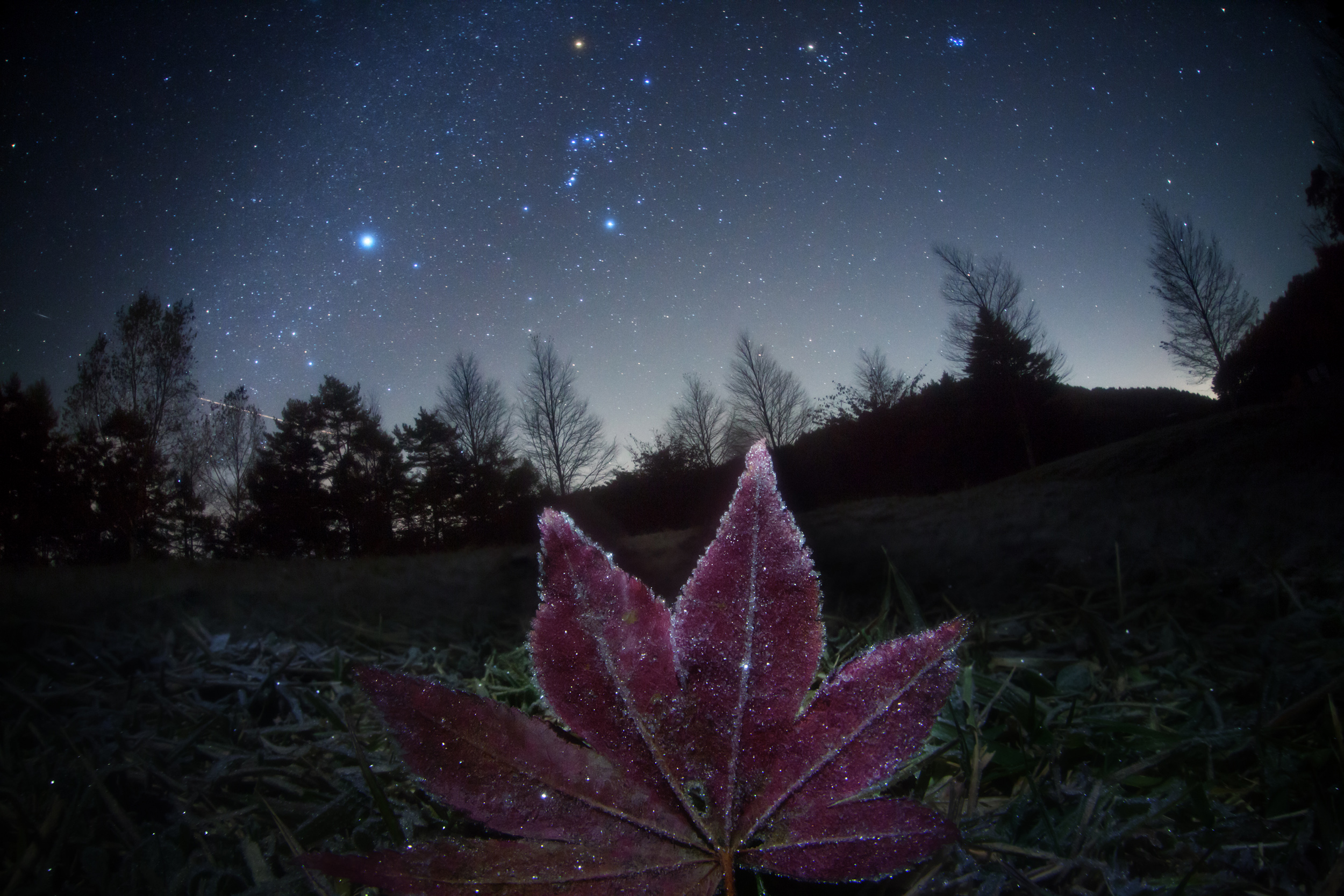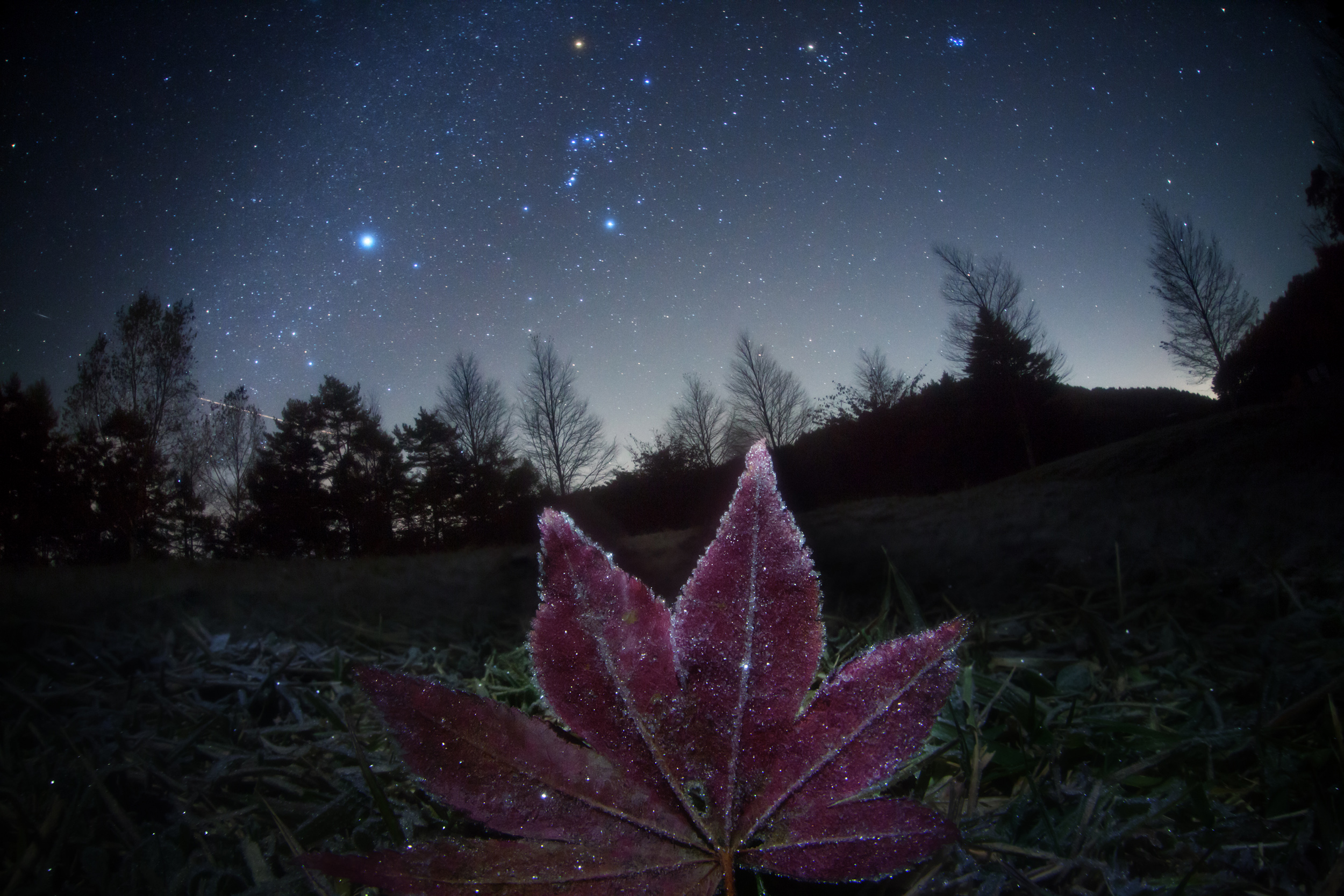
Sometimes, you can put some night sky in your art. Captured above Japan earlier this month, a picturesque night sky was photographed behind a picturesque frosted leaf. The reflecting ice crystals on the leaf coolly mimic the shining stars far in the background. The particular background sky on this 48-second wide angle exposure, however, might appear quite interesting and familiar. On the far left, although hard to find, appears a streaking meteor. Below and to the right of the meteor appears a longer and brighter streak of an airplane. The bright star on the left is the dog-star Sirius, the brightest star on the night sky. To Sirius' right appears the constellation of Orion, including the three linear belt stars below the red giant Betelgeuse. The bright patch of light further to the right is the Pleiades open star cluster. Similar views including the constellation Orion can be seen above much of the northern hemisphere for the next several months, although you might have to provide your own leaf. Challenge: Can you identify what type of leaf was imaged?
A veces, puedes incluir un poco del cielo nocturno en tu arte. Capturado sobre Japón a principios de este mes, un pintoresco cielo nocturno fue fotografiado detrás de una hoja congelada igualmente pintoresca. Los cristales de hielo reflejantes en la hoja imitan con elegancia las estrellas brillantes que aparecen en el fondo. Sin embargo, el cielo específico que aparece en esta exposición de 48 segundos con ángulo amplio podría parecer bastante interesante y familiar. A la izquierda lejana, aunque difícil de encontrar, aparece una estrella fugaz. Debajo y a la derecha de la estrella fugaz aparece una línea más larga y brillante de un avión. La estrella brillante a la izquierda es la estrella can Sirius, la estrella más brillante del cielo nocturno. A la derecha de Sirius aparece la constelación de Orión, incluyendo las tres estrellas lineales del cinturón, que se encuentran debajo de la gigante roja Betelgeuse. El parche brillante de luz aún más a la derecha es el cúmulo estelar abierto de las Pléyades. Vistas similares que incluyen la constelación de Orión pueden verse sobre gran parte del hemisferio norte durante los próximos meses, aunque es posible que tengas que proporcionar tu propia hoja. Desafío: ¿Puedes identificar qué tipo de hoja fue capturada en la imagen?