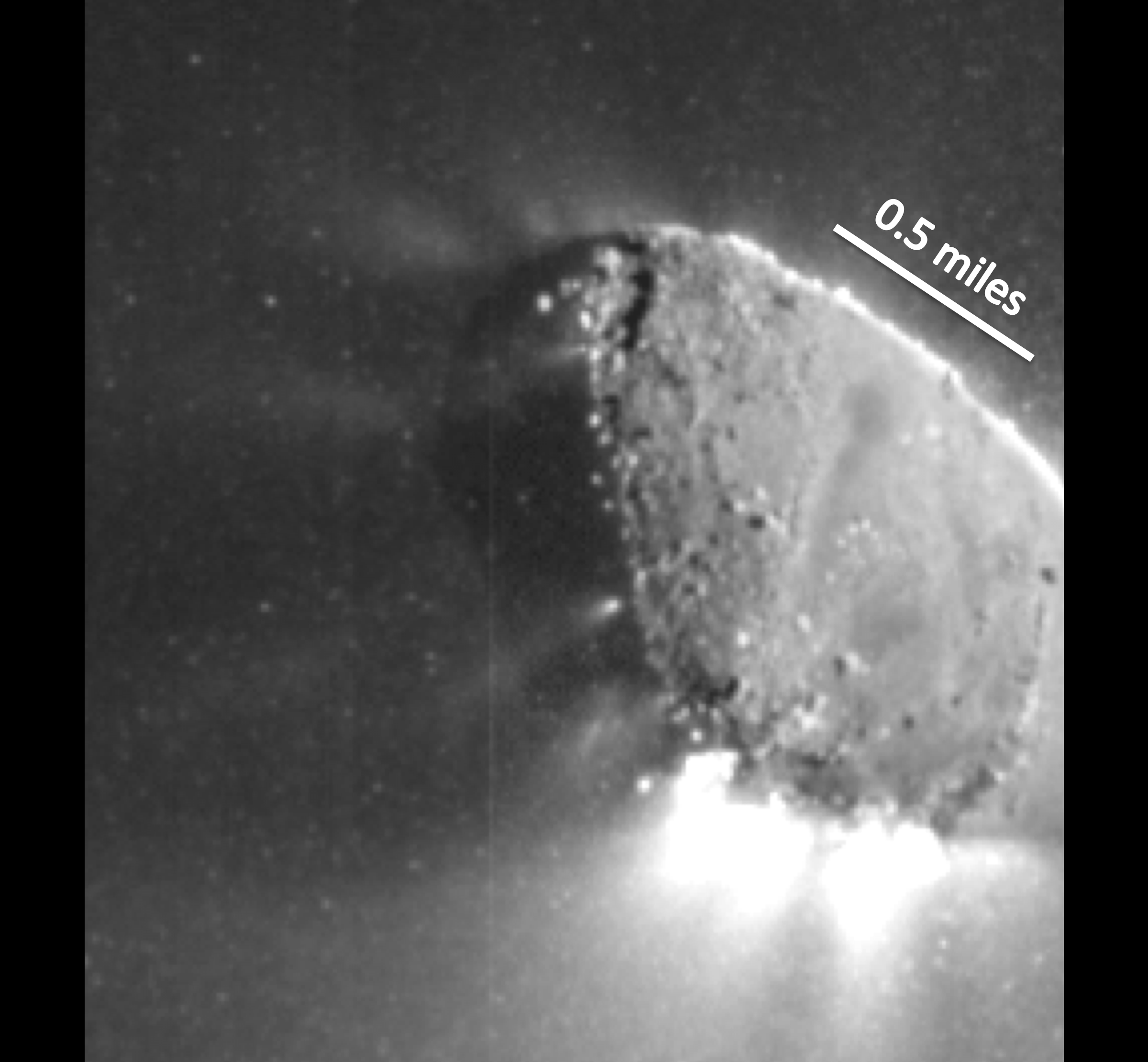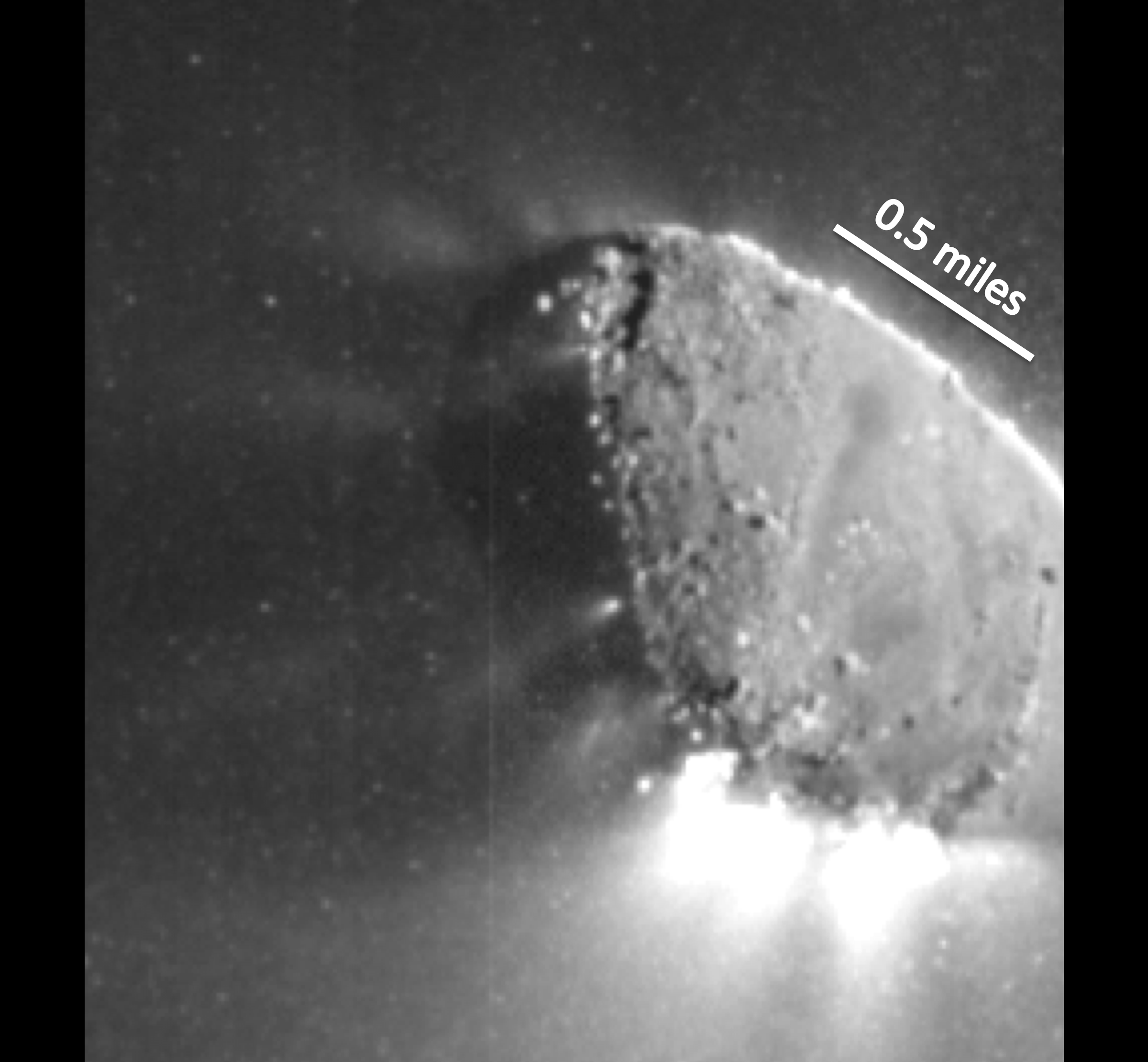
Unusual jets have been discovered emanating from Comet Hartley 2. The EPOXI spacecraft imaged the jets in unprecedented detail during its flyby of the comet earlier this month. Pictured above, sun-illuminated jets shoot away from the two-kilometer long decaying iceberg that orbits the Sun between Earth and Jupiter. Comet Hartley 2 became active recently as it neared the Sun and sunlight warmed the comet. Preliminary analyses of images like that shown above indicate that the smooth regions around the middle are porous and leak frozen water vapor directly out into space. Unexpectedly, however, the rough regions at either end appear to shoot carbon dioxide jets that expel fluffy snowballs, some as large as basketballs, from the nucleus. Many of the dots in the above image are thought to be snowballs. The unusual jets will continue to be studied, and may yield further clues as to how comets and asteroids formed and evolved during the early years of our Solar System. Comet Hartley 2 is slowly evaporating and may completely break up over the next 1,000 years.
Se han descubierto chorros inusuales emanando del cometa Hartley 2. La nave espacial EPOXI capturó imágenes de los chorros con un detalle sin precedentes durante su sobrevuelo del cometa a principios de este mes. En la imagen mostrada arriba, chorros iluminados por el Sol se proyectan desde el iceberg en descomposición de dos kilómetros de longitud que orbita al Sol entre la Tierra y Júpiter. El cometa Hartley 2 se ha vuelto activo recientemente a medida que se acerca al Sol y la luz solar calienta al cometa. Análisis preliminares de imágenes como la mostrada arriba indican que las regiones lisas alrededor del centro son porosas y liberan vapor de agua congelado directamente al espacio. Sin embargo, inesperadamente, las regiones rugosas en ambos extremos parecen expulsar chorros de dióxido de carbono que lanzan bolas de nieve esponjosas, algunas del tamaño de balones de baloncesto, desde el núcleo. Muchos de los puntos en la imagen de arriba se cree que son bolas de nieve. Los chorros inusuales continuarán siendo estudiados y podrían revelar más pistas sobre cómo se formaron y evolucionaron los cometas y asteroides durante los primeros años de nuestro sistema solar. El cometa Hartley 2 se está evaporando lentamente y podría desintegrarse completamente en los próximos 1000 años.