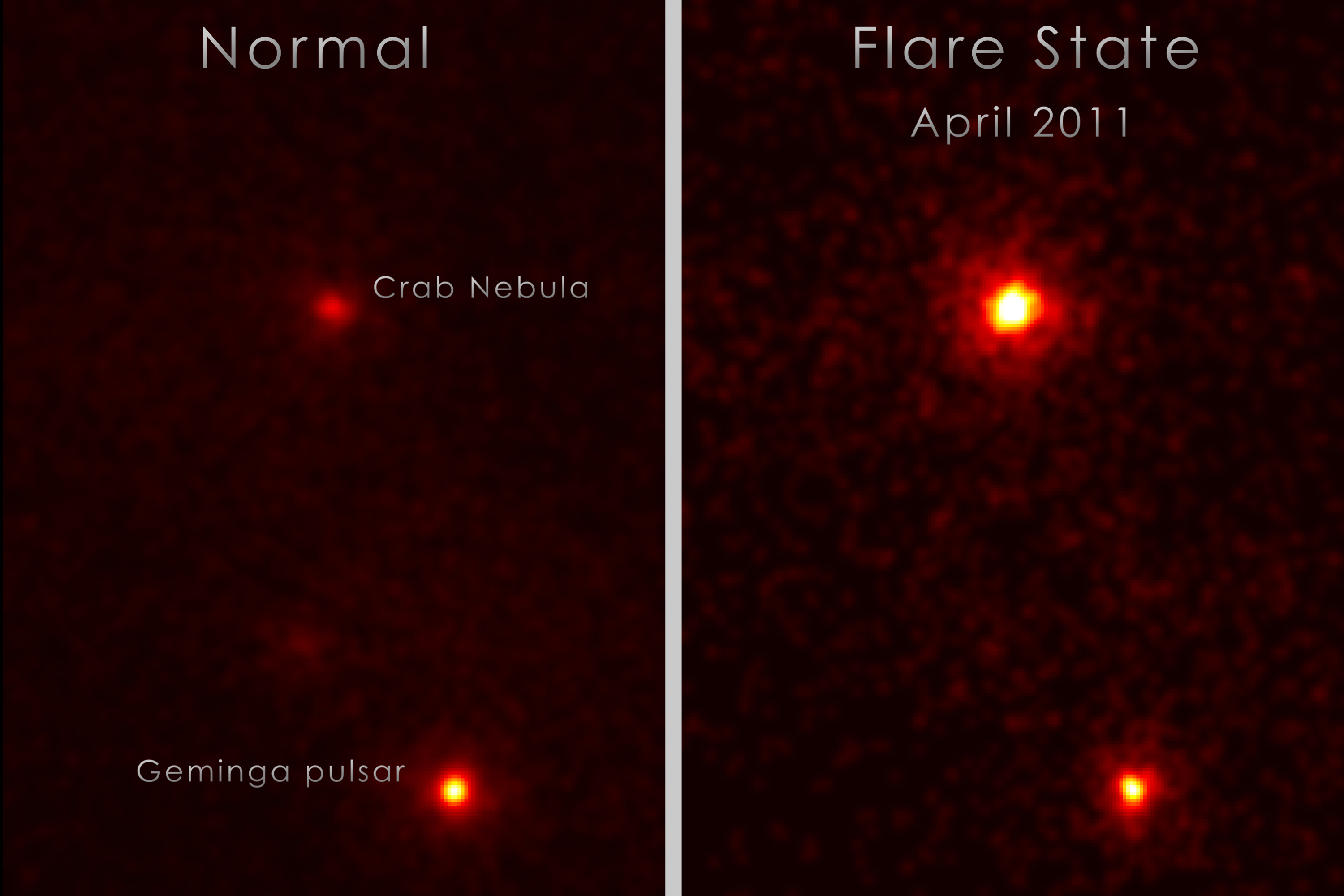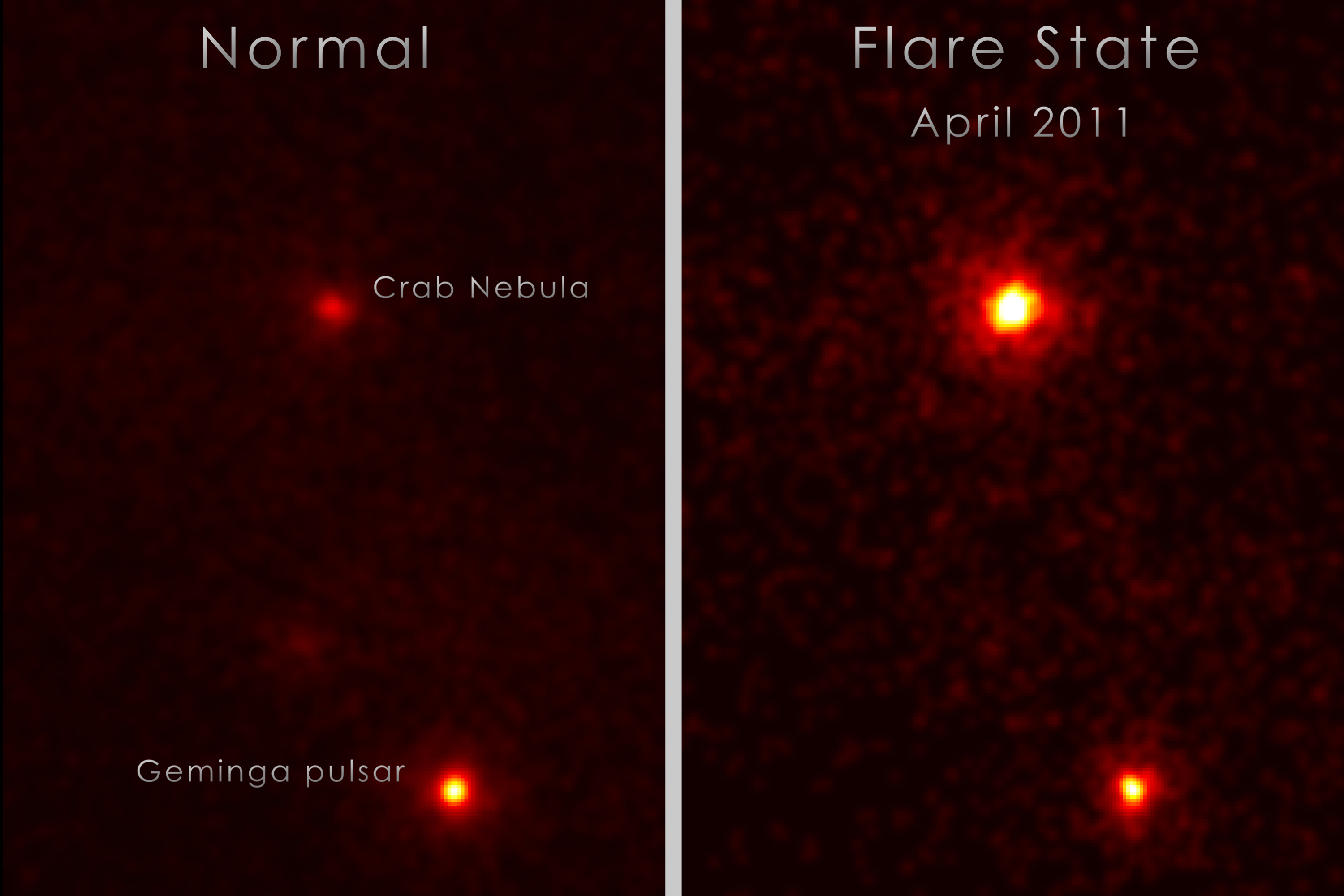
Why does the Crab Nebula flare? No one is sure. The unusual behavior, discovered over the past few years, seems only to occur in very high energy light -- gamma rays. As recently as one month ago, gamma-ray observations of the Crab Nebula by the Fermi Gamma Ray Space Telescope showed an unexpected increase in gamma-ray brightness, becoming about five times the nebula's usual gamma-ray brightness, and fading again in only a few days. Now usually the faster the variability, the smaller the region involved. This might indicate that the powerful pulsar at the center of the Crab, a compact neutron star rotating 30 times a second, is somehow involved. Specifically, speculation is centered on the changing magnetic field that surely surrounds the powerful pulsar. Rapid changes in this field might lead to waves of rapidly accelerated electrons which emit the flares, possibly in ways similar to our Sun. The above image shows how the Crab Nebula normally appears in gamma rays, as compared to the Geminga pulsar, and how it then appeared during the recent brightening.
¿Por qué emite destellos la Nebulosa del Cangrejo? Nadie lo sabe con certeza. Este comportamiento inusual, descubierto en los últimos años, parece ocurrir únicamente en luz de muy alta energía: los rayos gamma. Hace apenas un mes, observaciones en rayos gamma de la Nebulosa del Cangrejo realizadas por el Telescopio Espacial de Rayos Gamma Fermi mostraron un aumento inesperado en el brillo gamma, alcanzando aproximadamente cinco veces el brillo gamma habitual de la nebulosa, para luego atenuarse nuevamente en tan solo unos pocos días. Por lo general, cuanto más rápida es la variabilidad, más pequeña es la región involucrada. Esto podría indicar que el potente púlsar en el centro del Cangrejo —una estrella de neutrones compacta que rota 30 veces por segundo— está de alguna manera implicado. Específicamente, las especulaciones se centran en el campo magnético cambiante que sin duda rodea a dicho púlsar. Los cambios rápidos en este campo podrían generar ondas de electrones acelerados velozmente que emiten los destellos, posiblemente de manera similar a los fenómenos que ocurren en nuestro Sol. La imagen muestra el aspecto habitual de la Nebulosa del Cangrejo en rayos gamma, en comparación con el púlsar Géminga, y cómo apareció durante el reciente aumento de brillo.