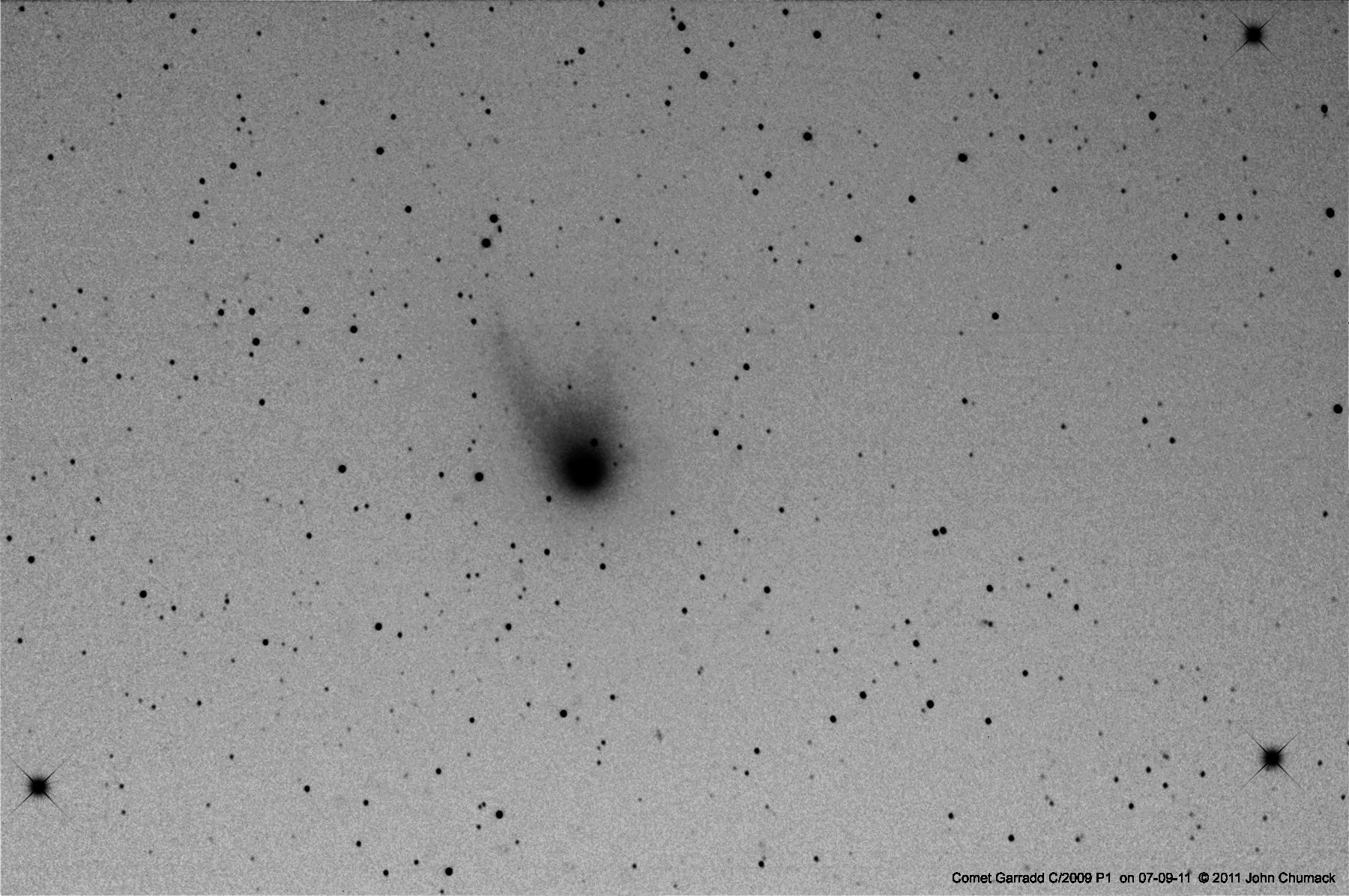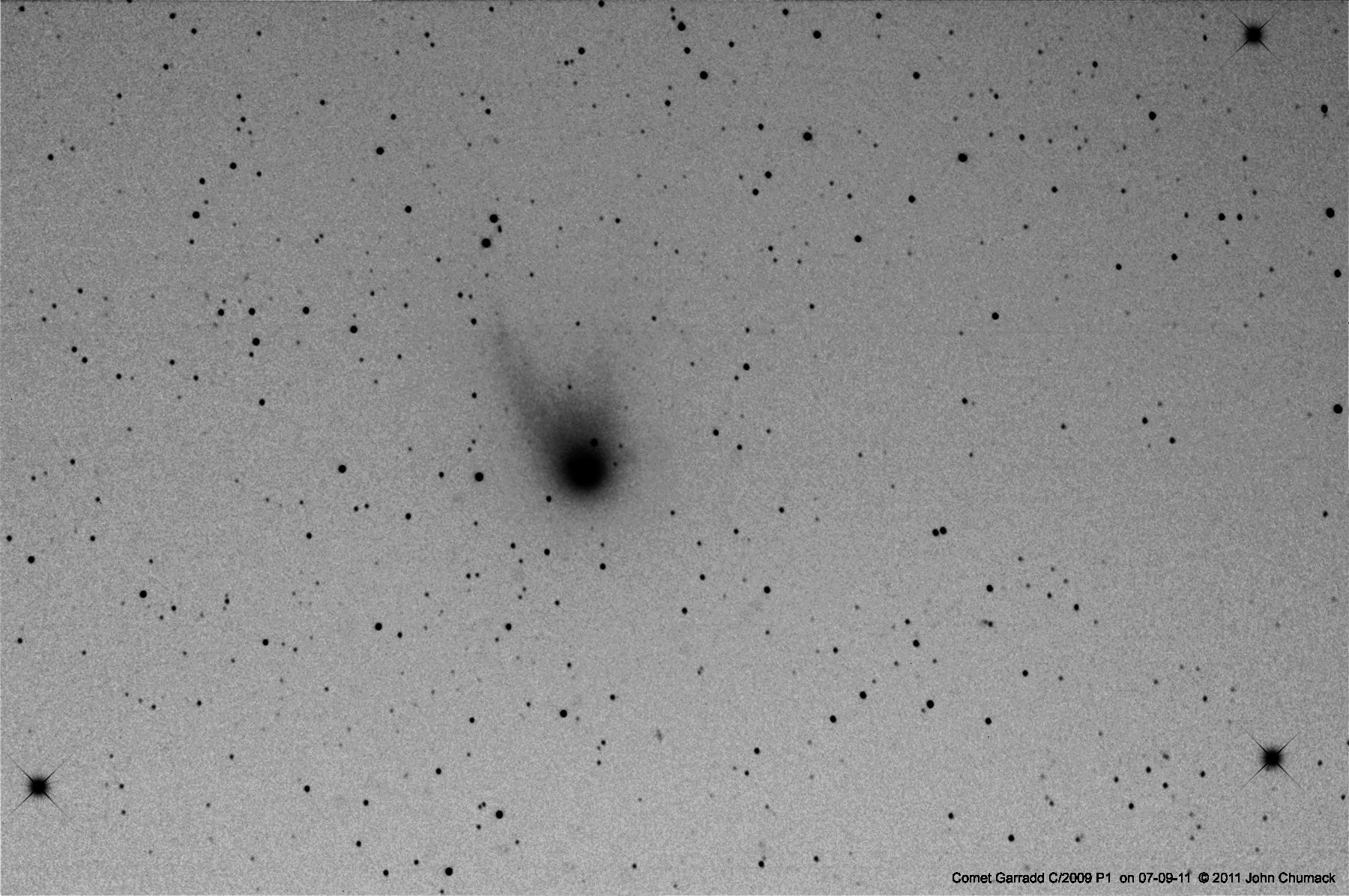
Another large snowball is falling toward the Sun. Comet Garradd was discovered two years ago by Gordon Garradd in Australia, and is currently visible through a small telescope at visual magnitude nine. Officially designated C/2009 P1 (Garradd), the comet will likely continue to brighten, with recent projections placing it at peak magnitude six or seven in February 2012, just below naked eye visibility. Comet Garradd is already showing a short tail and is seen as the elongated fuzzy patch in the above negative image recorded earlier this month from Yellow Springs, Ohio, USA. Other comets are also currently falling into the inner Solar System and brightening as well, including C/2010 X1 (Elenin), expected to peak near magnitude six in early September, 45P/Honda-Mrkos-Pajdusakova expected to peak brighten past magnitude eight in mid-August, and C/2011 L4 (PANSTARRS) which may become visible to the unaided eye during the early months of 2013.
Otra gran bola de nieve cae hacia el Sol. El cometa Garradd fue descubierto hace dos años por Gordon Garradd en Australia, y actualmente es visible con un pequeño telescopio con una magnitud visual de nueve. Oficialmente designado C/2009 P1 (Garradd), el cometa probablemente continuará aumentando su brillo, con proyecciones recientes que lo sitúan en una magnitud máxima de seis o siete en febrero de 2012, justo por debajo del umbral de visibilidad a simple vista. El cometa Garradd ya muestra una cola corta y se observa como la mancha difusa alargada en la imagen negativa superior, registrada a principios de este mes desde Yellow Springs, Ohio, EE. UU. Otros cometas también están cayendo actualmente hacia el Sistema Solar interior y aumentando su brillo, entre ellos C/2010 X1 (Elenin), que se espera alcance una magnitud máxima cercana a seis a principios de septiembre; 45P/Honda-Mrkos-Pajdusakova, que se prevé supere la magnitud ocho a mediados de agosto; y C/2011 L4 (PANSTARRS), que podría hacerse visible a simple vista durante los primeros meses de 2013.