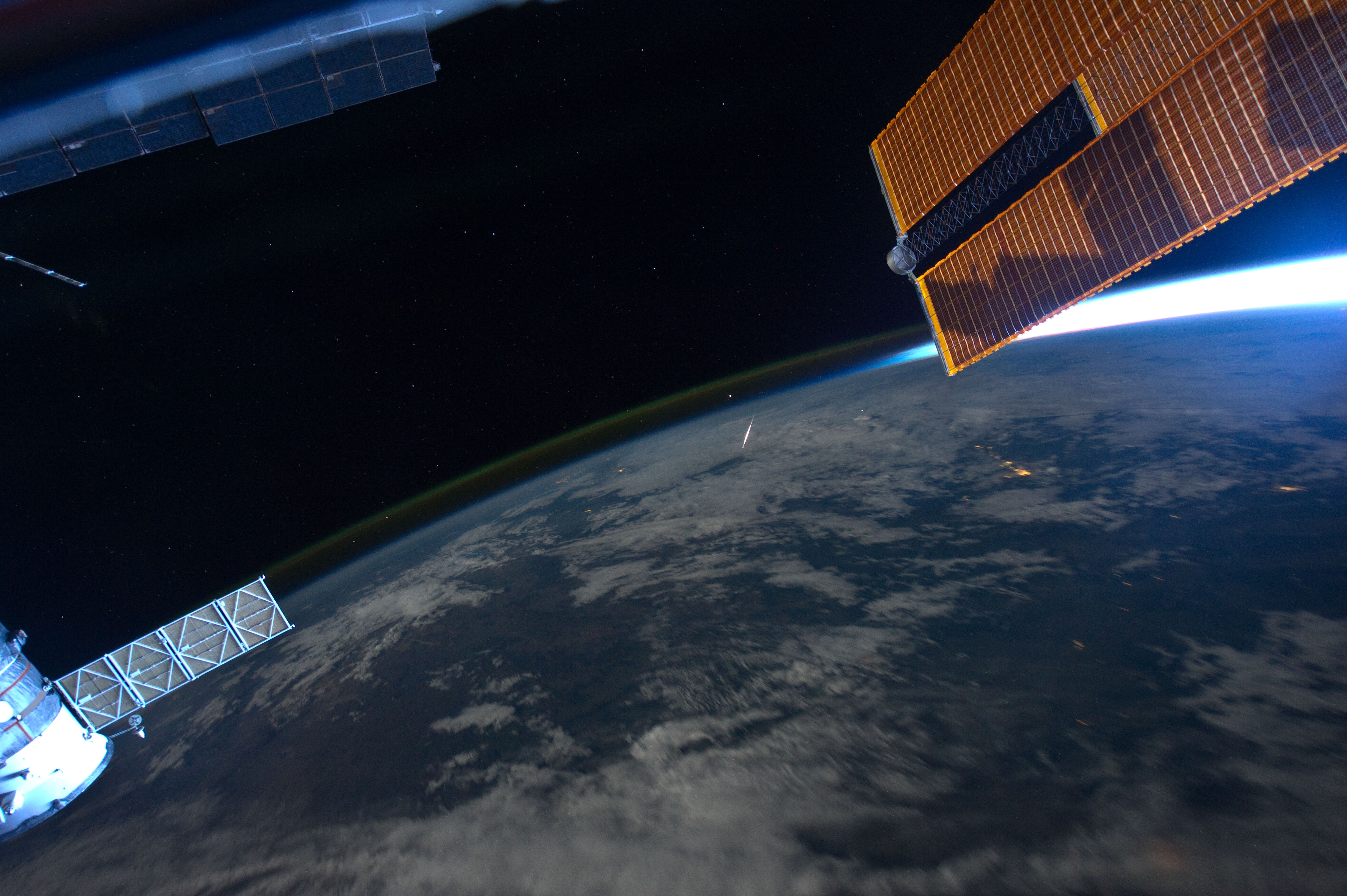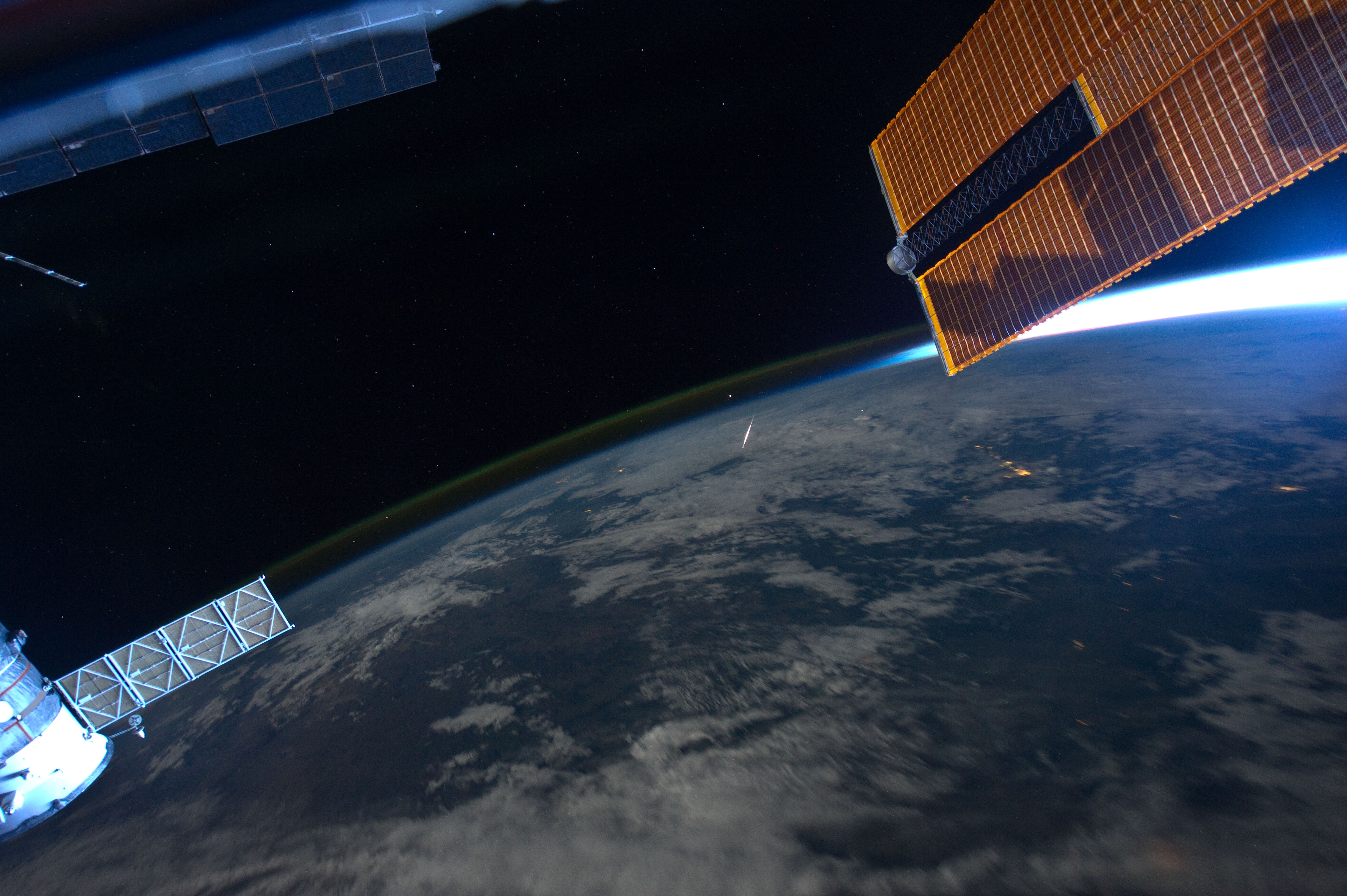
Denizens of planet Earth watched this year's Perseid meteor shower by looking up into the moonlit night sky. But this remarkable view captured by astronaut Ron Garan looks down on a Perseid meteor. From Garan's perspective onboard the International Space Station orbiting at an altitude of about 380 kilometers, the Perseid meteors streak below, swept up dust left from comet Swift-Tuttle heated to incandescence. The glowing comet dust grains are traveling at about 60 kilometers per second through the denser atmosphere around 100 kilometers above Earth's surface. In this case, the foreshortened meteor flash is right of frame center, below the curving limb of the Earth and a layer of greenish airglow. Out of the frame, the Sun is on the horizon beyond one of the station's solar panel arrays at the upper right. Seen above the meteor near the horizon is bright star Arcturus and a star field that includes the constellations Bootes and Corona Borealis. The image was recorded on August 13 while the space station orbited above an area of China approximately 400 kilometers to the northwest of Beijing. Poll: Is APOD a blog?
Los habitantes del planeta Tierra observaron la lluvia de meteoros Perseidas de este año mirando hacia el cielo nocturno iluminado por la Luna. Sin embargo, esta notable imagen, captada por el astronauta Ron Garan, muestra una Perseida vista desde arriba. Desde la perspectiva de Garan a bordo de la Estación Espacial Internacional, que orbita a una altitud de aproximadamente 380 kilómetros, los meteoros Perseidas dejan su estela por debajo, formados por polvo acumulado del cometa Swift-Tuttle que se calienta hasta alcanzar la incandescencia. Los granos de polvo cometario resplandecientes viajan a unos 60 kilómetros por segundo a través de la atmósfera más densa, a unos 100 kilómetros sobre la superficie terrestre. En esta imagen, el destello del meteoro, de apariencia escorzada, se encuentra a la derecha del centro del encuadre, por debajo del borde curvado de la Tierra y de una capa de airglow verdoso. Fuera del encuadre, el Sol se encuentra en el horizonte, más allá de uno de los paneles solares de la estación, visible en la esquina superior derecha. Por encima del meteoro, cerca del horizonte, se puede ver la brillante estrella Arturo y un campo estelar que incluye las constelaciones de Bootes y Corona Borealis. La imagen fue tomada el 13 de agosto mientras la estación espacial orbitaba sobre una zona de China situada aproximadamente 400 kilómetros al noroeste de Pekín.