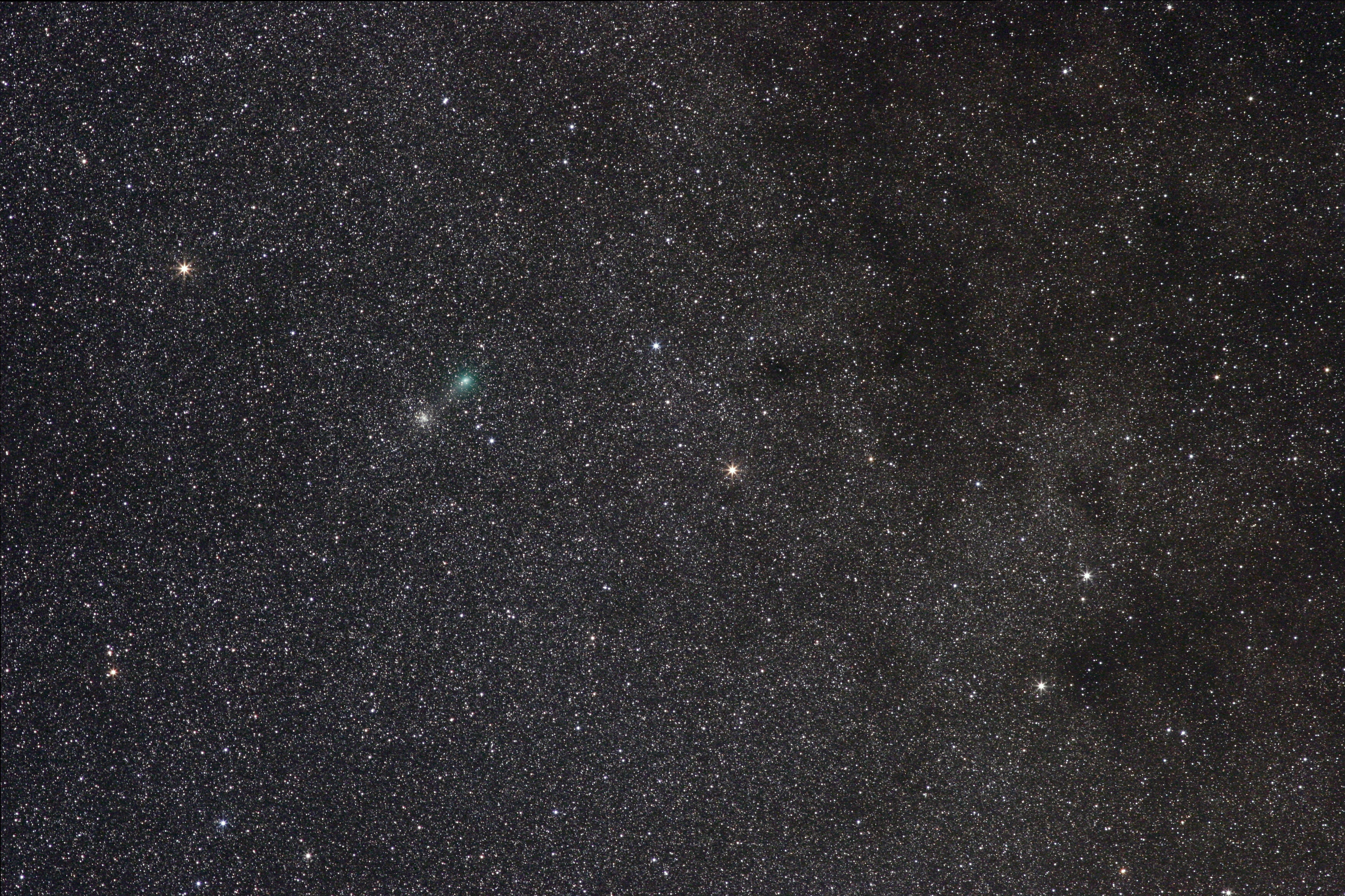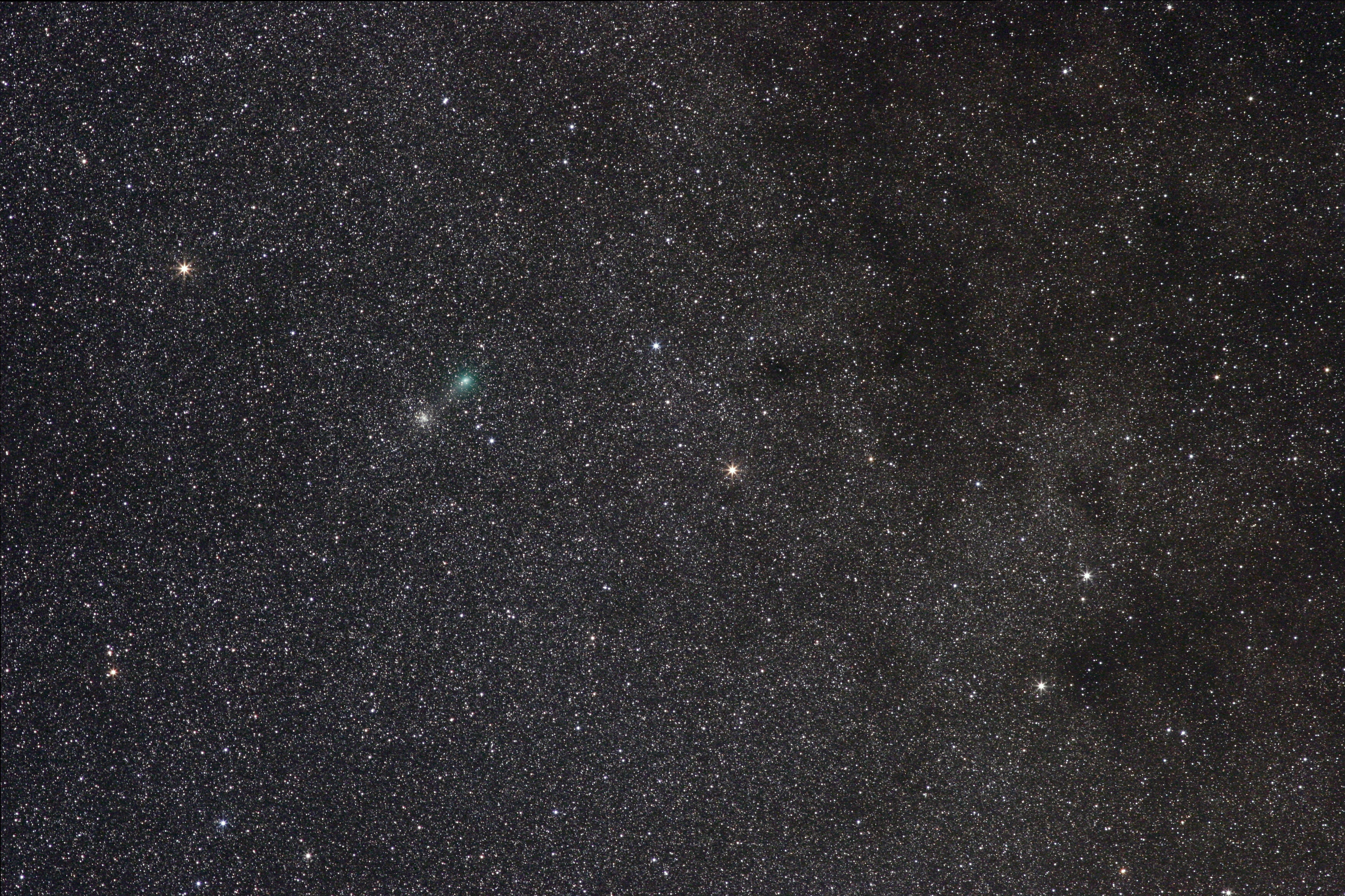
Comet Garradd continues to brighten as it drifts across the northern sky. Last week the comet, visible with binoculars and discernible by its green coma, passed nearly in front of globular cluster M71. M71 was once thought to be an open cluster, but is now known to be an older globular cluster containing over 10,000 stars. The photogenic duo was captured with a standard digital camera in a 10-minute, wide-angle exposure toward the northern constellation of the Arrow (Sagitta). The stars Sham (alpha Sagittae), beta Sagittae, gamma Sagittae, and the double star delta Sagittae are all visible in a diagonal band running down from the upper left. Comet C/2009 P1 (Garradd), will remain visible in northern skies for months and will reach its closest approach to the Sun in December.
El cometa Garradd continúa aumentando su brillo mientras se desplaza por el cielo septentrional. La semana pasada, el cometa, visible con binoculares y reconocible por su coma verde, pasó casi frente al cúmulo globular M71. En su momento se pensó que M71 era un cúmulo abierto, pero hoy se sabe que es un cúmulo globular más antiguo que contiene más de 10.000 estrellas. Esta fotogénica pareja fue capturada con una cámara digital estándar en una exposición de gran angular de 10 minutos orientada hacia la constelación septentrional de la Flecha (Sagitta). Las estrellas Sham (alfa Sagittae), beta Sagittae, gamma Sagittae y la estrella doble delta Sagittae son todas visibles en una banda diagonal que desciende desde la esquina superior izquierda. El cometa C/2009 P1 (Garradd) permanecerá visible en los cielos del hemisferio norte durante varios meses y alcanzará su máximo acercamiento al Sol en diciembre.