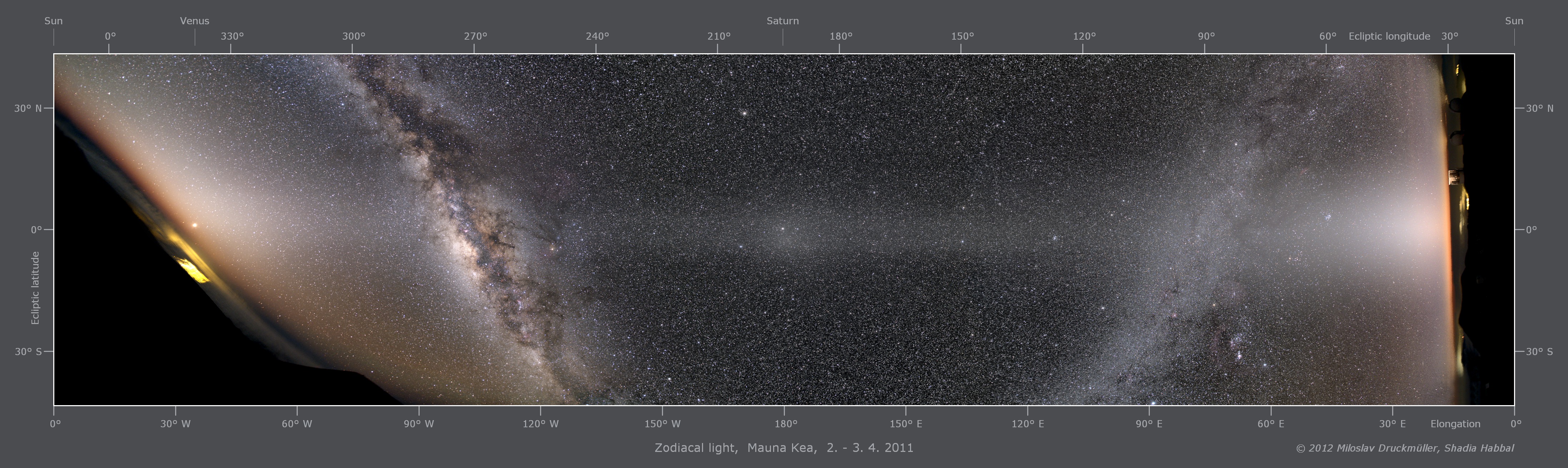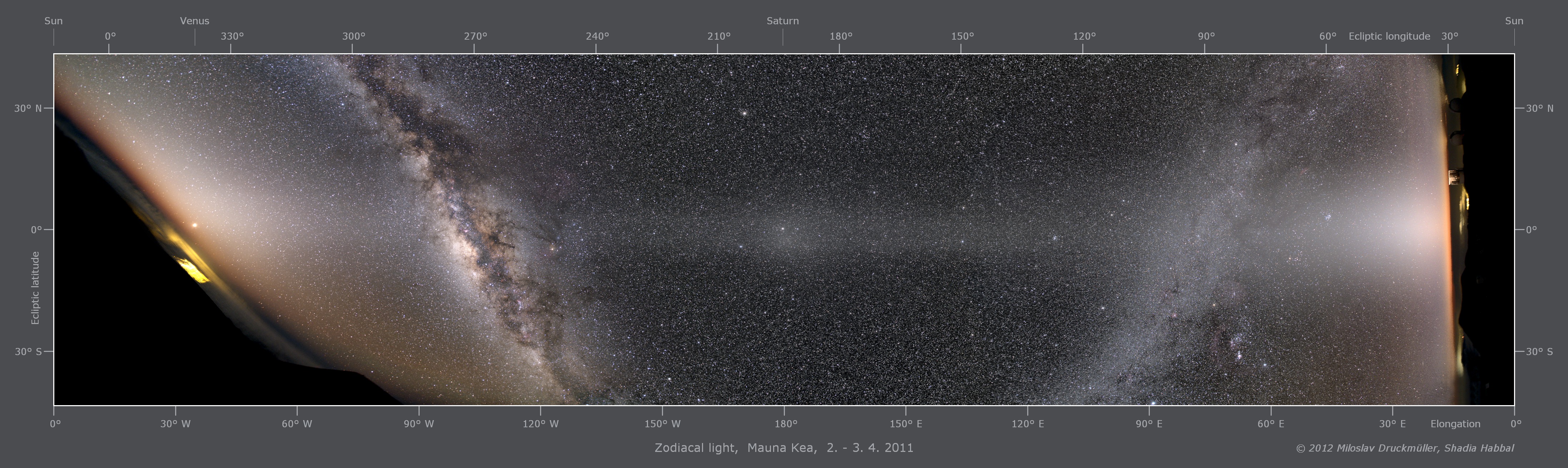
Sweeping from the eastern to western horizon, this 360 degree panorama follows the band of zodiacal light along the solar system's ecliptic plane. Dust scattering sunlight produces the faint zodiacal glow that spans this fundamental coordinate plane of the celestial sphere, corresponding to the apparent yearly path of the Sun through the sky and the plane of Earth's orbit. The fascinating panorama is a mosaic of images taken from dusk to dawn over the course of a single night at two different locations on Mauna Kea. The lights of Hilo, Hawaii are on the eastern (left) horizon, with the Subaru and twin Keck telescope structures near the western horizon. On that well chosen moonless night, Venus was shining as the morning star just above the eastern horizon, and Saturn was close to opposition. In fact, Saturn is seen immersed in a brightening of the zodiacal band known as the gegenschein. The gegenschein also lies near 180 degrees in elongation or angular distance from the Sun along the ecliptic. In the mosaic projection, the plane of our Milky Way Galaxy runs at an angle, crossing the horizontal band of zodiacal light above the two horizons. Nebulae, stars, and dust clouds of the bulging galactic center are rising in the east.
Crédito: NASA, CGRO SSC Esta panorámica de 360 grados abarca desde el horizonte oriental hasta el occidental, siguiendo la banda de luz zodiacal a lo largo del plano de la eclíptica del sistema solar. El polvo que dispersa la luz solar produce el tenue resplandor zodiacal que abarca este plano fundamental de coordenadas de la esfera celeste, correspondiente a la trayectoria aparente anual del Sol por el cielo y al plano de la órbita terrestre. El fascinante panorama es una mosaico de imágenes tomadas desde el atardecer hasta la madrugada durante una sola noche en dos ubicaciones diferentes en Mauna Kea. Las luces de Hilo, Hawái, aparecen en el horizonte oriental (izquierdo), con las estructuras del telescopio Subaru y los gemelos Keck cerca del horizonte occidental. Esa noche, cuidadosamente elegida sin luna, Venus brillaba como la estrella matutina justo por encima del horizonte oriental, y Saturno estaba cerca de la oposición. De hecho, Saturno se ve inmerso en un aclaramiento de la banda zodiacal conocido como gegenschein. El gegenschein también se encuentra cerca de 180 grados de elongación o distancia angular del Sol a lo largo de la eclíptica. En la proyección del mosaico, el plano de nuestra galaxia Vía Láctea cruza en ángulo, atravesando la banda horizontal de luz zodiacal por encima de los dos horizontes. Las nebulosas, estrellas y nubes de polvo del centro galáctico, que se abulta, están apareciendo en el este.